DNA: Evidence of Intelligent Design or Byproduct of Evolution?

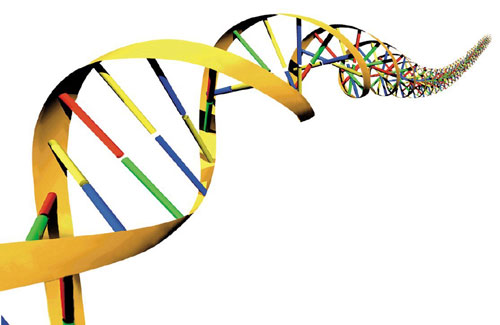
DNA is a self-replicating nucleic acid that supposedly encodes the instructions for building and maintaining cells of an organism.  With an ordered grouping of over a billion chemical base pairs which are identical for each cell in the organism, the unique DNA for a particular individual looks kind of like statements in a programming language.  This concept is not lost on Dr. Stephen Meyer (Ph.D., history and philosophy of science, Cambridge University), who posits that the source of information must be intelligent and therefore DNA, as information, is evidence of Intelligent Design.  He argues that all hypotheses that account for the development of this digital code, such as self-organization and RNA-first, have failed.  In a well publicized debate with Dr. Peter Atkins (Ph.D., theoretical chemistry, University of Leicester), a well known atheist and secular humanist, Atkins counters that information can come from natural mechanisms.  Sadly, Atkins resorts to insults and name calling, so the debate is kind of tainted, and he never got a chance to present his main argument in a methodical way because he let his anger get the best of him.  But it raised some very interesting questions, which I don’t think either side of the argument has really gotten to the bottom of.

ID’ers trot out the Second Law of Thermodynamics and state that the fact that simple molecules can’t self replicate without violating that Law proves Intelligent Design.  But it doesn’t really.  The Second Law applies to the whole system, including many instances of increased disorder weighed against the fewer instances of increased order.  Net net, disorder TENDs to increase, but that doesn’t mean that there can’t be isolated examples of increased order in the universe. That seems to leave the door open to the possibility that one such example might be the creation of self-replicating molecules.

Another point of contention is about the nature of information, such as DNA.  Meyer is wrong if he is making a blanket assertion that information can only come from intelligence.  I could argue that, given a long enough period of time, if you leave a typewriter outdoors, hailstones will ultimately hit the keys in an order that creates recognizable poetry.  So the question boils down to this – was there enough time and proper conditions for evolutionary processes to create the self-replicating DNA molecule from non-self replicating molecules necessary for creating the mechanism for life?

The math doesn’t look good for the atheists.  Dr. Robert L. Piccioni, Ph.D., Physics from Stanford says that the odds of 3 billion randomly arranged base-pairs matching human DNA is about the same as drawing the ace of spades one billion times in a row from randomly shuffled decks of cards.  Harold Morowitz, a renowned physicist from Yale University and author of Origin of Cellular Life  (1993), declared that the odds for any kind of spontaneous generation of life from a combination of the standard life building blocks is one chance in 10E100000000000 (you read that right, that’s 1 followed by 100,000,000,000 zeros).  Famed British Royal Astronomer Sir Fred Hoyle, proposed that such odds were one chance in 10E40000, or roughly “the same as the probability that a tornado sweeping through a junkyard could assemble a 747.”  By the way, scientists generally set their “Impossibility Standard” at one chance in 10E50 (1 in a 100,000 billion, billion, billion, billion, billion).  So, the likelihood that life formed via combinatorial chemical evolution (the only theory that scientists really have) is, for all intents and purposes, zero.

Atkins, Dawkins, and other secular humanists insist that materialism and naturalism are pre-supposed and that there is no argument for the introduction of the logic of intelligence into science.  That sounds to me to be pretty closed minded, and closes the door a priori on certain avenues of inquiry.  Imagine if that mentality were applied to string theory, a theory which has no experimental evidence to start with.  One has to wonder why science is so illogically selective with respect to the disciplines that it accepts into its closed little world.

My interest in this goes beyond this specific debate.  I have a hobby of collecting evidence that our reality is programmed.  I’m not sure yet whether DNA has a place in that collection yet.  It will definitely need a little more thought.
 

dna_500

Entropy and Puppies, like a Hand and a Glove

Ah yes, the good old 2nd Law of Thermodynamics. The idea that the total disorder of a system, e.g. the universe, always increases.  Or that heat always flows from hot to cold.  It’s why coffee always gets cold, why money seems to dissipate at a casino, why time flows forward, why Murphy had a law, why cats and dogs don’t tend to clean up the house.

Ultimately, due to this rather depressing physical law, the universe will die by “heat death,” where it reaches a state of absolute zero, no more heat, no motion of particles.  Don’t worry, that’s not predicted for another 10^100 (or, a Googol) years.  But, I always wondered, is it always always the case, or can entropy decrease in certain circumstances?

Got a spare fortnight? Google “violations of the second law of thermodynamics.”  Personally, I rather like Maxwell’s idea that it is a statistical argument, not an absolute one. “Maxwell’s Demon” is that hypothetical device that funnels hot molecules in one directions and cold ones in the opposite, thereby reversing the normal flow of heat.  Could a nanotech device do that some day?  Yes, I know that there has to be energy put into the system for the device to do its work, thereby increasing the size of the system upon which the 2nd law holds.  But, even without the demon, aren’t there statistical instances of 2nd Law violation in a closed system?  Not unlike the infinitesimal probability that someone’s constituent atoms suddenly line up in such a manner that they can walk through a door (see recent blog topic), so could a system become more coherent as time moves to the future.

What about lowering temperature to the point where superconductivity occurs?  Isn’t that less random than non-superconductivity.  One might argue that the energy that it takes to become superconductive exceeds the resulting decrease in entropy.  However, I would argue that since the transition from conductive to superconductive occurs abruptly, there must be a time period, arbitrarily small, during which you would watch entropy decrease.

There are those who cite life and evolution as examples of building order out of chaos.  Sounds reasonable to me, and the arguments against the idea sound circular and defensive.  However, it all seems to net out in the end.  Take a puppy, for instance.  Evolutionary processes worked for millions of years to create the domestic dog.  Entropy-decreasing processes seem to responsible for the formation of a puppy from its original constituents, sperm and an egg.  But then the puppy spends years ripping up your carpet, chewing the legs of the furniture and ripping your favorite magazines into little pieces; in short, increasing the disorder of the universe.  Net effect?  Zero.

shakespeareandleash185

Musings on the idea of Free Will

Think about what it means to make a decision.  The cashier gave you too much change – do you tell him/her?  It seems like you make your choice based on past events (your parents taught you that it was deceitful to take something that shouldn’t be yours) or the current state of your mind (the cashier is really cute, maybe I’ll get a few points by pointing out the mistake).  Upon further analysis, it really seems that the exact state of your brain (memories, neural pathways and triggers) and the state of external stimuli might be fully responsible for each decision and action.  However, one could make the same argument for a computer, which function is based on the concept of a finite state machine (each action is fully determined by the state of the machine and its inputs).  This idea essentially boils down to us being nothing more than robots.  Are you okay with that?

What about the following scenario:

Two kids with the same parents grow up in the same environment.  Why do they frequently have a completely different set of values?  One gives the money back to the cashier without question; one keeps the money without question.  Why?  It can’t be purely due to genetics.  And it can’t be purely due to upbringing.  Determinists would argue that slight differences in genetics or environment may have a domino effect on the value systems of the individual.  But, could it also be due to the possibility that these are two different souls, which have evolved differently?  Believers in reincarnation might say that the former has learned a universal lesson in a previous incarnation and is perhaps an older, or more experienced, soul.  It is therefore natural for that person to make such a decision, whereas the sibling’s soul has not yet learned that universal lesson.  We can’t be sure, but it does seem odd that people often talk of the deep personality differences between their children that are observable at such a young age that environmental differences are precluded.  This tends to lend support to the idea that there is a “ghost in the machine.”


Would it really be that bad to find life in our Solar System?

Nick Bostrom wrote an interesting article for the MIT Technology Review about how he hopes that the search for life on Mars finds nothing. In it, he reasons that inasmuch as we haven’t come across any signs of intelligent life in the universe yet, advanced life must be rare. But since conditions for life aren’t particularly stringent, there must be a “great filter” that prevents life from evolving beyond a certain point. If we are indeed alone, that probably means that we have made it through the filter. But if life is found nearby, like in our solar system, then the filter is probably ahead of us, or at least ahead of the evolutionary stage of the life that we find. And the more advanced the life form that we find, the more likely that we have yet to hit the filter, which implies ultimate doom for us.

But I wonder about some of the assumptions in this argument. He argues that intelligent ETs must not exist because they most certainly should have colonized the galaxy via von Neumann probes but apparently have not done so because we do not observe them. It seems to me, however, that it is certainly plausible that a sufficiently advanced civilization can be effectively cloaked from a far less advanced one. Mastery of some of those other 6 or 7 spatial dimensions that string theory predicts comes to mind. Or invisibility via some form of electromagnetic cloaking. And those are only early 21st century ideas. Imagine the possibilities of being invisible in a couple hundred years.

Then there is the programmed reality model. If the programmers placed multiple species in the galaxy for “players” to inhabit, it would certainly not be hard to keep some from interacting with each other, e.g. until the lesser civilization proves its ability to play nicely. Think about how some virtual reality games allow the players to walk through walls. It is a simple matter to maintain multiple domains of existence in a single programmed construct!  More support for the programmed reality model?…

(what do you think about the possibilities of life elsewhere? take our polls!)

Martian