WikiLeaks, Denial of Service Attacks, and Nanobot Clouds

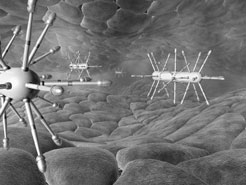
The recent firestorm surrounding WikiLeaks reminds me of one of Neal Stephenson’s visions of the future, “Diamond Age,” written back in 1995.  The web was only at its infancy, but Stephenson had already envisioned massive clouds of networked nanobots, some under control of the government, some under control of other entities.  Such nanobot swarms, also known as Utility Fogs, could be made to do pretty much anything; form a sphere of protection, gather information, inspect people and report back to a central server, or be commanded to attack each other.  One swarm under control of one organization may be at war with another swarm under the control of another organization.  That is our future.  Nanoterrorism.

A distributed denial of service attack (DDoS) is a network attack on a particular server or internet node.  It is often carried out by having thousands of computers saturate the target machine with packet requests, making it impossible for the machine to respond to normal HTTP requests, effectively bringing it to its knees, inaccessible on the internet.  The attacks are often coordinated by a central source who takes advantage of networks of already compromised computers (aka zombie computers, usually unknown to their owners) via malware inflections.  On command, these botnets initiate their attack with clever techniques called Smurf attacks, Ping floods, SYN floods, and other scary sounding events.  An entire underground industry has built up around botnets, some of which can number in the millions.  Botnets can be leased by anyone who knows how to access them and has a few hundred dollars.  As a result, an indignant group can launch an attack on, say, the WikiLeaks site.  And, in response, a WikiLeak support group can launch a counter attack on its enemies, like MasterCard, Visa, and PayPal for their plans to terminate service for WikiLeaks.  That is our present.  Cyberterrorism.

Doesn’t it sound a lot like the nanoterrorism envisioned by Stephenson?  Except it is still grounded in the hardware.  As I see it, the equation of the future is:

Nanoterrorism = Cyberterrorism + Microrobotics + Moore’s Law + 20 years.

Can’t wait!

ddos2 nanobots2_185

Why Worry about ET, Stephen Hawking?

Famous astrophysicist, Stephen Hawking, made the news recently when he called for us to stop attempting to contact ET.  No offense to Dr. Hawking and other scientists who have similar points of view, but I find the whole argument about dangerous ET’s, to use a Vulcan phrase, “highly illogical.”

First of all, there is the whole issue around the ability to contact ET.  As I showed in my post “Could Gliesians be Watching Baywatch“, it is virtually impossible to communicate with any extraterrestrial civilization beyond our solar system without significant power and antenna gain.  The world’s most powerful radio astronomy dish at Arecibo has a gain of 60 dB, which means that it could barely detect a 100 kilowatt non-directional signal generated from a planet 20 light years away, such as Gliese 581g, but only if it were pointed right at it.  More to the point, what are the odds that such a civilization would be at the right level of technology to be communicating with us, using a technique that overlaps what we know?

Using the famous Drake equation, N=R*·fp·ne·fl·fi·fc·L, with the following best estimates for parameters: R*= 10/year, fp= .5, ne= 2, fl= .5, fi= .001 (highly speculative), fc= .01, L=50 (duration in years of the radio transmitting period of a civilization), we get .0025 overlapping radio wave civilizations per galaxy.  But if you then factor in the (im)probabilities of reaching those star systems (I used a megawatt of power into an Arecibo-sized radio telescope), the likelihood of another “advanced technology” civilization even developing radio waves, the odds that we happen to be  pointing our radio telescope arrays at each other at the same time, and the odds that we are using the same frequency, we get a probability of 1.25E-22.  For those who don’t like scientific notation, how about .0000000000000000000000125.  (Details will be in a forthcoming paper that I will post on this site.  I’ll replace this text with the link once it is up)

So why is Stephen Hawking worried about us sending a message that gets intercepted by ET?  Didn’t anyone do the math?

But there is a second science/sci-fi meme that I also find highly illogical.  And that is that malevolent ETs may want to mine our dear old earth for some sort of mineral.  Really?  Are we to believe that ET has figured out how to transcend relativity, exceed the speed of light, power a ship across the galaxy using technology far beyond our understanding, but still have an inability to master the control of the elements?  We have been transmuting elements for 70 years.  Even gold was artificially created by bombarding mercury atoms with neutrons as far back as 1941.  Gold could be created in an accelerator or nuclear reactor at any time, although to be practical from an economic standpoint, we may need a few years.  However, if gold, or any particular element, was important enough to be willing to fly across the galaxy and repress another civilization for, then economics should not be an issue.  Simple nuclear technology can create gold far easier than it can power a spaceship at near light speeds through space.

Even if our space traveling friends need something on Earth that can’t possibly be obtained through technology, would they really be likely to be so imperialistic as to invade and steal our resources?  From the viewpoint of human evolution, as technology and knowledge has developed, so have our ethical sensibilities and social behavior.  Of course, there is still “Jersey Shore” and “Jackass,” but by and large we have advanced our ethical values along with our technological advances and there is no reason to think that these wouldn’t also go hand in hand with any other civilization.

So while I get that science fiction needs to have a compelling rationale for ET invasion because it is a good story, I fail to understand the fear that some scientists have that extraterrestrials will actually get all Genghis Khan on us.


Could Gliesians be Watching Baywatch?

[Note: Click here for a more thorough treament of the viability of SETI and the (high) likelihood of extraterrestrial intelligence]

Gliese 581g is an earthlike planet orbiting the star Gliese 581, 20.3 light years away from us.  Discovered just last week by astronomer Steven Vogt, he announced that the odds of life on this exosolar planet are 100%.  That’s a pretty bold statement, even for a planet thought to be in a habitable zone of a star a little smaller and cooler than our sun.  Most astronomers are attributing his statement to being a little overexcited with his discovery.  But it got me wondering – if there were technologically advanced lifeforms on this planet, is it possible that they would be able to receive our radio or TV transmissions?  And, remember that when Gliese 581g might be receiving from us today is what we broadcast 20.3 years ago, such as episodes of Baywatch.  Alternatively, can we hear them, as SETI has been attempting to do for the past 30 or so years?

As it turns out, there isn’t much to worry about, unless we decide to send a very high-powered narrow directional message to a planet that just happens to be at the perfect level of technology which also just happens to have outpaced their social evolution dramatically.  Not likely there either, for reasons that I will discuss in an upcoming post (sorry, Stephen Hawking).

Here’s the deal.  Let’s take a typical TV broadcasting station operating 50000 watts on Channel 2.  Because radio waves attenuate proportional to the square of the distance from the transmitter, this signal will be pretty miniscule by the time it gets to the edge of our solar system.  In fact, by the time this 6 MHz wide signal at 60 MHz gets about 1.4E+11 km away, its power density will be at the same level as the corresponding power density of the cosmic microwave background (CMB) radiation in that frequency band (feel free to check my math – it’s a little rusty).  In addition, the signal will be an indecipherable mess because it will be intermixed with all of the other TV stations broadcasting on Channel 2.  So how far out exactly is 1.4E+11 km?  Turns out this is past Pluto, but barely the beginning of the Oort cloud in our own Solar system, or .015 light years.  That is .00075 of the distance to Gliese 581, across which distance the signal will be attenuated by a further factor of 1.8 million and CMB background noise will completely swamp out the signal.

So, zero chance of Gliesians kicking back and enjoying an interstellar episode of Baywatch.  And not much chance of us hearing accidental radio waves generated from their planet, even assuming they followed a similar technological evolution at the exact same time as us.  Sorry, SETI.
 radioastronomy200 baywatch200

Rewriting the Past

“I don’t believe in yesterday, by the way.”
-John Lennon

The past is set in stone, right?  Everything we have learned tells us that you can not change the past, 88-MPH DeLoreans notwithstanding.

However, it would probably surprise you to learn that many highly respected scientists, as well as a few out on the fringe, are questioning that assumption, based on real evidence.

For example, leading stem cell scientist, Dr. Robert Lanza, posits that the past does not really exist until properly observed.  His theory of Biocentrism says that the past is just as malleable as the future.

Specific experiments in Quantum Mechanics appear to prove this conjecture.  In the “Delayed Choice Quantum Eraser” experiment, “scientists in France shot photons into an apparatus, and showed that what they did could retroactively change something that had already happened.” (Science 315, 966, 2007)

Paul Davies, renowned physicist from the Australian Centre for Astrobiology at Macquarie University in Sydney, suggests that conscious observers (us) can effectively reach back in history to “exert influence” on early events in the universe, including even the first moments of time.  As a result, the universe would be able to “fine-tune” itself to be suitable for life.

Prefer the Many Worlds Interpretation (MWI) of Quantum Mechanics over the Copenhagen one?  If that theory is correct, physicist Saibal Mitra from the University of Amsterdam has shown how we can change the past by forgetting.  Effectively if the collective observers memory is reset prior to some event, the state of the universe becomes “undetermined” and can follow a different path from before.  Check out my previous post on that one.

Alternatively, you can disregard the complexities of quantum mechanics entirely.  The results of some macro-level experiments twist our perceptions of reality even more.  Studies by Helmut Schmidt, Elmar Gruber, Brenda Dunne, Robert Jahn, and others have shown, for example, that humans are actually able to influence past events (aka retropsychokinesis, or RPK), such as pre-recorded (and previously unobserved) random number sequences

Benjamin Libet, pioneering scientist in the field of human consciousness at  the University of California, San Francisco is well known for his controversial experiments that seem to show reverse causality, or that the brain demonstrates awareness of actions that will occur in the near future.  To put it another way, actions that occur now create electrical brain activity in the past.

And then, of course, there is time travel.  Time travel into the future is a fact, just ask any astronaut, all of whom have traveled nanoseconds into the future as a side effect of high speed travel.  Stephen Hawking predicts much more significant time travel into the future.  In the future.  But what about the past?  Turns out there is nothing in the laws of physics that prevents it.  Theoretical physicist Kip Thorne designed a workable time machine that could send you into the past.  And traveling to the past of course provides an easy mechanism for changing it.  Unfortunately this requires exotic matter and a solution to the Grandfather paradox (MWI to the rescue again here).

None of this is a huge surprise to me, since I question everything about our conventional views of reality.  Consider the following scenario in a massively multiplayer online role playing game (MMORPG) or simulation.  The first time someone plays the game, or participates in the simulation, there is an assumed “past” to the construct of the game.  Components of that past may be found in artifacts (books, buried evidence, etc.) scattered throughout the game.  Let’s say that evidence reports that the Kalimdors and Northrendians were at war during year 1999.  But the evidence has yet to be found by a player.  A game patch could easily change the date to 2000, thereby changing the past and no one would be the wiser.  But, what if someone had found the artifact, thereby setting the past in stone.  That patch could still be applied, but it would only be effective if all players who had knowledge of the artifact were forced to forget.  Science fiction, right?  No longer, thanks to an emerging field of cognitive research.  Two years ago, scientists were able to erase selected memories in mice.  Insertion of false memories is not far behind.  This will eventually perfected, and applied to humans.

At some point in our future (this century), we will be able to snort up a few nanobots, which will archive our memories, download a new batch of memories to the starting state of a simulation, and run the simulation.  When it ends, the nanobots will restore our old memories.

Or maybe this happened at some point in our past and we are really living the simulation.  There is really no way to tell.

No wonder the past seems so flexible.

back_to_the_future_poster_224

Quantum Mechanics Anomalies – Solved!

Scientists are endlessly scratching their heads over the paradoxes presented by quantum mechanics – duality, entanglement, the observer effect, nonlocality, non-reality.  The recent cover story in New Scientist, “Reality Gap” (or “Is quantum theory weird enough for the real world?” in the online version) observes: “Our best theory of nature has no roots in reality.”

BINGO! But then they waste this accurate insight by looking for one.

Just three days later, a new article appears: “Infinite doppelgängers may explain quantum probabilities”  Browse the website or that of other popular scientific journals and you’ll find no end of esteemed physicists taking a crack at explaining the mysteries of QM.  Doppelgängers now?  Really?  I mean no disrespect to our esteemed experts, but the answer to all of your mysteries is so simple.  Take a brave step outside of your narrow field and sign up for Computer Science 101 and Information Theory 101.  And then think outside the box, if even just for a few minutes.

Every anomaly is explained, thusly:

Duality and the Observer Effect: “Double Slit Anomaly is No Mystery to Doctor PR

Entanglement: “Quantum Entanglement – Solved (with pseudocode)”

Non-Reality: “Reality Doesn’t Exist, according to the latest research

Nonlocality: “Non-locality Explained!”

Got any more anomalies?  Send them my way! Smile

realitycheck

Double Slit Anomaly is No Mystery to Doctor PR

One of the keys to understanding our reality is found in a very unusual and anomalous experiment done over 200 years ago by Thomas Young. The philosophical debate that resulted from this experiment and its successors during the quantum era of the 20th century may hold the key to understanding everything – from bona fide scientific anomalies to cold fusion and bigfoot sightings.

If you are unfamiliar with this experiment, please watch the Dr. Quantum cartoon on the Double Slit Experiment. It provides a good explanation of two paradoxes that have puzzled scientists for many years. In summary, here is the conundrum:

1. If you fire electrons at a screen through a single slit in an otherwise impenetrable barrier, there will be a resulting pattern on the screen as you might expect – a single band of points.

2. If you fire electrons at a screen through a barrier with two slits, the pattern that will build up on the screen is not one of two bands of points, but rather an entire interference pattern, as if the electrons were actually waves instead of particles.

This is one paradox – that electrons (and all other particles) have dual personalities in that they can act like both waves and particles. Further, the personality that emerges matches the type of experiment that you are doing. If you are testing to see if the electron acts like a particle, it will. If you are testing to see if the electron acts like a wave, it will.

3. Even if the electrons are fired one at a time, eliminating the possibility of electrons interfering with each other, over time, the same pattern emerges.

4. If you put a measuring device at the slit, thereby observing which slit each electron passes through, the interference pattern disappears.

This is the more mysterious paradox – that the mere act of observation changes the result of the experiment. The implications of this are huge because they imply that our conscious actions create or modify reality.

Dr. Programmed Reality will now provide the definitive explanation that Dr. Quantum could not:

1. Electrons, along with photons, all other particles, and ultimately everything, are really nothing but information. That information describes how the electron (for example) behaves under all circumstances, what probabilities it will travel in any particular direction, and how it will reveal its presence to our senses. That information, plus the rules of reality, fully determine how it can appear sometimes like a particle and sometimes like a wave. Because it is really neither – it is JUST information that is used to give us the sensory impression of one of those personalities under various circumstances. Paradox 1 solved.

2. The great cosmic Program that appears to control our reality (see my book “The Universe – Solved!” for evidence), is also fully aware of the state of consciousness of every free-willed observer in our reality. As a result, the behavior exhibited by an electron under observation can easily be made to be a function of the observation being made. Paradox 2 solved.

If you don’t believe that, here is the piece of pseudo-code that could represent the part of The Program that controls the outcomes of such experiments (each state of each object consists of all spatial coordinates, plus time, and directional vectors):

while(time!=EndTime) {

for n=1 to AllParticlesInTheUniverse {

Object=Particle(n)
CurrentState(Object)=AcquireState(Object);
ObservationState(Object)=CollectObservationalIntent(AllObservers(Object));
NextState(Object)=CalculateNextState(CurrentState(Object), ObservationState(Object));
ApplyNextState(NextState(Object));
next n
}
}

It’s all there – full control of the outcome of any experiment based on the objects under test and the observational status of all observers.  Any known quantum mechanical paradox fully explained by 1970s-vintage pseudocode without the need for the hand waving of collapsing wave functions or zillions of parallel realities.

doctorquantum

Jim and Craig Venter Argue over Who is more Synthetic: Synthia or Us?

So Craig Venter created synthetic life.  How cool is that?  I mean, really, this has been sort of a biologists holy grail for as long as I can remember.  Of course, Dr. Venter’s detractors are quick to point out that Synthia, the name given to this synthetic organism, was not really built from scratch, but sort of assembled from sub-living components and injected into a cell where it could replicate.  Either way, it is a huge step in the direction of man-made life forms.  If I were to meet Dr. Venter, the conversation might go something like this:

Jim: So, Dr. Venter, help me understand how man-made your little creation really is.  I’ve read some articles that state that while your achievement is most impressive, the cytoplasm that the genome was transplanted to was not man made.

Craig: True dat, Jim.  But we all need an environment to live in, and a cell is no different.  The organism was certainly man made, even if its environment already existed.

Jim: But wait a minute.  Aren’t we all man-made?  Wasn’t that the message in those sex education classes I took in high school?

Craig: No, the difference is that this is effectively a new species, created synthetically.

Jim: So, how different is that from a clone?  Are they also created synthetically?

Craig: Sort of, but a clone isn’t a new species.

Jim: How about genetically modified organisms then?  New species created synthetically?

Craig: Yes, but they were a modification made to an existing living organism, not a synthetically created one.

Jim: What about that robot that cleans my floor?  Isn’t that a synthetically created organism?

Craig: Well, maybe, in some sense, but can it replicate itself?

Jim: Ah, but that is just a matter of programming.  Factory robots can build cars, why couldn’t they be programmed to build other factory robots?

Craig: That wouldn’t be biological replication, like cell division.

Jim: You mean, just because the robots are made of silicon instead of carbon?  Seems kind of arbitrary to me.

Craig: OK, you’re kind of getting on my nerves, robot-boy.  The point is that this is the first synthetically created biological organism.

Jim: Um, that’s really cool and all, but we can build all kinds of junk with nanotech, including synthetic meat, and little self-replicating machines.

Craig: Neither of which are alive.

Jim: Define alive.

Craig: Well, generally life is anything that exhibits growth, metabolism, motion, reproduction, and homeostasis.

Jim: So, a drone bee isn’t alive because it can’t reproduce?

Craig: Of course, there are exceptions.

Jim: What about fire, crystals, or the earth itself.  All of those exhibit your life-defining properties.  Are they alive?

Craig: Dude, we’re getting way off topic here.  Let’s get back to synthetic organisms.

Jim: OK, let’s take a different tack.  Physicist Paul Davies said that Google is smarter than any human on the planet.  Is Google alive?  What about computer networks that can reconfigure themselves intelligently.

Craig: Those items aren’t really alive because they have to be programmed.

Jim: Yeah, and what’s that little code in Synthia’s DNA?

Craig: Uhhh…

Jim: And how do you know that you aren’t synthetic?  Is it at all possible that your world and all of your perceptions could be completely under programmed control?

Craig: I suppose it could be possible.  But I highly doubt it.

Jim: Doubt based on what? All of your preconceived notions about reality?

Craig: OK, let’s say we are under programmed control.  So what?

Jim: Well, that implies a creator.  Which in turn implies that our bodies are a creation.  Which makes us just as synthetic as Synthia.  The only difference is that you created Synthia, while we might have been created by some highly advanced geek in an other reality.

Craig: Been watching a few Wachowski Brothers movies, Jim?

Jim: Guilty as charged, Craig.

CraigVenterGod

DNA: Evidence of Intelligent Design or Byproduct of Evolution?

DNA is a self-replicating nucleic acid that supposedly encodes the instructions for building and maintaining cells of an organism.  With an ordered grouping of over a billion chemical base pairs which are identical for each cell in the organism, the unique DNA for a particular individual looks kind of like statements in a programming language.  This concept is not lost on Dr. Stephen Meyer (Ph.D., history and philosophy of science, Cambridge University), who posits that the source of information must be intelligent and therefore DNA, as information, is evidence of Intelligent Design.  He argues that all hypotheses that account for the development of this digital code, such as self-organization and RNA-first, have failed.  In a well publicized debate with Dr. Peter Atkins (Ph.D., theoretical chemistry, University of Leicester), a well known atheist and secular humanist, Atkins counters that information can come from natural mechanisms.  Sadly, Atkins resorts to insults and name calling, so the debate is kind of tainted, and he never got a chance to present his main argument in a methodical way because he let his anger get the best of him.  But it raised some very interesting questions, which I don’t think either side of the argument has really gotten to the bottom of.

ID’ers trot out the Second Law of Thermodynamics and state that the fact that simple molecules can’t self replicate without violating that Law proves Intelligent Design.  But it doesn’t really.  The Second Law applies to the whole system, including many instances of increased disorder weighed against the fewer instances of increased order.  Net net, disorder TENDs to increase, but that doesn’t mean that there can’t be isolated examples of increased order in the universe. That seems to leave the door open to the possibility that one such example might be the creation of self-replicating molecules.

Another point of contention is about the nature of information, such as DNA.  Meyer is wrong if he is making a blanket assertion that information can only come from intelligence.  I could argue that, given a long enough period of time, if you leave a typewriter outdoors, hailstones will ultimately hit the keys in an order that creates recognizable poetry.  So the question boils down to this – was there enough time and proper conditions for evolutionary processes to create the self-replicating DNA molecule from non-self replicating molecules necessary for creating the mechanism for life?

The math doesn’t look good for the atheists.  Dr. Robert L. Piccioni, Ph.D., Physics from Stanford says that the odds of 3 billion randomly arranged base-pairs matching human DNA is about the same as drawing the ace of spades one billion times in a row from randomly shuffled decks of cards.  Harold Morowitz, a renowned physicist from Yale University and author of Origin of Cellular Life  (1993), declared that the odds for any kind of spontaneous generation of life from a combination of the standard life building blocks is one chance in 10E100000000000 (you read that right, that’s 1 followed by 100,000,000,000 zeros).  Famed British Royal Astronomer Sir Fred Hoyle, proposed that such odds were one chance in 10E40000, or roughly “the same as the probability that a tornado sweeping through a junkyard could assemble a 747.”  By the way, scientists generally set their “Impossibility Standard” at one chance in 10E50 (1 in a 100,000 billion, billion, billion, billion, billion).  So, the likelihood that life formed via combinatorial chemical evolution (the only theory that scientists really have) is, for all intents and purposes, zero.

Atkins, Dawkins, and other secular humanists insist that materialism and naturalism are pre-supposed and that there is no argument for the introduction of the logic of intelligence into science.  That sounds to me to be pretty closed minded, and closes the door a priori on certain avenues of inquiry.  Imagine if that mentality were applied to string theory, a theory which has no experimental evidence to start with.  One has to wonder why science is so illogically selective with respect to the disciplines that it accepts into its closed little world.

My interest in this goes beyond this specific debate.  I have a hobby of collecting evidence that our reality is programmed.  I’m not sure yet whether DNA has a place in that collection yet.  It will definitely need a little more thought.


dna_500

Your Universe is Different than Mine

We used to be taught that the universe was everything there is.  But, over the past few years, it is beginning to have a new meaning.  The universe is now meant to be everything that we can possibly see or experience.  Let me illustrate with a story.  Imagine our protagonist Jack happily living in his little universe.  His astronomer buddies have used their most advanced equipment to peer into the deepest depths of space and have detected things a few billion light years away in all directions.  There could be things beyond that “practical observational horizon”, but we are limited by the state of the art of equipment in the year 2010.

However, there is another horizon beyond “a” which denotes the point at which it would be impossible to see beyond, due to the speed of light.  The light from objects at that distance has been traveling toward us since the beginning of the big bang.  This is our theoretical horizon, beyond which we can never see or detect anything no matter how advanced our equipment becomes.  It should be noted, that this statement presumes that nothing travels faster than the speed of light and even if it did, we would not be able to detect it.  Despite a century of hard evidence supporting Einstein’s famous assumption regarding the limitations of the speed of light, there are a number of physicists who don’t rule out the possibility that this barrier could someday be broken.  But that’s a topic for another post.  Setting such arguments aside, there is then a “theoretical observational horizon,” also known as the Hubble Volume, which is generally accepted to be about 42 billion light years in diameter.  But that doesn’t mean there’s nothing beyond the Hubble Volume.  In fact, the inflationary theory of the big bang allows for quite a bit of the material from the big bang to exist beyond that horizon because the inflationary period was superluminal. (We were just saying…?)  But, for all practical purposes, the Hubble Volume contains all that you can ever know about.  By convention, astronomers call that “The Universe.”

By definition, a Universe depends on what is identified to be its center.  So, for example, Jill, standing on a planet 1 light year away from Jack, actually lives in a slightly different Universe.  One which has one horizon one light year further away from Jack’s in the opposite direction and another horizon one light year closer than Jack’s in the direction toward Jack.  So Jack has some stuff in his Universe that Jill doesn’t have and vice versa.

jackandjill

The choice of a light year between Jack and Jill’s positions was arbitrary.  They could be standing next to each other and still have slightly different Hubble Volumes.  In fact, when you get down to it, we all live in different Universes.

Royal Astronomers Figure Out What Sci-Fi Writers Have Known for Years

Last month, Lord Martin Rees, the president of Britain’s Royal Society and “astronomer to the Queen of England”, hosted the National Science Academy’s first conference on the possibility of extraterrestrial life, which was attended by such scientific illuminaries as physicist Paul Davies, SETI founder and astrophysicist extraordinaire Frank Drake.  And the resulting sound bite of the week is “World-Leading Physicist Says ‘They Could Exist in Forms We Can’t Conceive'”?

Really?  That’s it?  That’s news?  That’s what we get from the world’s leading thinkers on cosmology?

Sorry for my tone, but it’s about time these guys got caught up with science fiction writers from 50 years ago.  Check out a 1959 movie called “Invisible Invaders.”  Or at a minimum, take Carl Sagan’s brainchild from the late 70’s, “Contact” (film treatment in 1979, book in 1985, and movie in 1997) featuring a highly advanced extraterrestrial race who can appear to us in any form they want.  I’m sure there were many other writers who considered that a civilization advanced enough to cross millions of light years of space, might be advanced enough to learn how to cloak.  I certainly pondered that idea as a kid.

No doubt, these guys are a bright bunch.  But not necessarily seeing the forest for the trees.  Take SETI, for example.

We tend to assign attributes of our own civilization and our own values to other potential civilizations.  But there is really no reason to assume that once life forms on a particular planet that it will evolve into a life form that is eager to communicate.  One could argue that the intelligence of dolphins, elephants, and humans are roughly equivalent (turn the clock back 50,000 years and look at what we assume about the behavior of each species; is there much difference?)  We don’t see dolphins building SETI dishes.  Using Drake’s own equation for counting the number of ET civilizations that we might be able to communicate with, we need to consider the duration of a civilization communicating with electromagnetic radiation in the radio spectrum.  One can make the assumption that it might be similar to ours and in the range of 50-100 years.  But this is a big assumption.  Maybe ET modulates magnetic fields, or seismic waves, maybe they got fully wired for broadband internet before discovering radio wave propagation, maybe they communicate via telepathy, or entanglement, or some form of communication that is completely unknown to us.  Expecting them to have a period of radio wave technology that just happens to overlap ours is probably quite unlikely.  When I made reasonable assumptions for the factors in the Drake Equation in my book “The Universe – Solved!“, I got the result of .08 overlapping radio wave civilizations per galaxy, making it unlikely that SETI will find anything before funding dries up.

On the other hand, modifying the Drake Equation to estimate the likelihood of ET visitation, I came to the following conclusion: If 50% of intelligent life forms can make it to Type III status, there should be thousands of migrating/colonizing/traveling species in our neighborhood.  On the other hand, would they even care about us?  When we take a walk through a field, do we attempt to communicate with the ants in an anthill?  If the field is ready to be leveled in order to make room for a housing development, do we attempt to save the ants?  No.  Why not?  Because they are so far beneath our intellect level or our perceived level of net worth, that such endeavors are simply not worth our time.  Now imagine what a Type II or III civilization might be like.  Consider how far we have progressed (some might say, regressed) as a society since the hunter/gatherer stage of human evolution 10,000 years ago.  Further, consider that we are accelerating in this progression exponentially.  So, for all practical purposes, it is impossible to even imagine where we might be in 10,000 years.  Telepathic communication, control of time and space, simultaneous access to parallel universes, full merge with AI?  Some futurists predict these things in hundreds of years, not 10,000.  Furthermore, since 100 million years represents less than 1% of the lifetime of our galaxy, it is not unrealistic to assume that Type III civilizations may be 100’s of millions of years advanced compared to our own society.  Given the foregoing discussion, it is easy to make an argument that it is highly unlikely that ETs are zipping about in our atmosphere in vehicles that appear to be no more than 50 years ahead of our technology (they supposedly crash, after all).  The only possible “True ET” explanation is that extremely advanced species either intentionally appear in a form that makes us realize that they are here (not unlike the father figure in the Carl Sagan movie “Contact”) or they don’t appear to us at all.  The above section was taken from my book and written in 2007.

Lord Martin Rees, you should have saved yourself the expense of a conference and picked up a copy of “Contact” and “The Universe – Solved!

drakeequation185