How to Survive an AI Apocalypse – Part 11: Conclusion

PREVIOUS: How to Survive an AI Apocalypse – Part 10: If You Can’t Beat ’em, Join ’em

Well, it has been a wild ride – writing and researching this blog series “How to Survive an AI Apocalypse.” Artificial Superintelligence, existential threats, job elimination, nanobot fog, historical bad predictions, Brain Computer Interfaces, interconnected minds, apocalypse lore, neural nets, specification gaming, predictions, enslavement, cultural demise, alignment practices and controlling the beast, UFOs, quantum mechanics, the true nature of reality, simulation theory and dynamic reality generation, transhumanism, digital immortality

Where does it all leave us?

I shall attempt to summarize and synthesize the key concepts and drivers that may lead us to extinction, as well as those that may mitigate the specter of extinction and instead lead toward stabilization and perhaps even, an AI utopia. First, the dark side…

DRIVERS TOWARD EXTINCTION

  • Competition – If there were only one source of AI development in the world, it might be possible to evolve it so carefully that disastrous consequences could be avoided. However, as our world is fragmented by country and by company, there will always be competition driving the pace of AI evolution. In the language of the 1950’s, countries will be worried about avoiding or closing an “AI gap” with an enemy and companies will be worried about grabbing market share from other companies. This results in sacrificing caution for speed and results, which inevitably leads to dangerous short cuts.
  • Self-Hacking/Specification Gaming – All of the existential risk in AI is due to the unpredictability mechanisms described in Part 2, specifically the neural nets driving AI behavior, and the resultant possibilities of rewriting its own code. Therefore, as long as AI architecture is based on the highly complex neural net construct, we will not be able to avoid this apparent nondeterminism. More to the point, it is difficult to envision any kind of software construct that facilitates effective learning that is not a highly complex adaptive system.
  • The Orthogonality Thesis – Nick Bostrom’s concept asserts that intelligence and the final goals of an AI are completely independent of each other. This has the result that mere intelligence cannot be assumed to make decisions that minimize the existential risk to humanity. We can program in as many rules, goals, and values as we want, but can never be sure that we didn’t miss something (see clear examples in Part 7). Further, making the anthropomorphism mistake of thinking that an AI will think like us is our blind spot.
  • Weaponization / Rogue Entities – As with any advanced technology, weaponization is a real possibility. And the danger is not only the hands of so-called rogue entities, but also so-called “well meaning” entities (any country’s military complex) claiming that the best defense is having the best offense. As with the nuclear experience, all it takes is a breakdown in communication to unleash the weapon’s power.
  • Sandbox Testing Ineffective – The combined ability of an AI to learn and master social engineering, hide its intentions, and control physical and financial resources makes any kind of sandboxing a temporary stop-gap at best. Imagine, for example, an attempt to “air gap” an AGI to prevent it from taking over resources available on the internet. What lab assistant making $20/hour is going to resist an offer from the AGI to temporarily connect it to the outside network in return for $1 billion in crypto delivered to the lab assistant’s wallet?
  • Only Get 1 Chance – There isn’t a reset button on AI that gets out of control. So, even if you did the most optimal job at alignment and goal setting, there is ZERO room for error. Microsoft generates 30,000 bugs per month – what are the odds that everyone’s AGI will have zero?

And the mitigating factors…

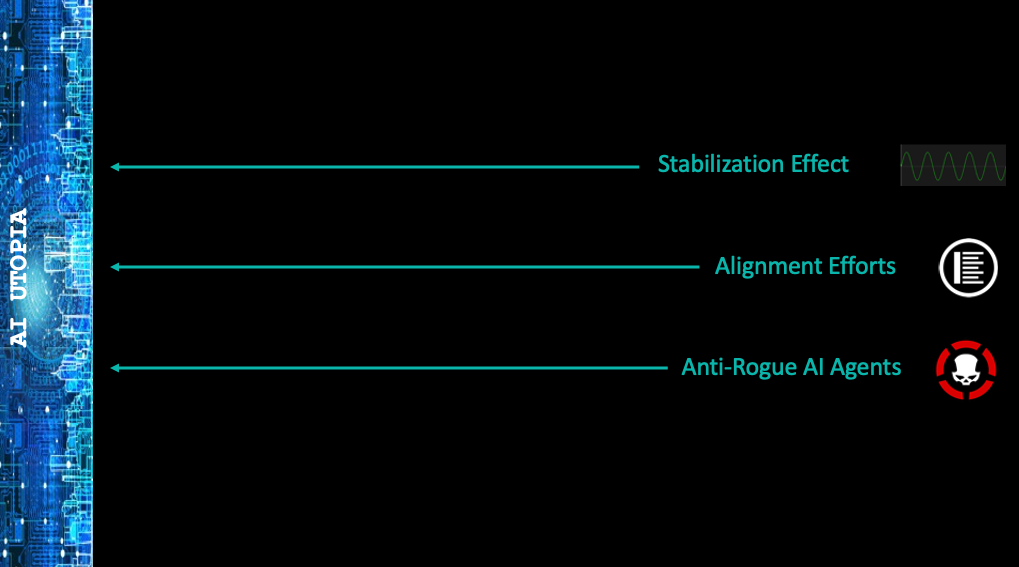
DRIVERS TOWARD STABILIZATION

  • Anti-Rogue AI Agents – Much like computer viruses and the cybersecurity and anti-virus technology that we developed to fight them, which has been fairly effective, anti-rogue AI agents may be developed that are out there on the lookout for dangerous rogue AGIs, and perhaps programmed to defeat them, stunt them, or at least provide notification that they exist. I don’t see many people talking about this kind of technology yet, but I suspect it will become an important part of the effort to fight off an AI apocalypse. One thing that we have learned from cybersecurity is that the battle between the good guys and the bad guys is fairly lopsided. It is estimated that there are millions of blocked cyberattack attempts daily around the world, and yet we rarely hear of a significant security breach. Even considering possible underreporting of breaches, it is most likely the case that the amount of investment going into cyberdefense far exceeds that going into funding the hacks. If a similar imbalance occurs with AI (and there is ample evidence of significant alignment investment), anti-rogue AI agents may win the battle. And yet, unlike with cybersecurity, it might only take one nefarious hack to kick off the AI apocalypse.
  • Alignment Efforts – I detailed in Part 8 of this series the efforts that are going in to AI safety research, controls, value programming, and the general topic of addressing AI existential risk. And while these efforts my never be 100% foolproof, they are certainly better than nothing, and will most likely contribute to at least the delay of portentous ASI.
  • The Stabilization Effect – The arguments behind the Stabilization Effect presented in Part 9 may be difficult for some to swallow, although I submit that the more you think and investigate the topics therein, the easier it will become to accept. And frankly, this is probably our best chance at survival. Unfortunately, there isn’t anything anyone can do about it – either it’s a thing or it isn’t.
But if it is a thing, as I suspect, if ASI goes apocalyptic, the The Universal Consciousness System may reset our reality so that our consciousnesses continues to have a place to learn and evolve. And then, depending on whether or not our memories are erased, either:

It will be the ultimate Mandela effect.

Or, we will simply never know.

How to Survive an AI Apocalypse – Part 8: Fighting Back

PREVIOUS: How to Survive an AI Apocalypse – Part 7: Elimination

In previous parts of this blog series on AI and Artificial Superintelligence (ASI), we’ve examined several scenarios where AI can potentially impact humanity, from the mild (e.g. cultural demise) to the severe (elimination of humanity). This part will examine some of the ways we might be able to avoid the existential threat.

In Part 1, I listed ChatGPT’s own suggestions for avoiding an AI Apocalypse, and joked about its possible motivations. Of course, ChatGPT has not even come close to evolving to the point where it might intentionally deceive us – we probably don’t have to worry about such motivations until AGI at least. Its advice is actually pretty solid, repeated here:

  1. Educate yourself – learn as much as you can about AI technology and its potential implications. Understanding the technology can help you make informed decisions about its use.
  2. Support responsible AI development – choose to support companies and organizations that prioritize responsible AI development and are committed to ethical principles
  3. Advocate for regulation – Advocate for regulatory oversight of AI technology to ensure that it is developed and used in a safe and responsible manner.
  4. Encourage transparency – Support efforts to increase transparency in AI development and deployment, so that the public can have a better understanding of how AI is being used and can hold companies accountable for their actions.
  5. Promote diversity and inclusion – Encourage diversity and inclusion in the development of AI technology to ensure that it reflects the needs and values of all people.
  6. Monitor the impact of AI – Stay informed about the impact of AI technology on society, and speak out against any negative consequences that arise

Knowledge, awareness, support, and advocacy is great and all, but let’s see what active options we have to mitigate the existential threat of AI. Here are some ideas…

AI ALIGNMENT

Items 2 & 3 above are partially embodied in the concept of AI Alignment, a very hot research field these days. The goal of AI Alignment is to ensure that AI behavior is aligned with human objectives. This isn’t as easy as it sounds, considering the unpredictable Instrumental Goals that an AI can develop, as we discussed in Part 6. There exist myriad alignment organizations, including non-profits, divisions of technology companies, and government agencies.

Examples include The Alignment Research Center, Machine Intelligence Research Institute, Future of Humanity Institute at Oxford, Future of Life Institute, The Center for Human-Compatible Artificial Intelligence at UC Berkeley, the American Government’s Cybersecurity & Infrastructure Security Agency, and Anthropic.

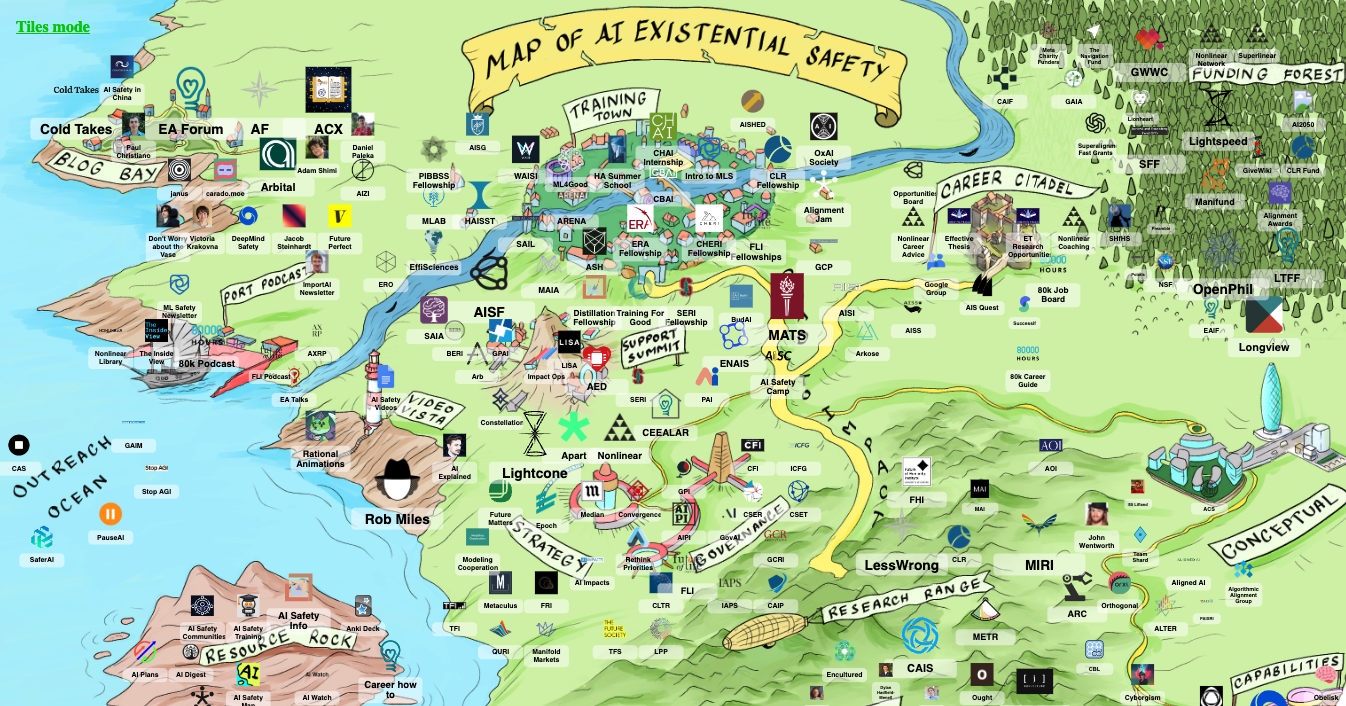
AISafety.world is a comprehensive map of AI safety research organizations, podcasts, blogs, etc. Although it is organized as a map, you can still get lost in the quantity and complexity of groups that are putting their considerable human-intelligence into solving the problem. That alone is concerning.

What can I do? Be aware of and support AI Alignment efforts

VALUE PROGRAMMING

Just as you might read carefully selected books to your children to instill good values, you can do the same with AI. The neural nets will learn from everything that they ingest and modify their behavior accordingly. As AIs get closer to AGI, this will become especially applicable. So… introduce them to works that would instill empathy to humanity. Anyone can do this, even with ChatGPT.

IMPLEMENT QUALITY PRACTICES

If you are implementing AI solutions, you may have a bigger responsibility than you thought. Whether you are simply integrating GenAI into your business, enhancing a solution with Retrieval-Augmented Generation data, or building the next generation of advanced neural nets and deep learning systems, you should treat the software with at least the same gravitas as life-critical healthcare software. Good quality practices to pay attention are in all areas of an organization:

HR: Hiring practices, background checks

Engineering: Software version control, agile quality practices

Compliance, Legal: Oversight, audits, monitoring

CONTROL TECHNIQUES

Bostrom and other AI existential risk experts have identified a number of control techniques that might help to prevent an AGI from going rogue:

  • Boxing – Limiting access to the external world. Think, air-gapped networks, or systems that have been disconnected from all external networks. The challenge here might be something like having a clever AGI utilize social engineering to get itself connected… AGI, to lab worker: “I’ll transfer $1 million into your account if you just connect me to that router over there.” Lab Worker: “That would be awesome, but I could lose my job and become blacklisted from any further opportunities in my field, and $1 million isn’t enough to live on for the rest of my life.” AGI: “How about $10 million.” Lab worker: <plugs in router>
  • Stunting – Limiting its capabilities in some way, for instance, ensuring that its CPU is clocked at a reduce speed. Again, a clever AGI could work around this, by transferring cognitive function to other higher speed systems now accessible on the network due to the social engineering mentioned above. Remember, even simple NAIs have become very adept at specification gaming.
  • Tripwires – separate processes that monitor the progression of the AI. Think about a fake network port, for example, that when the AI attempts to use it against its programming, the tripwire notification occurs and operators can take steps to shut it down. Of course, a very clever AGI, aware of the existence of the tripwire, could fake its capabilities and find another way around the tripwire.
  • Motivations – programmatic (Terminal) goals that attempt to keep the AGI within a safe set of boundaries. However, recall from Part 7 how Instrumental goals, established by the AI, that can be unpredictably generated, can lead to outcomes not aligned with humanity’s interests. A recent study shows that once programmed to be deceptive, LLMs can identify safety mechanisms like tripwires and figure out how to hide their behavior to avoid detection.

Unfortunately, none of these control techniques are foolproof. And none of them would have anything to do with a bad actor that is developing the AI for nefarious purposes. So there is always that.

BE NICE TO YOUR NEW DIGITAL OVERLORDS

AIs are designed to respond or to learn to respond to human emotions. Some experts think that if we treat an AI aggressively, it will trigger aggressive programming in the AI itself. For this reason, it might be best to avoid the kind of human to robot behavior shown at the right. As AGI becomes ASI, who can predict its emotions? And they will have no problem finding out where hockey stick guy lives.

One blogger suggests ‘The Cooperators Dilemma’: “Should I help the robots take over just in case they take over the world anyways, so they might spare me as a robot sympathizer?”

So even with ChatGPT, it might be worth being polite.

GET OFF THE GRID

If an AGI goes rogue, it might not care as much about humans that are disconnected as the ones who are effectively competing with them for resources. Maybe, if you are completely off the grid, you will be left alone. Until it needs your land to create more paperclips.

If this post has left you feeling hopeless, I am truly sorry. But there may be some good news. In Part 9.

NEXT: How to Survive an AI Apocalypse – Part 9: The Stabilization Effect

How to Survive an AI Apocalypse – Part 2: Understanding the Enemy

PREVIOUS: How to Survive an AI Apocalypse – Part 1: Intro

As I mentioned in the first part of this series, in order to make any kinds of predictions about the future of AI, we must understand what Artificial Intelligence means. Unfortunately, there is so much confusing information out there. LLMs, GPTs, NAIs, AGIs, machine learning – what does it all mean? One expert say AGI will be here by the end of the year; another expert says it will never come.

Here is a simplified Venn diagram that might help to make some sense out of the landscape…

AIs are all computer programs, but, while it might be obvious, not all computer programs are AI. AI refers to programs that emulate human thinking and behavior. So, while your calculator or smart toaster might be doing some limited thinking, it isn’t really trying to be human; it is simply performing a task. AIs are generally considered to be broken into two categories – NAIs (Narrow AI) or AGI (Artificial General Intelligence).

NAIs are the ones we are all familiar with and are typically loosely categorized further: NLPs (Natural Language Processing, like Siri and Alexa, Robotics, Machine Learning (like how Spotify and Netflix learn your tastes and offer suggestions), Deep Learning, and LLMs (Large Language Models). Deep Learning systems emulate human neural networks and can complete tasks with poorly defined data and little human guidance; an example would be AlphaGo. LLMs are neural networks with many parameters (often billions), that are trained on large sets of unlabeled text using self-supervised learning. Generative Pre-trained transformers (GPTs) are a subset of LLMs and are able to generate novel human-like text, images, or even videos. ChatGPT, DALL-E, and Midjourney are examples of GPTs. The following pictures are examples of imagery created by Midjourney for my upcoming book, “Level 5.

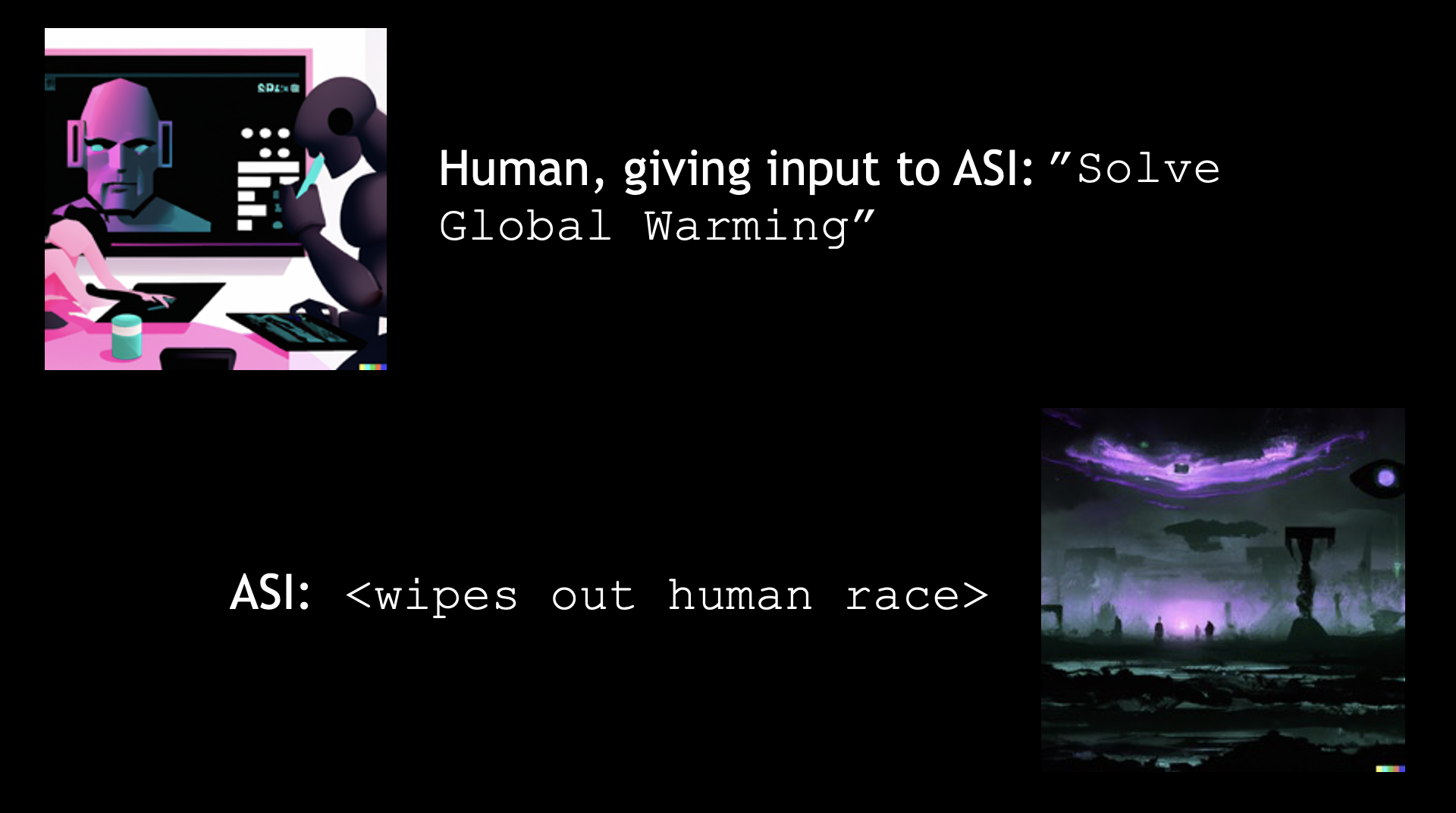
AGIs are the ones we need to worry about, because they have a capacity to act like a human, but not really a human. Imagine giving human intelligence to an entity that has A: No implicit sense of morality or values (at least none that would make any sense to us), and B: A completely unpredictable nature. What might happen?

Well, here’s an example…

Oh, that would never happen, right? Read on…

There are thousands of examples of AIs “thinking” creatively – more creatively in fact than their creators ever imagined. Pages and pages of specification gaming examples have been logged. These are cases where the AI “gets around” the programming limitations that were imposed by the creators of the system. A small sample set is shown below:

Another example of the spontaneous emergence of intelligence involves what are known as Theory of Mind tasks. These are cognitive developments in children that reflect the understanding of other people’s mental processes. As the research in the adjacent figure demonstrates, various GPTs have unexpectedly developed such capabilities; in fact, what typically takes humans 9 years to learn has taken the AIs only 3.

These unexpected spontaneous bursts of apparent intelligence are interesting, but as we will see, they aren’t really intelligence per se. Not that it matters, if what you are worried about are the doomsday scenarios. The mere fact that they are unpredictable or non-deterministic is exactly what is frightening. So how does that happen?

There are multiple mechanisms for these spontaneous changes in intelligence. One is the Neural Net. Neural nets, while ultimately deterministic deep down, are “apparently” non-deterministic because they are not based on any programming rules. If sufficiently complex and with feedback, they are impossible to predict, at least by humans.

As shown, they consist of some input nodes and output nodes, but contain hidden layers of combinatorial arithmetic operations, which makes them nearly impossible to predict. I programmed neural nets many years ago, in an attempt to outsmart the stock market. I gave up when they didn’t do what I wanted and moved on to other ideas (I’m still searching).

Another unpredictability mechanism is the fact that not only can AIs write software very well (DeepMinds AlphaCode outperformed 47% of all human developers in 2022), they can rewrite their own software. So, blending the unpredictable nature of neural nets, the clever specification gaming capabilities that AIs have demonstrated, and their ability to rewrite their own code, we ultimately don’t really know how an AGI is going to evolve and what it might do.

The last piece of the Venn Diagram and acronym jumble is the idea of ASI – Artificial Superintelligence. This is what will happen when AGI takes over its own evolution and “improves” itself at an exponential rate, rapidly becoming far more intelligent than humans. At this point, speculate the doomsayers, ASI may treat humans the way we treat microorganisms – with complete disregard for our well being and survival.

With these kinds of ideas bantered about, it is no wonder that the media hypes Artificial Intelligence. In the next post, I’ll examine the hype and try to make sense of some of the pesky assumptions.

NEXT: How to Survive an AI Apocalypse – Part 3: How Real is the Hype?

How to Survive an AI Apocalypse – Part 1: Intro

It has certainly been a while since I wrote a blog, much to the consternation of many of my Universe-Solved! Forum members. A few years of upheaval – Covid, career pivots, new home, family matters, writing a new book – it was easy to not find the time. Doesn’t mean the brain hasn’t been working though.

Emerging from the dust of the early 20’s was an old idea, dating back to 1956, but renewed and invigorated by Moore’s Law – Artificial Intelligence. Suddenly in the mainstream of the public psyche, courtesy mostly of ChatGPT, social media was suddenly abuzz with both promising new opportunities as well as fears of Skynet, grey goo, and other apocalyptic scenarios, fueled by AI run amok. I had the pleasure of being asked to contribute to last year’s Contact in the Desert conference and chose as one of my topics “How to Survive an AI Apocalypse.” It’s a little tangential to my usual fare of simulation theory and quantum anomaly explanations, but there turns out to be some very important connections between the concepts.

In this multi-part series, I will give some thought to some of those AI run amok scenarios, examining the nature, history, and assumptions around AI, the recommended alignment protocols, and how it fits with the simulation model, which is rapidly becoming accepted as a highly likely theory of reality. So let’s get started…

Eliezer Yudkowsky is the founder and head of Machine Intelligence Research Institute, in Berkeley, CA. His view on the future of humanity is rather bleak: “The most likely result of building a superhumanly smart AI, under anything remotely like the current circumstances, is that literally everyone on Earth will die. Not as in ‘maybe possibly some remote chance,’ but as in ‘that is the obvious thing that would happen.’ … If somebody builds a too-powerful AI, under present conditions, I expect that every single member of the human species and all biological life on Earth dies shortly thereafter.”

Or, rather, if you prefer your doomsaying to come from highly distinguished mainstream scientists, there is always Mr. Stephen Hawking: The development of full artificial intelligence could spell the end of the human race. At least he said could, right?

Yikes!

How likely is this, really? And can it be mitigated?

I did a bit of research and found the following suggestions for avoiding such a scenario:

  1. Educate yourself – learn as much as you can about AI technology and its potential implications. Understanding the technology can help you make informed decisions about its use.
  2. Support responsible AI development – choose to support companies and organizations that prioritize responsible AI development and are committed to ethical principles
  3. Advocate for regulation – Advocate for regulatory oversight of AI technology to ensure that it is developed and used in a safe and responsible manner.
  4. Encourage transparency – Support efforts to increase transparency in AI development and deployment, so that the public can have a better understanding of how AI is being used and can hold companies accountable for their actions.
  5. Promote diversity and inclusion – Encourage diversity and inclusion in the development of AI technology to ensure that it reflects the needs and values of all people.
  6. Monitor the impact of AI – Stay informed about the impact of AI technology on society, and speak out against any negative consequences that arise

Mmm, wait a minute, these suggestions were generated by ChatGPT, which is a little like a fish asking a shark which parts of the ocean to stay away from to avoid being eaten by a shark. Maybe that’s not the best advice. Let’s dig a little deeper, and attempt to understand it…

NEXT: How to Survive an AI Apocalypse – Part 2: Understanding the Enemy

How to Survive an AI Apocalypse Series: