How to Survive an AI Apocalypse – Part 9: The Stabilization Effect

PREVIOUS: How to Survive an AI Apocalypse – Part 8: Fighting Back

Here’s where it gets fun.

Or goes off the rails, depending on your point of view.

AI meets Digital Philosophy meets Quantum Mechanics meets UFOs.

This entire blog series has been about surviving an AI-based Apocalypse, a very doomsday kind of event. For some experts, this is all but inevitable. You readers may be coming to a similar conclusion.

But haven’t we heard this before? Doomsday prophesies have been around as long as… Keith Richards. The Norse Ragnarök, The Hindu prophecy of the end of times during the current age of Kaliyuga, the Zoroastrian Renovation, and of course, the Christian Armageddon. An ancient Assyrian tablet dated 2800-2500 BCE tells of corruption and unruly teenagers and prophecies that “earth is in its final days; the world is slowly deteriorating into a corrupt society that will only end with its destruction.” Fast forward to the modern era, where the Industrial Revolution was going to lead to the world’s destruction. We have since had the energy crisis, the population crisis, and the doomsday clock ticking down to nuclear armageddon. None of it ever comes to pass.

Is the AI apocalypse more of the same, or is it frighteningly different in some way? This Part 9 of the series will examine such questions and present a startling conclusion that all may be well.

THE NUCLEAR APOCALYPSE

To get a handle on the likelihood of catastrophic end times, let’s take a deep dive into the the specter of a nuclear holocaust.

It’s hard for many of us to appreciate what a frightening time it was in the 1950s, as people built fallout shelters and children regularly executed duck and cover drills in the classrooms.

Often considered to be the most dangerous point of the cold war, the 1962 Cuban Missile Crisis was a standoff between the Soviet Union and the United States involving the deployment of Soviet missiles in Cuba. At one point the US Navy began dropping depth charges to force a nuclear-armed Soviet submarine to surface. The crew on the sub, having had no radio communication with the outside world didn’t know if war was breaking out or not. The captain, Valentin Savitsky, wanted to launch a nuclear weapon, but a unanimous decision among the three top officers was required for launch. Vasily Arkhipov, the second in command, was the sole dissenting vote and even got into an argument with the other two officers. His courage effectively prevented the nuclear war that was likely to result. Thomas S Blanton, later the director of the US National Security Archive called Arkhipov “the man who saved the world.”

But that wasn’t the only time we were a hair’s breadth away from the nuclear apocalypse.

On May 23, 1967, US military commanders issued a high alert due to what appeared to be jammed missile detection radars in Alaska, Greenland, and the UK. Considered to be an act of war, they authorized preparations for war, including the deployment of aircraft armed with nuclear weapons. Fortunately, a NORAD solar forecaster identified the reason for the jammed radar – a massive solar storm.

Then, on the other side of the red curtain, on 26 September 1983, with international tensions still high after the recent Soviet military shoot down of Korean Air Lines Flight 007, a nuclear early-warning system in Moscow reported that 5 ICBMs (intercontinental ballistic missiles) had been launched from the US. Lieutenant colonel Stanislav Petrov was the duty officer at the command center and suspected a false alarm, so he awaited confirmation before reporting, thereby disobeying Soviet protocol. He later said that had he not been on the shift at that time, his colleagues would have reported the missile launch, likely triggering a nuclear war.

In fact, over the years there have been at least 21 nuclear war close calls, any of which could easily led to a nuclear conflagration and the destruction of humanity. The following timeline, courtesy of the Future of Life Institute, shows how many occurred in just the 30-year period from 1958 to 1988.

It kinds of makes you wonder what else could go wrong…

END OF SOCIETY PREDICTED

Another modern age apocalyptic fear was driven by the recognition that exponential growth and limited resources are ultimately incompatible. At the time, the world population was growing exponentially and important resources like oil and arable land were being depleted. The Rockefeller Foundation partnered with the OECD (Organization for Economic Cooperation and Development) to form The Club of Rome, a group of current and former heads of state, scientists, economists, and business leaders to discuss the problem and potential solutions. In 1972, with the support of computational modeling from MIT, they issued their first report, The Limits to Growth, which painted a bleak picture of the world’s future. Some of the predictions (and their ultimate outcomes) follow:

Another source for this scare was the book The Population Bomb by Stanford biologist Paul Ehrlich. He and people like Harvard biologist George Wald also made some dire predictions…

There is actually no end to failed environmental apocalyptic predictions – too many to list. But a brief smattering includes:

  • “Unless we are extremely lucky, everyone will disappear in a cloud of blue steam in 20 years.” (New York Times, 1969)
  • “UN official says rising seas to ‘obliterate nations’ by 2000.” (Associated Press, 1989)
  • “Britain will Be Siberian in less than 20 years” (The Guardian, 2004)
  • “Scientist Predicts a New Ice Age by 21th Century” (Boston Globe, 1970)
  • “NASA scientist says we’re toast. In 5-10 years, the arctic will be ice free.” (Associated Press, 2008)

Y2K

And who could forget this apocalyptic gem…

My intent is not to cherry pick the poor predictions and make fun of them. It is simply that when we are swimming in the sea of impending doom, it is really hard to see the way out. And yet, there does always seem to be a way out. 

Sometimes it is mathematical. For example, there was a mathematical determination of when we would run out of oil based on known supply and rate of usage, perhaps factoring in the trend of increase in rate of usage. But what were not factored into the equation were the counter effects of the rate of new reserves being discovered and the improvements in engine efficiencies. One could argue that in the latter case, the scare achieved its purpose, just as the fear of global warming has resulted in a number of new environmental policies and laws, such as California’s upcoming ban on gasoline powered vehicles in 2035. However, that isn’t always the case. Many natural resources, for instance, seem to actually be increasing in supply. I am not necessarily arguing for something like the abiotic oil theory. However, at the macro level, doesn’t it sometimes feel like a game of civilization, where we are given a set of resources, cause and effect interrelationships, and ability to acquire certain skills. In the video game, when we fail on an apocalyptic level, we simply hit the reset button and start over. But in real life we can’t do that. Yet, doesn’t it seem like the “game makers” always hand us a way out, such as unheard of new technologies that are seemingly suddenly enabled? And it isn’t always human ingenuity that saves us? Sometimes, the right person is on duty at the perfect time against all odds. Sometimes, oil fields magically replenish on their own. Sometimes asteroids strike the most remote place on the planet.

THE STABILIZATION EFFECT

In fact, it seems statistically significant that apocalypses, while seemingly imminent, NEVER really occur. So much so that I decided to model it with a spreadsheet using random number generation (also demonstrating how weak my programming skills have gotten). The intent of the model is to encapsulate the state of humanity on a simple timeline using a parameter called “Mood” for lack of a better term. We start at a point in society that is neither euphoric (the Roaring Twenties) nor disastrous (the Great Depression). As time progresses, events occur that push the Mood in one direction or the other, with a 50/50 chance of either occurring. The assumption in this model is that no matter what the Mood is, it can still get better or worse with equal probability. Each of the following graphs depicts a randomly generated timeline.

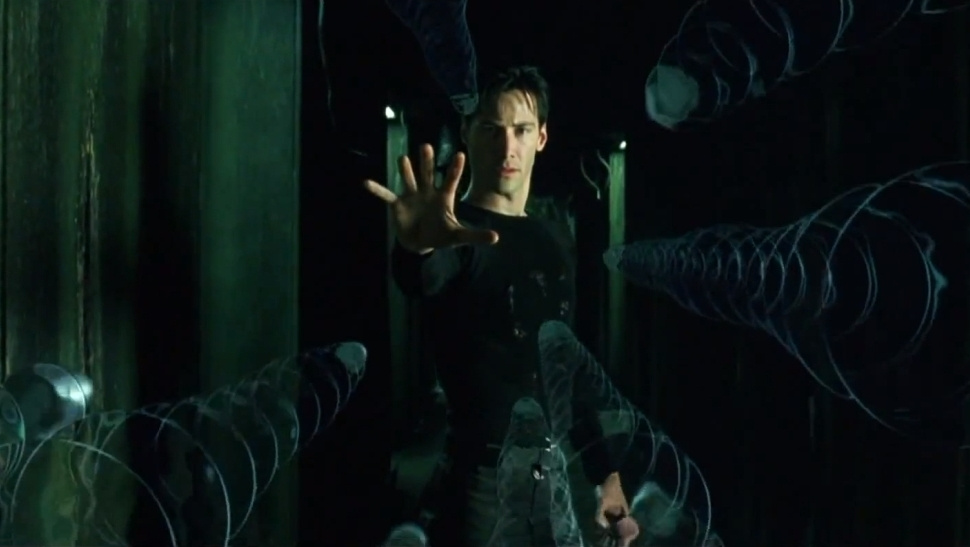
On the graph are two thresholds – one of a positive nature, where things seemingly can’t get much better, and one of a negative nature, whereby all it should take is a nudge to send us down the path to disaster. In any of the situations we’ve discussed in this part of the series, when we are on the brink of apocalypse, the statistical likelihood that the situation would improve at that point should not be more than 50/50. If true, running a few simulations shows that an apocalypse is actually fairly likely. Figures 1 and 3 pop over the positive limit and then turn back toward neutral. Figure 2 seems to take off in the positive direction even after passing the limit. Figure 4 hits and goes through the negative limit several times, implying that if our reality actually worked this way, apocalyptic situations would actually be likely.

However, what always seems to happen is that when things get that bad, there is a stabilizing force of some sort. I made an adjustment to my reality model by inserting some negative feedback to model this stabilizing effect. For those unfamiliar with the term, complex systems can have positive or negative feedback loops; often both. Negative feedback tends to bring a system back to a stable state. Examples in the body include the maintenance of body temperature and blood sugar levels. If blood sugar gets too high, the pancreas secretes insulin which chemically reduces the level. When it gets too low, the pancreas secretes glucagon which increases the level. In nature, when the temperature gets high, cloud level increases, which provides the negative feedback needed to reduce the temperature. Positive feedback loops also exist in nature. The runaway greenhouse effect is a classic example.

When I applied the negative feedback to the reality model, all curves tended to stay within the positive and negative limits, as show below.

Doesn’t it feel like this is how our reality works at the most fundamental level? But how likely would it be that every aspect of our reality is subject to negative feedback? And where does that negative feedback come from?

REALITY IS ADAPTIVE

This is how I believe that reality works at its most fundamental level…
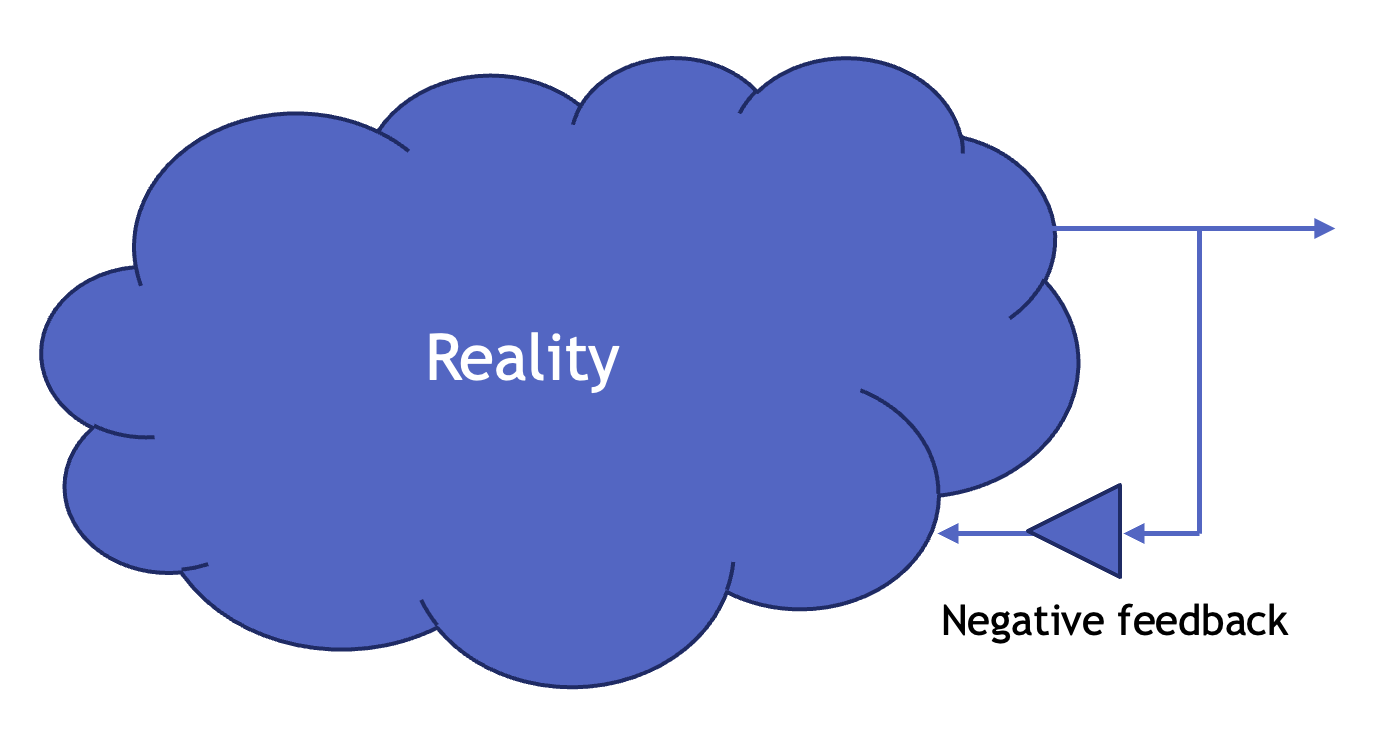
Why would that be? Two obvious ideas come to mind.

  1. Natural causes – this would be the viewpoint of reductionist materialist scientists. Heat increase causes ice sheets to melt which creates more water vapor, generating more clouds, reducing the heating effect of the sun. But this does not at all explain why the human condition, and the civilization trends that we’ve discussed in this article, always tend toward neutral.
  2. God – this would be the viewpoint of people whose beliefs are firmly grounded in their religion. God is always intervening to prevent catastrophes. But apparently God doesn’t mind minor catastrophes and plenty of pain and suffering in general. More importantly though, this does not explain dynamic reality generation.

DYNAMIC REALITY GENERATION

Enter Quantum Mechanics.

The Double-slit experiment was first done by Thomas Young back in 1801, and was an attempt to determine if light was composed of particles or waves. A beam of light was projected at a screen with two vertical slits. If light was composed of particles, only two bands of light should be on the phosphorescent screen behind the one with the slits. If wave-based, an interference pattern should result. The wave theory was initially confirmed experimentally, but that was later called into question by Einstein and others. 

The experiment was later done with particles, like electrons, and it was clearly assumed that these would be shown to be hard fixed particles, generating the expected pattern shown on the right.

However, what resulted was an interference pattern, implying that the electrons were actually waves. Thinking that perhaps electrons were interfering with each other, the experiment was modified to shoot one electron at a time. And still the interference pattern slowly build up on the back screen.
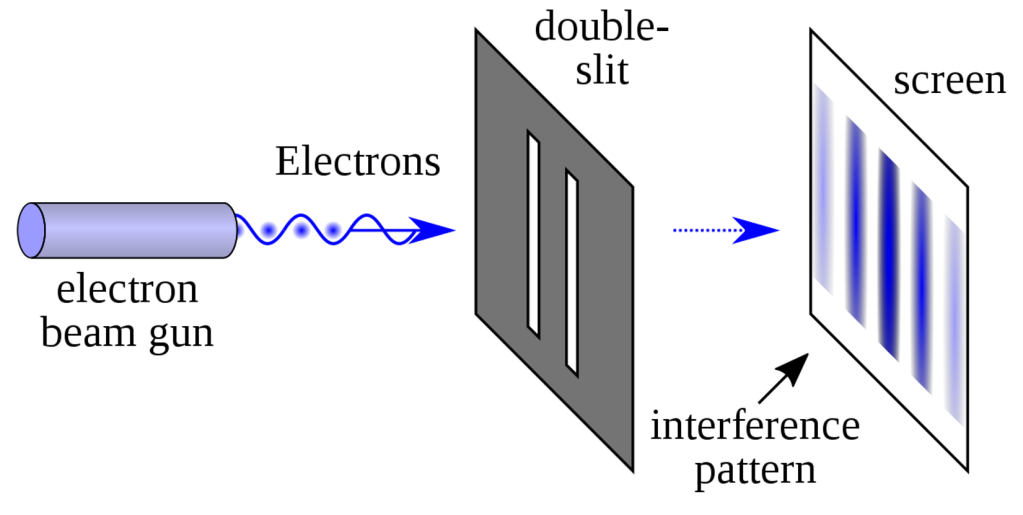
To make sense of the interference pattern, experimenters wondered if they could determine which slit each electron went through, so they put a detector before the double list. Et voila, the interference pattern disappeared! It was as if the actual conscious act of observation converted the electrons from waves to particles. The common interpretation was that the electrons actual exist only a probability function and the observation actually snaps them into existence.

It is very much like the old adage that a tree falling in the woods makes no sound unless someone is there to see it. Of course, this idea of putting consciousness as a parameter in the equations of physics generated no end of consternation for the deterministic materialists. They have spent the last twenty years designing experiments to disprove this “Observer Effect” to no avail. Even when the “which way” detector is place after the double slit, the interference pattern disappears. The only tenable conclusion is that reality does not exist in an objective manner and its instantiation depends on something. But what?

The diagram below helps us visualize the possibilities. When does reality come into existence?
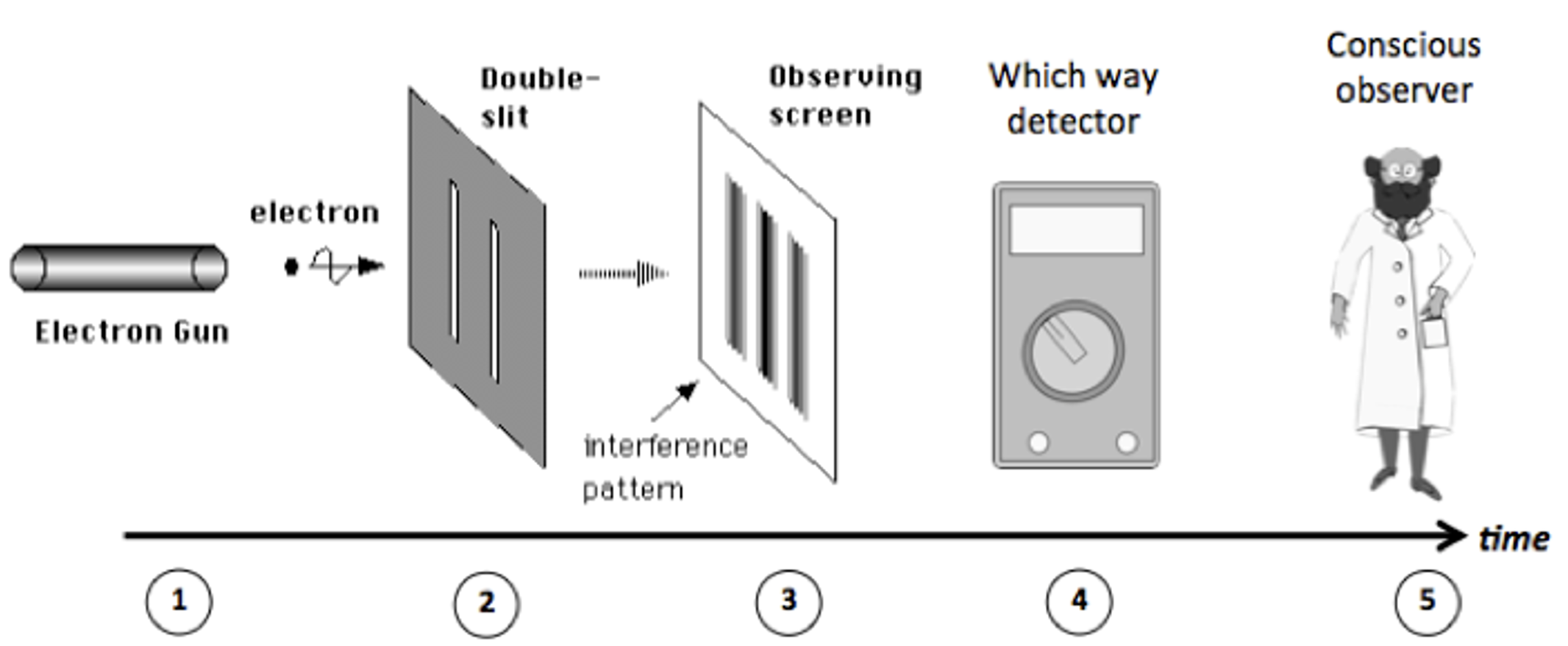
Clearly it is not at points 1, 2 or 3, because it isn’t until the “which way” detector is installed that we see the shift in reality. So is it due to the detector itself or the conscious observer reading the results of the detector. One could image experiments where the results of the “which way” detector are hidden from the conscious observer for an arbitrary period of time; maybe printed out and put in an envelope without looking, where it sits on the shelf for a day while the interference pattern exists. And someone opens the envelope and suddenly the interference pattern disappears. I have always suspected that the answer will be that reality comes into existence at point 4. I believe that it is just logical that a reality generating universe be efficient. Recent experiments bear this out.

I believe this says something incredibly fundamental about the nature of our reality. But what would efficiency have to do with the nature of reality? Let’s explore a little further – what kinds of efficiencies would this lead to?

POP QUIZ! – is reality analog or digital? There is actually no conclusion to this question and many papers have been written in support of either point of view. But if our reality is created on some sort of underlying construct, there is only one answer – it has to be digital. Here’s why…

How much information would it take to fully describe the cup of coffee on the right?

In an analog reality, it would take an infinite amount of information.

In a digital reality, fully modeled at the Planck resolution (what some people think is the deepest possible digital resolution), it would require 4*1071 bits/second give or take. It’s a huge number for sure, but infinitely less than the analog case.

But wait a minute.  Why would we need that level of information to describe a simple cup of coffee? So let’s ask a different question… How much information is needed for a subjective human experience of that cup of coffee – the smell, the taste, the visual experience. You don’t really need to know the position and momentum vector of each subatomic particle in each molecule of coffee in that cup. All you need to know is what it takes to experience it. The answer is roughly 1*109 bits/second. In other words, there could be as much as a 4*1062 factor of compression involved in generating a subjective experience. In other words, we don’t really need to know where each electron is in the coffee, just as you don’t need to know which slit each electron goes through in the double slit experiment. That is, UNTIL YOU MEASURE IT!

So, the baffling results of the double slit experiments actually make complete sense if reality is:

  • Digital
  • Compressed
  • Dynamically generated to meet the needs of the inhabitants of that reality

Sounds computational doesn’t it? In fact, if reality were a computational system, it would make sense for it to need to have efficiencies at this level. 

There are such systems – one well known example is a video game called No Man’s Sky that dynamically generates its universe as the user plays the game. Art inadvertently imitating life?

Earlier in this article I suggested that the concept of God could explain the stabilization effect of our reality. If we redefine “God” to mean “All That There Is” (of which, our apparent physical reality is only a part), reality becomes a “learning lab” that needs to be stable for our consciousnesses to interact virtually.

I wrote about this and proposed this model back in 2007 in my first book “The Universe-Solved!.”  In 2021, an impressive set of physicists and technologists came up with the same theory, which they called “The Autodidactic Universe.” They collaborated to explore methods, structures, and topologies in which the universe might be learning and modifying its laws according to what is needed. Such ideas included neural nets and Restricted Boltzman Machines. This provides an entirely different way of looking at any potential apocalypse. And it make you wonder…

UFO INTERVENTION

In 2021, over one hundred military personnel, including Retired Air Force Captain Robert Salas, Retired First Lieutenant Robert Jacobs, and Retired Captain David Schindele met at the National Press Club in Washington, DC to present historical case evidence that UFOs have been involved with disarming nuclear missiles. A few examples…

  • Malmstrom Air Force Base, Montana, 1967 – “a large glowing, pulsating red oval-shaped object hovering over the front gate,” as alarms went off showing nearly all 10 missiles shown in the control room had been disabled.
  • Minot Air Force Base, North Dakota, 1966 – Eight airmen said that 10 missiles at silos in the vicinity all went down with guidance and control malfunctions when an 80- to 100-foot wide flying object with bright flashing lights had hovered over the site.
  • Vandenberg Air Force Base, California, 1964 – “It went around the top of the warhead, fired a beam of light down on the top of the warhead.” After circling, it “then flew out the frame the same way it had come in.”
  • Ukraine, 1982 – launch countdowns were activated for 15 seconds while a disc-shaped UFO hovered above the base, according to declassified KGB documents

As the History Channel reported, areas of high UFO activity are correlated with nuclear and military facilities worldwide.

Perhaps UFOs are an artifact of our physical reality learning lab, under the control of some conscious entity or possibly even an autonomous (AI) bot in the system. As part of the “autodidactic” programming mechanisms that maintain stability in our programmed reality. Other mechanisms could involve things like adjusting the availability of certain resources or even nudging consciousnesses toward solutions to problems. If this model of reality is accurate, we may find that we have little to worry about regarding an AI apocalypse. Instead it will just be another force that contributes toward our evolution.

To that end, there is also a sector of thinkers who recommend a different approach. Rather than fight the AI progression, or simply let the chips fall, we should welcome our AI overlords and merge with them. That scenario will be explored in Part 10 of this series.

NEXT: How to Survive an AI Apocalypse – Part 10: If You Can’t Beat ’em, Join ’em

Nick Bostrom Elon Musk Nick Bostrom Elon Musk

OMG can anyone write an article on the simulation hypothesis without focusing on Nick Bostrom and Elon Musk? It’s like writing an article about climate change and only mentioning Al Gore.

Dear journalists who are trying to be edgy and write about cool fringe theories, please pay attention. The idea that we might be living in an illusory world is not novel. Chinese philosopher Zhuangzi wrote about it with his butterfly dream in 369 BC. Plato discussed his cave allegory in 380 BC. The other aspect of simulation theory, the idea that the world is discrete or digital, is equally ancient. Plato and Democritous considered atoms, and therefore the fundamental constructs of reality, to be discrete.

I’m not taking anything away from Nick Bostrom, who is a very intelligent modern philosopher. His 2001 Simulation Argument is certainly thought provoking and deserves its place in the annals of digital philosophy. But it was predated by “The Matrix”. Which was predated by Philip K. Dick’s pronouncement in 1977 that we might be living in a computer-programmed reality. Which was predated by Konrad Zuse’s 1969 work on discrete reality, “Calculating Space.”

And as interesting as Bostrom’s Simulation Argument is, it was a 12-page paper on a single idea. Since then, he has not really evolved his thinking on digital philosophy, preferring instead to concentrate on existential risk and the future of humanity.

Nor am I taking anything away from Elon Musk, a brilliant entrepreneur who latched onto Bostrom’s idea for a few minutes, generated a couple sound bites, and then it was back to solar panels and hyperloops.

But Bostrom, Musk, and the tired old posthuman-generated simulation hypothesis is all that the rank and file of journalists seem to know to write about. It is really sad, considering that Tom Campbell wrote an 800-page treatise on the computational nature of reality. I have written two books on the subject. Both of our material is largely consistent and has evolved the thinking far beyond the idea that we live in a posthuman-generated simulation. In fact, I provide a great deal of evidence that the Bostrom-esque possibility is actually not very likely. And Brian Whitworth has a 10-year legacy of provocative scientific papers on evidence for a programmed reality that are far beyond the speculations of Musk and Bostrom.

The world need to know about these things and Campbell, Whitworth, and I can’t force people to read our books, blogs, and papers. So journalists, with all due respect, please up your simulation game.

Comments on the Possibilist Transactional Interpretation of Quantum Mechanics, aka Models vs. Reality

Reality is what it is. Everything else is just a model.

From Plato to Einstein to random humans like myself, we are all trying to figure out what makes this world tick. Sometimes I think I get it pretty well, but I know that I am still a product of my times, and therefore my view of reality is seen through the lens of today’s technology and state of scientific advancement. As such, I would be a fool to think that I have it all figured out. As should everyone else.

At one point in our recent past, human scientific endeavor wasn’t so humble. Just a couple hundred years ago, we thought that atoms were the ultimate building blocks of reality and everything could be ultimately described by equations of mechanics. How naïve that was, as 20th century physics made abundantly clear. But even then, the atom-centric view of physics was not reality. It was simply a model. So is every single theory and equation that we use today, regardless of whether it is called a theory or a law: Relativistic motion, Schrodinger’s equation, String Theory, the 2nd Law of Thermodynamics – all models of some aspect of reality.

We seek to understand our world and derive experiments that push forward that knowledge. As a result of the experiments, we define models to best fit the data.

One of the latest comes from quantum physicist Ruth Kastner in the form of a model that better explains the anomalies of quantum mechanics. She calls the model the Possibilist Transactional Interpretation of Quantum Mechanics (PTI), an updated version of John Cramer’s Transactional Interpretation of Quantum Mechanics (TIQM, or TI for short) proposed in 1986. The transactional nature of the theory comes from the idea that the wavefunction collapse behaves like a transaction in that there is an “offer” from an “emitter” and a “confirmation” from an “absorber.” In the PTI enhancement, the offers and confirmations are considered to be outside of normal spacetime and therefore the wavefunction collapse creates spacetime rather than occurs within it. Apparently, this helps to explain some existing anomalies, like uncertainty and entanglement.

This is all cool and seems to serve to enhance our understanding of how QM works. However, it is STILL just a model, and a fairly high level one at that. And all models are approximations, approximating a description of reality that most closely matches experimental evidence.

Underneath all models exist deeper models (e.g. string theory), many as yet to be supported by real evidence. Underneath those models may exist even deeper models. Consider this layering…

Screen Shot 2015-09-29 at 8.18.55 PM

Every layer contains models that may be considered to be progressively closer to reality. Each layer can explain the layer above it. But it isn’t until you get to the bottom layer that you can say you’ve hit reality. I’ve identified that layer as “digital consciousness”, the working title for my next book. It may also turn out to be a model, but it feels like it is distinctly different from the other layers in that, by itself, it is no longer an approximation of reality, but rather a complete and comprehensive yet elegantly simple framework that can be used to describe every single aspect of reality.

For example, in Digital Consciousness, everything is information. The “offer” is then “the need to collapse the wave function based on the logic that there is now an existing conscious observer who depends on it.” The “confirmation” is the collapse – the decision made from probability space that defines positions, spins, etc. This could also be seen as the next state of the state machine that defines such behavior. The emitter and absorber are both parts of the “system”, the global consciousness that is “all that there is.” So, if experimental evidence ultimately demonstrates that PTI is a more accurate interpretation of QM, it will nonetheless still be a model and an approximation. The bottom layer is where the truth is.

Elvidge’s Postulate of Countable Interpretations of QM…

The number of intepretations of Quantum Mechanics always exceeds the number of physicists.

Let’s count the various “interpretations” of quantum mechanics:

  • Bohm (aka Causal, or Pilot-wave)
  • Copenhagen
  • Cosmological
  • Ensemble
  • Ghirardi-Rimini-Weber
  • Hidden measurements
  • Many-minds
  • Many-worlds (aka Everett)
  • Penrose
  • Possibilist Transactional (PTI)
  • Relational (RQM)
  • Stochastic
  • Transactional (TIQM)
  • Von Neumann-Wigner
  • Digital Consciousness (DCI, aka Elvidge)

Unfortunately you won’t find the last one in Wikipedia. Give it about 30 years.

istock_000055801128_small-7dde4d0d485dcfc0d5fe4ab9e600bfef080121d0-s800-c85

Who Is God?

I’m starting this ridiculously presumptuous topic with the assumption that we live in a consciousness-driven digital reality. (For the reasons that I think this is the ONLY compelling theory of reality, please see the evidence, or my book, “The Universe – Solved!”) As such, we can draw from the possibilities proposed by various simulation theorists, such as Tom Campbell, Nick Bostrom, Andrei Linde, the Wachowskis, and others. In all cases, our apparent self, what Morpheus called “residual self image” is simply, in effect, an avatar. Our real free-will-wielding consciousness is in the mind of the “sim player”, wherever it may be.

god1-100 god2-100 god3-100

Some possibilities…

  1. We live in a post-human simulation written by humans of the future. This is Nick Bostrom’s “Simulation Argument.” “God” is thus, effectively, a future human, maybe some sniveling teen hacker working at the 2050 equivalent of Blizzard Entertainment. We are contemporaries of the hacker.
  1. We live in a simulation created by an AI, a la “The Matrix.” God is the Architect of the Matrix; we may be slaves or we may just enjoy playing the simulation that the AI created. We may be on earth or somewhere entirely different.
  1. We live in a simulation created by an alien. God is the alien; again, we may be slaves or we may just enjoy playing the simulation that ET has created.
  1. Stanford physicist Andrei Linde, the developer of the “eternal chaotic inflation theory” of the multiverse, once said “On the evidence, our universe was created not by a divine being, but by a physicist hacker.” That would make God a physicist – a future human one, or one from another planet.
  1. We live in a digital system, which continuously evolves to a higher level due to a fundamental law of continuous improvement. Physicist Tom Campbell has done the most to develop this theory, which holds that each of our consciousnesses are “individuated” parts of the whole system, interacting with another component of the system, the reality simulation in which we “live.” God is then a dispassionate digital information system, all that there is, the creator of our reality and of us. We are effectively a part of God.

The kingdom of God is within you” – Jesus

“He who knows his own self, knows God” – Mohammed

“There is one Supreme Ruler, the inmost Self of all beings, who makes His one form manifold. Eternal happiness belongs to the wise, who perceive Him within themselves – not to others” – from the Vedas, original Indian holy text

“The first peace, which is most important, is that which comes within the souls of men when they realize their relationship, their oneness, with the universe and all its Powers, and when they realize that at the center of the universe dwells Wakan-Tanka, and that this center is really everywhere, it is within each of us.” – Native American

There are a couple major challenges with possibilities 1 through 4. First of all is the problem of motivation. Would a significantly advanced civilization really be interested in playing out a seemingly mundane existence in a pre-post-human epoch on an ordinary planet? Would we want to live out the entire life of an Australopithecus four million years ago, given the opportunity in a simulation? Of course, this argument anthropomorphizes our true self, which may not even be of human form, like its avatar. In the System model of God, however, motivation is simple; it is part of the fundamental process of continuous improvement. We experience the simulation, or “Reality Learning Lab”, as Campbell calls it, in order to learn and evolve.

The bigger challenge is how to explain these anomalies:

  • Near Death Experiences, many of which have common themes; tunnels toward a white light, interaction with deceased (only!) relatives, life reviews, peace and quiet in an unearthly environment, a perception of a point of no return, and fundamental and lasting change in the experiencer’s attitude about life and death.
  • Past Life Experiences, as recounted by patients of hypnotherapists. Roots of reincarnation beliefs exist in every religion throughout the globe. It is fundamental in Hinduism, Jainism, Buddhism, Sikhism, and many Native American nations and African tribes, as well as some of the more esoteric (some might say “spiritually pure”) sects of Islam (Druze, Ghulat, Sufism), Judaism (Kabbalah and Hasidic), and even Christianity (Cathars, Gnostics).
  • In-between Life Experiences, as recounted by patients of hypnotherapists, as well as historical prophet figures, and modern spiritualists, such as Edgar Cayce, have common themes, such as encountering spirit guides who help design the next life.
  • Mystical experiences have been reported in many cultures throughout history, from Mohammed, Moses, Jesus, and Buddha to Protestant leader Jacob Boehme to modern day astronaut Rusty Schweickart. Common experiences include the expansion of consciousness beyond the body and ego, timelessness, the perception of being part of a unified whole, a oneness with a “cosmic consciousness”, and a deep understanding of the universe.

Only possibility 5, the “System” concept, can incorporate all of these anomalies. In that model, we are part of the whole, as experienced. We do reincarnate, as experienced. NDEs are simply the experience of our consciousness detaching from the Reality Learning Lab (RLL), and interacting with non-RLL entities.

The problem with the word “God” is the imagery and assumptions that it conjures up; old man with a flowing beard in the clouds. With the variety of simulation models, “God” could also be an incredibly advanced piece of software, or an incredibly advance alien (“light being”?), or a human in a quasi-futuristic grey suit. The word “System”, while probably much more accurate, is equally problematic in the assumptions that it generates. Still, I prefer that, or “All that there is” (ATTI?).

The System model clearly wins, in terms of its explanatory power. Which makes God a very different entity than most of us are used to thinking about.

But I bet the Buddha, Jesus, and Mohammed would all love this theory!

Which came first, the digital chicken, or the digital philosophy egg?

Many scientists, mathematicians, futurists, and philosophers are embracing the idea that our reality is digital these days. In fact, it would be perfectly understandable to wonder if digital philosophy itself is tainted due to the tendency of humans to view ideas through the lens of their times. We live in a digital age, surrounded by computers, the Internet, and smart phones, and so might we not be guilty of imagining that the world behaves just as a multi-player video game does? We probably wouldn’t have had such ideas 50 years ago, when, at a macroscopic level at least, everything with which we interacted appeared analog and continuous. Which came first, the digital chicken, or the digital philosophy egg?

Actually, the concepts of binary and digital are not at all new. The I Ching is an ancient Chinese text that dates to 1150 BCE. In it are 64 combinations of 8 trigrams (aka the Bagua), each of which clearly contain the first three bits of a binary code. 547px-Bagua-name-earlier.svg

Many other cultures, including the Mangareva in Polynesia (1450), and Indian (5th to 2nd century BCE), have used binary encodings for communication for thousands of years. Over 12,000 years ago, African tribes developed a binary divination system called Odu Ifa.

German mathematician and philosopher Gottfried Leibniz is generally credited as developing the modern binary number system in 1679, based on zeros and ones. Naturally, all of these other cultures are ignored so that we can maintain the illusion that all great philosophical and mathematical thought originated in Europe. Regardless of Eurocentric biases, it is clear that binary encoding is not a new concept. But what about applying it to the fundamental construct of reality?

It turns out that while modern digital physics or digital philosophy references are replete with sources that only date to the mid-20th century, the ancient Greeks (namely Plato) believed that reality was discrete. Atoms were considered to be discrete and fundamental components of reality.

A quick clarification of the terms “discrete”, “digital”, “binary”, “analog”, and “continuous” is probably in order:

Discrete – Having distinct points of measurement in the time domain

Digital – Having properties that can be encoded into bits

Binary – Encoding that is done with only two digits, zeros and ones

Analog – Having continuously variable properties

Continuous – The time domain is continuous

So, for example, if we encode the value of some property (e.g. length or voltage) digitally using 3 values (0, 1, 2), that would be digital, but not binary (rather, ternery). If we say that between any two points in time, there is an infinitely divisible time element, but for each point, the value of the measurement being performed on some property is represented by bits, then we would have a continuous yet digital system. Conversely, if time can be broken into chunks such that at a fine enough temporal granularity there is no concept of time between two adjacent points in time, but at each of these time points, the value of the measurement being performed is continuously variable, then we would have a discrete yet analog system.

In the realm of consciousness-driven digital philosophy, it is my contention that the evidence strongly supports reality being discrete and digital; that is, time moves on in “chunks” and at each discrete point in time, every property of everything can be perfectly represented digitally. There are no infinities.

I believe that this is a logical and fundamental conclusion, regardless of the fact that we live in a digital age. There are many reasons for this, but for the purposes of this particular blog post, I shall only concentrate on a couple. Let’s break down the possibilities of our reality, in terms of origin and behavior:

  1. Type 1 – Our reality was created by some conscious entity and has been following the original rules established by that entity. Of course, we could spend a lifetime defining “conscious” or “entity” but let’s try to keep it simple. This scenario could include traditional religious origin theories (e.g. God created the heavens and the earth). It could also include the common simulation scenarios, a la Nick Bostrom’s “Simulation Argument.”
  1. Type 2 – Our reality was originally created by some conscious entity and has been evolving according to some sort of fundamental evolutionary law ever since.
  1. Type 3 – Our reality was not created by some conscious entity, and its existence sprang out of nothing and has been following primordial rules of physics ever since. To explain the fact that our universe is incredibly finely-tuned for matter and life, materialist cosmologists dreamt up the idea that we must exist in an infinite set of parallel universes, and via the anthropic principle, the one we live only appears finely-tuned because it has to in order for us to be in it. Occam would be turning over in his grave.
  1. Type 4 – Our reality was not created by some particular conscious entity, but rather has been evolving according to some sort of fundamental evolutionary law from the very beginning.

I would argue that in the first two cases, reality would have to be digital. For, if a conscious entity is going to create a world for us to live in and experience, that conscious entity is clearly highly evolved compared to us. And, being so evolved, it would certainly make use of the most efficient means to create a reality. A continuous reality is not only inefficient, it is theoretically impossible to create because it involves infinities in the temporal domain as well as any spatial domain or property.

pixelated200I would also argue that in the fourth case, reality would have to be digital for similar reasons. Even without a conscious entity as a creator, the fundamental evolutionary law would certainly favor a perfectly functional reality that doesn’t require infinite resources.

Only in the third case above, would there be any possibility of a continuous analog reality. Even then, it is not required. As MIT cosmologist and mathematician Max Tegmark succinctly put it, “We’ve never measured anything in physics to more than about sixteen significant digits, and no experiment has been carried out whose outcome depends on the hypothesis that a true continuum exists, or hinges on nature computing something uncomputable.” Hence there is no reason to assume, a priori, that the world is continuous. In fact, the evidence points to the contrary:

  • Infinite resolution would imply that matter implodes into black holes at sub-Planck scales and we don’t observe that.
  • Infinite resolution implies that relativity and quantum mechanics can’t coexist, at least with the best physics that we have today. Our favorite contenders for rationalizing relativity and quantum mechanics are string theory and loop quantum gravity. And they only work with minimal length (aka discrete) scales.
  • We actually observe discrete behavior in quantum mechanics. For example, a particle’s spin value is always quantized; there are no intermediate states. This is anomalous in continuous space-time.

For many other reasons, as are probably clear from the evidence compiled on this site, I tend to favor reality Type 4. No other type of reality structure and origin can be shown to be anywhere near as consistent with all of the evidence (philosophical, cosmological, mathematical, metaphysical, and experimental). And it has nothing to do with MMORPGs or the smart phone in my pocket.

Objective vs. Subjective Reality

Today’s blog is one part rehash of an ancient dilemma that has puzzled and divided philosophers and scientists for millennia and two parts The Universe – Solved!

First a couple definitions…

Objective Reality – a reality that completely exists independent of any conscious entity to observe it.

Subjective Reality – what we perceive.

As it is well known, subjective reality is “subject” to an elaborate set of filters, any one of which can modify a perception of that reality; sensory apparatus (e.g. the rods and cones in our eyes), sensory processing (e.g. the visual cortex), higher level brain function, and psychological factors (e.g. expectations). As such, what one person experiences is always different than what any other person experiences, but usually in subtle ways.

Fundamentally, one cannot prove the existence of an objective reality. We can only infer its properties through observations, which of course, are subjective. However, it may be possible to prove that objective reality doesn’t exist, if, for example, it can be shown that the properties inferred via a particular observer fundamentally contradict properties inferred via another observer. But even then those inferences may be hopelessly subjective. Suppose person A sees a car as red and person B sees the same car as green. We can’t conclude that there is no objective reality because person B could simply have an unusual filter somewhere between the car and the seat of their consciousness.

What if we can use some sort of high-precision reproducible measurement apparatus to make some observations on reality and find that under certain controlled circumstances, reality changes depending on some parameter that appears to be disconnected to the reality itself? There are a lot of qualifiers and imperfections in that question – like “high (vs. infinite) precision” and “appears” – but what comes to mind is the well-known double slit experiment. In 1998, researchers at the Weizmann Institute of Science, demonstrated that reality shifts depending on the amount of observation, even if the “observer” is a completely non-intrusive device. IQOQI upped the ante in terms of precision in 2008 by showing that objective reality doesn’t exist to a certainly of 80 orders of magnitude (probability of being false due to error or chance = 1E-80). That’s good enough for me. And, in 2012, Dr. Dean Radin conducted what appear to be well-designed and rigorous scientific experiments that show to a high probability that conscious intent can directly alter the results of the double slit experiment. Just as it only takes one white crow to prove that not all crows are black, it only takes one experiment that demonstrates the non-existence of objective reality to prove that objective reality is an illusion.

So that debate is over. Let’s get past it and move onto the next interesting questions

What is this reality that we all perceive to be “almost” solid and consistent?

I believe it is a digital consciousness-influenced high-consensus reality for reasons outlined here. It has to have a high degree of consensus because, in order to learn and evolve our consciousness, we have to believe in a well-grounded cause and effect.

What does “almost” mean?

We could define “almost” as 1 minus the degree to which apparent objective reality is inconsistent, either between separate observers, or in experiments that have a different outcomes depending on the state of the observer. For now, I’ll have to punt on the estimates because I haven’t found any supporting research, but I suspect it is between 99.999% and 1.

How does “almost” work?

Subjective reality does not mean that you can call the shots and become a millionaire just due to intent. The world would be insane if that were the case. Because of the “consensus” requirement, the effects are much more subtle than that. For you to see a passing car and make it turn red just because you want to, would violate the color consensus that must be maintained for the other 1000 people that see that car drive by. In fact, there is nothing to say that the aggregate of conscious intents from all conscious entities fully shape the subjective reality. Most of it may be driven by the rules of the system (that aspect of digital global consciousness that drives the projection of the physical reality). See the figure below. In the digital global consciousness system (see my “The Universe-Solved!” or Tom Campbell’s “My Big TOE” for more in depth explanations of this view of the nature of reality), Brandon and I are just individuated segments of the greater whole. (Note: This is how we are all connected. The small cloud borders are not impervious to communication, either from other individuated consciousnesses (aka telepathy) or from the system as a whole (aka spiritual enlightenment)).

system

Brandon’s reality projection may have three components. First, it is generated by the system, based on whatever rules the system has for creating our digital reality. Second, it may be influenced by the aggregate of the intent of all conscious entities, which is also known by the system. Finally, his projection may be slightly influenced by his own consciousness. The same applies to my own projection. Hence, our realities are slightly different, but not enough to notice on a day-to-day basis. Only now that our scientific instrumentation has become sensitive enough, are we starting to be able to realize (but not yet quantify) this. Perhaps 5% of reality is shaped by the aggregate consensus and 95% by the system itself. Or 1% and 99%. Or .00001% and 99.99999%. All are possible, but none are objective.

Quantum Zeno Effect Solved

Lurking amidst the mass chaos of information that exists in our reality is a little gem of a concept called the Quantum Zeno Effect.  It is partially named after ancient Greek philosopher Zeno of Elea, who dreamed up a number of paradoxes about the fluidity of motion and change.  For example, the “Arrow Paradox” explores the idea that if you break down time into “instants” of zero duration, motion cannot be observed.  Thus, since time is composed of a set of instants, motion doesn’t truly exist.  We might consider Zeno to have been far ahead of his time as he appeared to be thinking about discrete systems and challenging the continuity of space and time a couple thousand years before Alan Turing resurrected the idea in relation to quantum mechanics: “It is easy to show using standard theory that if a system starts in an eigenstate of some observable, and measurements are made of that observable N times a second, then, even if the state is not a stationary one, the probability that the system will be in the same state after, say, one second, tends to one as N tends to infinity; that is, that continual observations will prevent motion …”.  The term “Quantum Zeno Effect” was first used by physicists George Sudarshan and Baidyanath Misra in 1977 to describe just such a system – one that does not change state because it is continuously observed.

The challenge with this theory has been in devising experiments that can verify or falsify it.  However, technology has caught up to philosophy and, over the last 25 years, a number of experiments have been performed which seem to validate the effect.  In 2001, for example, physicist Mark Raizen and a team at the University of Texas showed that the effect is indeed real and the transition of states in a system can be either slowed down or sped up simply by taking measurements of the system.

I have enjoyed making a hobby of fully explaining quantum mechanics anomalies with the programmed reality theory.   Admittedly, I don’t always fully grasp some of the deep complexities and nuances of the issues that I am tackling, due partly to the fact that I have a full time job that has naught to do with this stuff, and partly to the fact that my math skills are a bit rusty, but thus far, it doesn’t seem to make a difference.  The more I dig in to each issue, the more I find things that simply support the idea that we live in a digital (and programmed) reality.

The quantum Zeno effect might not be observed in every case.  It only works for non-memoryless processes.  Exponential decay, for instance, is an example of a memoryless system.  Frequent observation of a particle undergoing radioactive decay would not affect the result.  [As an aside, I find it very interesting that a “memoryless system” invokes the idea of a programmatic construct.  Perhaps with good reason…]

A system with memory, or “state”, however, is, in theory, subject to the quantum Zeno effect.  It will manifest itself by appearing to reset the experiment clock every time an observation is made of the state of the system.  The system under test will have a characteristic set of changes that vary over time.  In the case of the University of Texas experiment, trapped ions tended to remain in their initial state for a brief interval or so before beginning to change state via quantum tunneling, according to some probability function.  For the sake of developing a clear illustration, let’s imagine a process whereby a particle remains in its initial quantum state (let’s call it State A) for 2 seconds before probabilistically decaying to its final state (B) according to a linear function over the next second.  Figure A shows the probability of finding the particle in State A as a function of time.  For the first 2 seconds, of course, it has a 0% probability of changing state, and between 2 and 3 seconds it has an equal probability of moving to state B at any point in time.  A system with this behavior, left on its own and measured at any point after 3 seconds, will be in State B.

probability

What happens, however, when you make a measurement of that system, to check and see if it changed state, at t=1 second?  Per the quantum Zeno effect, the experiment clock will effectively be reset and now the system will stay in State A from t=1 to t=3 and then move to state B at some point between t=3 and t=4.  If you make another measurement of the system at t=1, the clock will again reset, delaying the behavior by another second.  In fact, if you continue to measure the state of the system every second, it will never change state.  Note that this has absolutely nothing to do with the physical impact of the measurement itself; a 100% non-intrusive observation will have exactly the same result.

Also note that, it isn’t that the clock doesn’t reset for a memoryless system, but rather, that it doesn’t matter because you cannot observe any difference.  One may argue that if you make observations at the Planck frequency (one per jiffy), even a memoryless sytem might never change state.  This actually approaches the true nature of Zeno’s arguments, but that is a topic for another essay, one that is much more philosophical than falsifiable.  In fact, “Quantum Zeno Effect” is a misnomer.  The non-memoryless system described above really has little to do with the ad infinitum inspection of Zeno’s paradoxes, but we are stuck with the name.  And I digress.

So why would this happen?

It appears to be related in some way to the observer effect and to entanglement:

  • Observer Effect – Once observed, the state of a system changes.
  • Entanglement – Once observed, the states of multiple particles (or, rather, the state of a system of multiple particles) are forever connected.
  • Quantum Zeno – Once observed, the state of a system is reset.

What is common to all three of these apparent quantum anomalies is the coupling of the act of observation with the concept of a state.  For the purposes of this discussion, it will be useful to invoke the computational concept of a finite state machine, which is a system that changes state according to a set of logic rules and some input criteria.

I have explained the Observer effect and Entanglement as logical necessities of an efficient programmed reality system.  What about Quantum Zeno?  Why would it not be just as efficient to start the clock on a process and let it run, independent of observation?

A clue to the answer is that the act of observation appears to create something.

In the Observer effect, it creates the collapse of the probability wave functions and the establishment of definitive properties of certain aspects of the system under observation (e.g. position).  This is not so much a matter of efficiency as it is of necessity, because without probability, free will doesn’t exist and without free will, we can’t learn, and if the purpose of our system is to grow and evolve, then by necessity, observation must collapse probability.

In Entanglement, the act of observation may create the initiation of a state machine, which subsequently determines the behavior of the particles under test.  Those particles are just data, as I have shown, and the data elements are part of the same variable space of the state machine.  They both get updated simultaneously, regardless of the “virtual” distance between them.

So, in Quantum Zeno, the system under test is in probability space.  The act of observation “collapses” this initial probability function and kicks off the mathematical process by which futures states are determined based on the programmed probability function.  But that is now a second level of probability function; call it probability function 2.  Observing this system a second time now must collapse the probability wave function 2.  But to do so means that the system would now have to calculate a modified probability function 3 going forward – one that takes into account the fact that some aspect of the state machine has already been determined (e.g. the system has or hasn’t started its decay).  For non-memoryless systems, this could be an arbitrarily complex function (3) since it may take a different shape for every time at which the observation occurs.  A third measurement complicates the function even further because even more states are ruled out.

On the other hand, it would be more efficient to simply reset the probability function each time an observation is made, due to the efficiency of the reality system.

The only drawback to this algorithm is the fact that smart scientists are starting to notice these little anomalies, although the assumption here is that the reality system “cares.”  It may not.  Or perhaps that is why most natural processes are exponential, or memoryless – it is a further efficiency of the system.  Man-made experiments, however, don’t follow the natural process and may be designed to be arbitrarily complex, which ironically serves to give us this tiny little glimpse into the true nature of reality.

What we are doing here is inferring deep truths about our reality that are in fundamental conflict with the standard materialist view.  This will be happening more and more as time goes forward and physicists and philosophers will soon have no choice but to consider programmed reality as their ToE.

matrix-stoppingreality

Ever Expanding Horizons

Tribal Era

tribalera200Imagine the human world tens of thousands of years ago.  A tribal community lived together, farming, hunting, trading, and taking care of each other.  There was plenty of land to support the community and as long as there were no strong forces driving them to move, they stayed where they were, content.  As far as they knew, “all that there is” was just that community and the land that was required to sustain it.  We might call this the Tribal Era.

Continental Era

continentalera200But, at some point, for whatever reason – drought, restlessness, desire for a change of scenery – another tribe moved into the first tribe’s territory.  For the first time, that tribe realized that the world was bigger than their little community.  In fact, upon a little further exploration, they realized that the boundaries of “all that there is” just expanded to the continent on which they lived, and there was a plethora of tribes in this new greater community.  The horizon of their reality just reached a new boundary and their community was now a thousand fold larger than before.

Planetary Era

planetaryera200According to researchers, the first evidence of cross-oceanic exploration was about 9000 years ago.  Now, suddenly, this human community may have been subject to an invasion of an entirely different race of people with different languages coming from a place that was previously thought to not exist.  Again, the horizon expands and “all that there is” reaches a new level, one that consists of the entire planet.

Solar Era

The Ancient Greek philosophers and astronomers recognized the existence of other solarera200planets.  Gods were thought to have come from the sun or elsewhere in the heavens, which consisted of a celestial sphere that wasn’t too far out away from the surface of our planet.

Imaginations ran wild as horizons expanded once again.

Galactic Era

galacticera200In 1610, Galileo looked through his telescope and suddenly humanity’s horizon expanded by another level.  Not only did the other planets resemble ours, but it was clear that the sun was the center of the known universe, stars were extremely far away, there were strange distant nebulae that were more than nearby clouds of debris, and the Milky Way consisted of distant stars.  In other worlds, “all that there is” became our galaxy.

Universal Era

universalera200A few centuries later, in 1922, it was time to expand our reality horizon once again, as the 100-inch telescope at Mount Wilson revealed that some of those fuzzy nebulae were actually other galaxies.  The concept of deep space and “Universe” was born and new measurement techniques courtesy of Edwin Hubble showed that “all that there is” was actually billions of times more than previously thought.

Multiversal Era

multiversalera200These expansions of “all that there is” are happening so rapidly now that we are still debating the details about one worldview, while exploring the next, and being introduced to yet another.  Throughout the latter half of the 20th century, a variety of ideas were put forth that expanded our reality horizon to the concept of many (some said infinite) parallel universes.  The standard inflationary big bang theory allowed for multiple Hubble volumes of universes that are theoretically within our same physical space, but unobservable due to the limitations of the speed of light.  Bubble universes, MWI, and many other theories exist but lack any evidence.  In 2003, Max Tegmark framed all of these nicely in his concept of 4 levels of Multiverse.

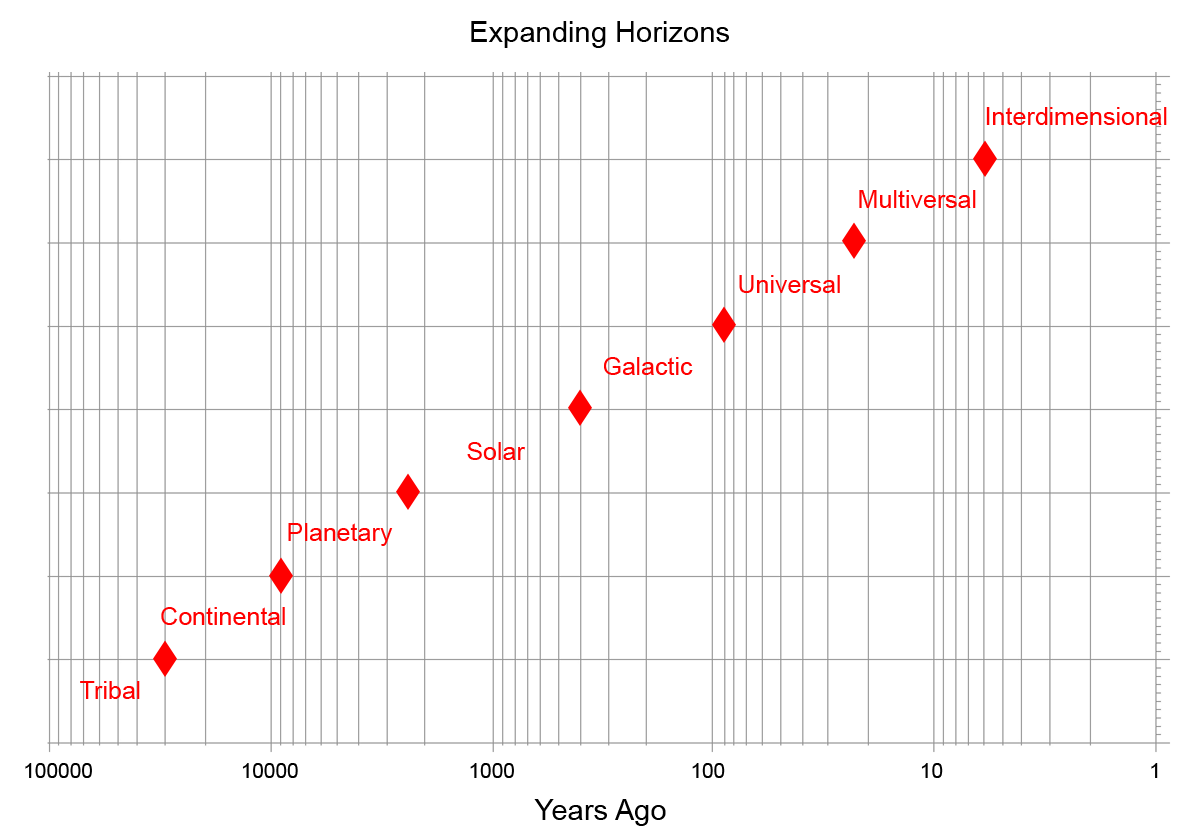
I sense one of those feelings of acceleration with the respect to the entire concept of expanding horizons, as if our understanding of “all that there is” is growing exponentially.  I was curious to see how exponential it actually was, so I took the liberty of plotting each discrete step in our evolution of awareness of “all that there is” on a logarithmic plot and guess what?

Almost perfectly exponential! (see below)

horizons

Dramatically, the trend points to a new expansion of our horizons in the past 10 years or so.  Could there really be a something beyond a multiverse of infinitely parallel universes?  And has such a concept recently been put forth?

Indeed there is and it has.  And, strangely, it isn’t even something new.  For millennia, the spiritual side of humanity has explored non-physical realities; Shamanism, Heaven, Nirvana, Mystical Experiences, Astral Travel.  Our Western scientific mentality that “nothing can exist that cannot be consistently and reliably reproduced in a lab” has prevented many of us from accepting these notions.  However, there is a new school of thought that is based on logic, scientific studies, and real data (if your mind is open), as well as personal knowledge and experience.  Call it digital physics (Fredkin), digital philosophy, simulation theory (Bostrom), programmed reality (yours truly), or My Big TOE (Campbell).  Tom Campbell and others have taken the step of incorporating into this philosophy the idea of non-material realms.  Which is, in fact, a new expansion of “all that there is.”  While I don’t particularly like the term “dimensional”, I’m not sure that we have a better descriptor.

Interdimensional Era

interdiensionalera200Or maybe we should just call it “All That There Is.”

At least until a few years from now.

Einstein Would Have Loved Programmed Reality

Aren’t we all Albert Einstein fans, in one way or another?  If it isn’t because of his 20th Century revolution in physics (relativity), or his Nobel Prize that led to that other 20th Century revolution (quantum mechanics), or his endless Twainsian witticisms, it’s his underachiever-turned-genius story, or maybe even that crazy head of hair.  For me, it’s his regular-guy sense of humor:

“The hardest thing in the world to understand is the income tax.”

and…

“Put your hand on a hot stove for a minute, and it seems like an hour. Sit with a pretty girl for an hour, and it seems like a minute. THAT’S relativity.”

Albert Einstein on a bicycle in Niels Bohr's garden

But, the more I read about Albert and learn about his views on the nature of reality, the more affinity I have with his way of thinking.  He died in 1955, hardly deep enough into the digital age to have had a chance to consider the implications of computing, AI, consciousness, and virtual reality.  Were he alive today, I suspect that he would be a fan of digital physics, digital philosophy, simulism, programmed reality – whatever you want to call it.  Consider these quotes and see if you agree:

“Reality is merely an illusion, albeit a very persistent one.”

“I wished to show that space-time isn’t necessarily something to which one can ascribe a separate existence, independently of the actual objects of physical reality. Physical objects are not in space, but these object are spatially extended. In this way the concept of ’empty space’ loses its meaning.”

As far as the laws of mathematics refer to reality, they are uncertain; and as far as they are certain, they do not refer to reality.”

“A human being is part of a whole, called by us the ‘Universe’ —a part limited in time and space. He experiences himself, his thoughts, and feelings, as something separated from the rest—a kind of optical delusion of his consciousness. This delusion is a kind of prison for us, restricting us to our personal desires and to affection for a few persons nearest us. Our task must be to free ourselves from this prison by widening our circles of compassion to embrace all living creatures and the whole of nature in its beauty.”

“Space does not have an independent existence.”

“Hence it is clear that the space of physics is not, in the last analysis, anything given in nature or independent of human thought.  It is a function of our conceptual scheme [mind].”

 “Every one who is seriously involved in the pursuit of science becomes convinced that a spirit is manifest in the laws of the Universe-a spirit vastly superior to that of man, and one in the face of which we with our modest powers must feel humble.”

I can only imagine the insights that Albert would have had into the mysteries of the universe, had he lived well into the computer age.  It would have given him an entirely different perspective on that conundrum that puzzled him throughout his later life – the relationship of consciousness to reality.  And he might have even tossed out the Unified Field Theory that he was forever chasing and settled in on something that looked a little more digital.


Bizarro Physics

All sorts of oddities emerge from equations that we have developed to describe reality.  What is surprising is that rather than being simply mathematical artifacts, they actually show up in our physical world.

Perhaps the first such bizarro (see DC Comics) entity was antimatter; matter with an opposite charge and spin.  A mathematical solution to Paul Dirac’s relativistic version of Schrödinger’s equation (it makes my head hurt just looking at it), antimatter was discovered 4 years after Dirac predicted it.

One of last year’s surprises was the negative frequencies that are solutions to Maxwell’s equations and have been shown to reveal themselves in components of light.

And, earlier this month, German physicists announced the ability to create a temperature below absolute zero.

So when we were told in physics class to throw out those “negative” solutions to equations because they were in the imaginary domain, and therefore had no basis in reality…uh, not so fast.

What I find interesting about these discoveries is the implications for the bigger picture.  If our reality were what most of us think it is – 3 dimensions of space, with matter and energy following the rules set forth by the “real” solutions to the equations of physics – one might say that reality trumps the math; that solutions to equations only make sense in the context of describing reality.

However, it appears to be the other way around – math trumps reality.  Solutions to equations previously thought to be in the “imaginary domain” are now being shown to manifest in our reality.

This is one more category of evidence that underlying our apparent reality are data and rules.  The data and rules don’t manifest from the reality; they create the reality.

Bizarro185 antimatter185