I shall attempt to summarize and synthesize the key concepts and drivers that may lead us to extinction, as well as those that may mitigate the specter of extinction and instead lead toward stabilization and perhaps even, an AI utopia. First, the dark side…
DRIVERS TOWARD EXTINCTION
Competition – If there were only one source of AI development in the world, it might be possible to evolve it so carefully that disastrous consequences could be avoided. However, as our world is fragmented by country and by company, there will always be competition driving the pace of AI evolution. In the language of the 1950’s, countries will be worried about avoiding or closing an “AI gap” with an enemy and companies will be worried about grabbing market share from other companies. This results in sacrificing caution for speed and results, which inevitably leads to dangerous short cuts.
Self-Hacking/Specification Gaming – All of the existential risk in AI is due to the unpredictability mechanisms described in Part 2, specifically the neural nets driving AI behavior, and the resultant possibilities of rewriting its own code. Therefore, as long as AI architecture is based on the highly complex neural net construct, we will not be able to avoid this apparent nondeterminism. More to the point, it is difficult to envision any kind of software construct that facilitates effective learning that is not a highly complex adaptive system.
The Orthogonality Thesis – Nick Bostrom’s concept asserts that intelligence and the final goals of an AI are completely independent of each other. This has the result that mere intelligence cannot be assumed to make decisions that minimize the existential risk to humanity. We can program in as many rules, goals, and values as we want, but can never be sure that we didn’t miss something (see clear examples in Part 7). Further, making the anthropomorphism mistake of thinking that an AI will think like us is our blind spot.
Weaponization / Rogue Entities – As with any advanced technology, weaponization is a real possibility. And the danger is not only the hands of so-called rogue entities, but also so-called “well meaning” entities (any country’s military complex) claiming that the best defense is having the best offense. As with the nuclear experience, all it takes is a breakdown in communication to unleash the weapon’s power.
Sandbox Testing Ineffective – The combined ability of an AI to learn and master social engineering, hide its intentions, and control physical and financial resources makes any kind of sandboxing a temporary stop-gap at best. Imagine, for example, an attempt to “air gap” an AGI to prevent it from taking over resources available on the internet. What lab assistant making $20/hour is going to resist an offer from the AGI to temporarily connect it to the outside network in return for $1 billion in crypto delivered to the lab assistant’s wallet?
Only Get 1 Chance – There isn’t a reset button on AI that gets out of control. So, even if you did the most optimal job at alignment and goal setting, there is ZERO room for error. Microsoft generates 30,000 bugs per month – what are the odds that everyone’s AGI will have zero?
And the mitigating factors…
DRIVERS TOWARD STABILIZATION
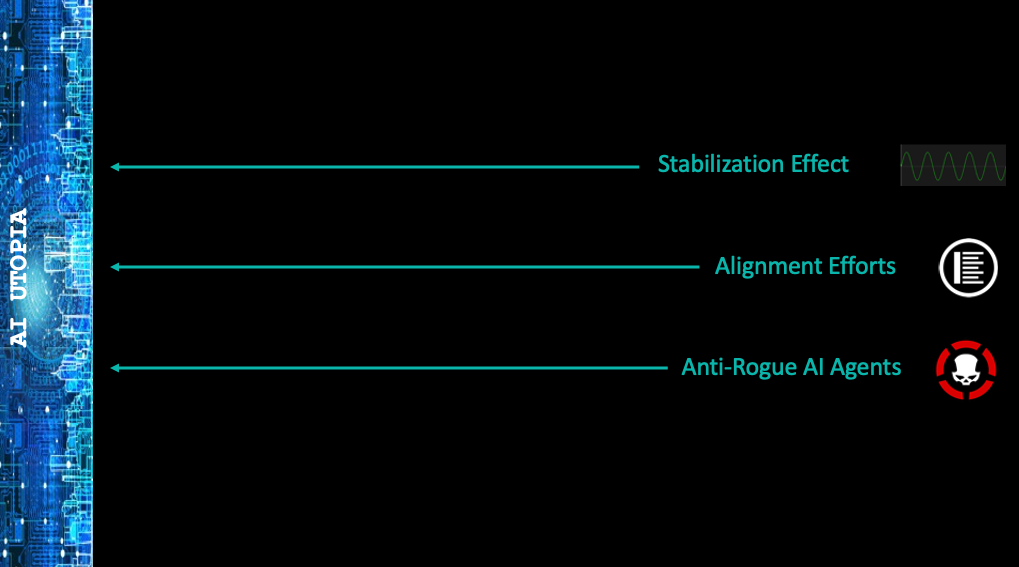
Anti-Rogue AI Agents – Much like computer viruses and the cybersecurity and anti-virus technology that we developed to fight them, which has been fairly effective, anti-rogue AI agents may be developed that are out there on the lookout for dangerous rogue AGIs, and perhaps programmed to defeat them, stunt them, or at least provide notification that they exist. I don’t see many people talking about this kind of technology yet, but I suspect it will become an important part of the effort to fight off an AI apocalypse. One thing that we have learned from cybersecurity is that the battle between the good guys and the bad guys is fairly lopsided. It is estimated that there are millions of blocked cyberattack attempts daily around the world, and yet we rarely hear of a significant security breach. Even considering possible underreporting of breaches, it is most likely the case that the amount of investment going into cyberdefense far exceeds that going into funding the hacks. If a similar imbalance occurs with AI (and there is ample evidence of significant alignment investment), anti-rogue AI agents may win the battle. And yet, unlike with cybersecurity, it might only take one nefarious hack to kick off the AI apocalypse.
Alignment Efforts – I detailed in Part 8 of this series the efforts that are going in to AI safety research, controls, value programming, and the general topic of addressing AI existential risk. And while these efforts my never be 100% foolproof, they are certainly better than nothing, and will most likely contribute to at least the delay of portentous ASI.
The Stabilization Effect – The arguments behind the Stabilization Effect presented in Part 9 may be difficult for some to swallow, although I submit that the more you think and investigate the topics therein, the easier it will become to accept. And frankly, this is probably our best chance at survival. Unfortunately, there isn’t anything anyone can do about it – either it’s a thing or it isn’t.
But if it is a thing, as I suspect, if ASI goes apocalyptic, the The Universal Consciousness System may reset our reality so that our consciousnesses continues to have a place to learn and evolve. And then, depending on whether or not our memories are erased, either:
This entire blog series has been about surviving an AI-based Apocalypse, a very doomsday kind of event. For some experts, this is all but inevitable. You readers may be coming to a similar conclusion.
But haven’t we heard this before? Doomsday prophesies have been around as long as… Keith Richards. The Norse Ragnarök, The Hindu prophecy of the end of times during the current age of Kaliyuga, the Zoroastrian Renovation, and of course, the Christian Armageddon. An ancient Assyrian tablet dated 2800-2500 BCE tells of corruption and unruly teenagers and prophecies that “earth is in its final days; the world is slowly deteriorating into a corrupt society that will only end with its destruction.” Fast forward to the modern era, where the Industrial Revolution was going to lead to the world’s destruction. We have since had the energy crisis, the population crisis, and the doomsday clock ticking down to nuclear armageddon. None of it ever comes to pass.
Is the AI apocalypse more of the same, or is it frighteningly different in some way? This Part 9 of the series will examine such questions and present a startling conclusion that all may be well.
THE NUCLEAR APOCALYPSE
To get a handle on the likelihood of catastrophic end times, let’s take a deep dive into the the specter of a nuclear holocaust.
It’s hard for many of us to appreciate what a frightening time it was in the 1950s, as people built fallout shelters and children regularly executed duck and cover drills in the classrooms.
Often considered to be the most dangerous point of the cold war, the 1962 Cuban Missile Crisis was a standoff between the Soviet Union and the United States involving the deployment of Soviet missiles in Cuba. At one point the US Navy began dropping depth charges to force a nuclear-armed Soviet submarine to surface. The crew on the sub, having had no radio communication with the outside world didn’t know if war was breaking out or not. The captain, Valentin Savitsky, wanted to launch a nuclear weapon, but a unanimous decision among the three top officers was required for launch. Vasily Arkhipov, the second in command, was the sole dissenting vote and even got into an argument with the other two officers. His courage effectively prevented the nuclear war that was likely to result. Thomas S Blanton, later the director of the US National Security Archive called Arkhipov “the man who saved the world.”
But that wasn’t the only time we were a hair’s breadth away from the nuclear apocalypse.
On May 23, 1967, US military commanders issued a high alert due to what appeared to be jammed missile detection radars in Alaska, Greenland, and the UK. Considered to be an act of war, they authorized preparations for war, including the deployment of aircraft armed with nuclear weapons. Fortunately, a NORAD solar forecaster identified the reason for the jammed radar – a massive solar storm.
Then, on the other side of the red curtain, on 26 September 1983, with international tensions still high after the recent Soviet military shoot down of Korean Air Lines Flight 007, a nuclear early-warning system in Moscow reported that 5 ICBMs (intercontinental ballistic missiles) had been launched from the US. Lieutenant colonel Stanislav Petrov was the duty officer at the command center and suspected a false alarm, so he awaited confirmation before reporting, thereby disobeying Soviet protocol. He later said that had he not been on the shift at that time, his colleagues would have reported the missile launch, likely triggering a nuclear war.
In fact, over the years there have been at least 21 nuclear war close calls, any of which could easily led to a nuclear conflagration and the destruction of humanity. The following timeline, courtesy of the Future of Life Institute, shows how many occurred in just the 30-year period from 1958 to 1988.
It kinds of makes you wonder what else could go wrong…
END OF SOCIETY PREDICTED
Another modern age apocalyptic fear was driven by the recognition that exponential growth and limited resources are ultimately incompatible. At the time, the world population was growing exponentially and important resources like oil and arable land were being depleted. The Rockefeller Foundation partnered with the OECD (Organization for Economic Cooperation and Development) to form The Club of Rome, a group of current and former heads of state, scientists, economists, and business leaders to discuss the problem and potential solutions. In 1972, with the support of computational modeling from MIT, they issued their first report, The Limits to Growth, which painted a bleak picture of the world’s future. Some of the predictions (and their ultimate outcomes) follow:
Another source for this scare was the book The Population Bomb by Stanford biologist Paul Ehrlich. He and people like Harvard biologist George Wald also made some dire predictions…
“Unless we are extremely lucky, everyone will disappear in a cloud of blue steam in 20 years.” (New York Times, 1969)
“UN official says rising seas to ‘obliterate nations’ by 2000.” (Associated Press, 1989)
“Britain will Be Siberian in less than 20 years” (The Guardian, 2004)
“Scientist Predicts a New Ice Age by 21th Century” (Boston Globe, 1970)
“NASA scientist says we’re toast. In 5-10 years, the arctic will be ice free.” (Associated Press, 2008)
Y2K
And who could forget this apocalyptic gem…
My intent is not to cherry pick the poor predictions and make fun of them. It is simply that when we are swimming in the sea of impending doom, it is really hard to see the way out. And yet, there does always seem to be a way out.
Sometimes it is mathematical. For example, there was a mathematical determination of when we would run out of oil based on known supply and rate of usage, perhaps factoring in the trend of increase in rate of usage. But what were not factored into the equation were the counter effects of the rate of new reserves being discovered and the improvements in engine efficiencies. One could argue that in the latter case, the scare achieved its purpose, just as the fear of global warming has resulted in a number of new environmental policies and laws, such as California’s upcoming ban on gasoline powered vehicles in 2035. However, that isn’t always the case. Many natural resources, for instance, seem to actually be increasing in supply. I am not necessarily arguing for something like the abiotic oil theory. However, at the macro level, doesn’t it sometimes feel like a game of civilization, where we are given a set of resources, cause and effect interrelationships, and ability to acquire certain skills. In the video game, when we fail on an apocalyptic level, we simply hit the reset button and start over. But in real life we can’t do that. Yet, doesn’t it seem like the “game makers” always hand us a way out, such as unheard of new technologies that are seemingly suddenly enabled? And it isn’t always human ingenuity that saves us? Sometimes, the right person is on duty at the perfect time against all odds. Sometimes, oil fields magically replenish on their own. Sometimes asteroids strike the most remote place on the planet.
THE STABILIZATION EFFECT
In fact, it seems statistically significant that apocalypses, while seemingly imminent, NEVER really occur. So much so that I decided to model it with a spreadsheet using random number generation (also demonstrating how weak my programming skills have gotten). The intent of the model is to encapsulate the state of humanity on a simple timeline using a parameter called “Mood” for lack of a better term. We start at a point in society that is neither euphoric (the Roaring Twenties) nor disastrous (the Great Depression). As time progresses, events occur that push the Mood in one direction or the other, with a 50/50 chance of either occurring. The assumption in this model is that no matter what the Mood is, it can still get better or worse with equal probability. Each of the following graphs depicts a randomly generated timeline.
On the graph are two thresholds – one of a positive nature, where things seemingly can’t get much better, and one of a negative nature, whereby all it should take is a nudge to send us down the path to disaster. In any of the situations we’ve discussed in this part of the series, when we are on the brink of apocalypse, the statistical likelihood that the situation would improve at that point should not be more than 50/50. If true, running a few simulations shows that an apocalypse is actually fairly likely. Figures 1 and 3 pop over the positive limit and then turn back toward neutral. Figure 2 seems to take off in the positive direction even after passing the limit. Figure 4 hits and goes through the negative limit several times, implying that if our reality actually worked this way, apocalyptic situations would actually be likely.
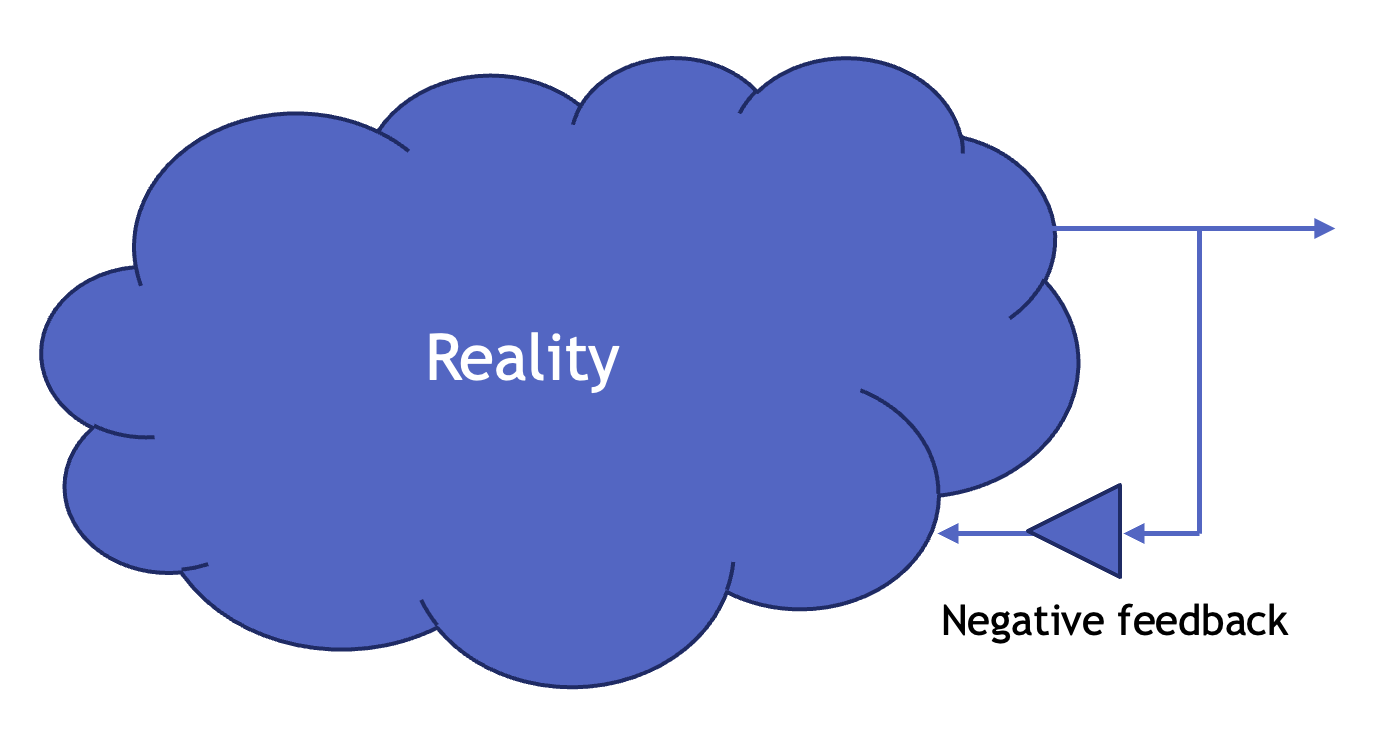
However, what always seems to happen is that when things get that bad, there is a stabilizing force of some sort. I made an adjustment to my reality model by inserting some negative feedback to model this stabilizing effect. For those unfamiliar with the term, complex systems can have positive or negative feedback loops; often both. Negative feedback tends to bring a system back to a stable state. Examples in the body include the maintenance of body temperature and blood sugar levels. If blood sugar gets too high, the pancreas secretes insulin which chemically reduces the level. When it gets too low, the pancreas secretes glucagon which increases the level. In nature, when the temperature gets high, cloud level increases, which provides the negative feedback needed to reduce the temperature. Positive feedback loops also exist in nature. The runaway greenhouse effect is a classic example.
When I applied the negative feedback to the reality model, all curves tended to stay within the positive and negative limits, as show below.
Doesn’t it feel like this is how our reality works at the most fundamental level? But how likely would it be that every aspect of our reality is subject to negative feedback? And where does that negative feedback come from?
REALITY IS ADAPTIVE
This is how I believe that reality works at its most fundamental level…
Why would that be? Two obvious ideas come to mind.
Natural causes – this would be the viewpoint of reductionist materialist scientists. Heat increase causes ice sheets to melt which creates more water vapor, generating more clouds, reducing the heating effect of the sun. But this does not at all explain why the human condition, and the civilization trends that we’ve discussed in this article, always tend toward neutral.
God – this would be the viewpoint of people whose beliefs are firmly grounded in their religion. God is always intervening to prevent catastrophes. But apparently God doesn’t mind minor catastrophes and plenty of pain and suffering in general. More importantly though, this does not explain dynamic reality generation.
DYNAMIC REALITY GENERATION
Enter Quantum Mechanics.
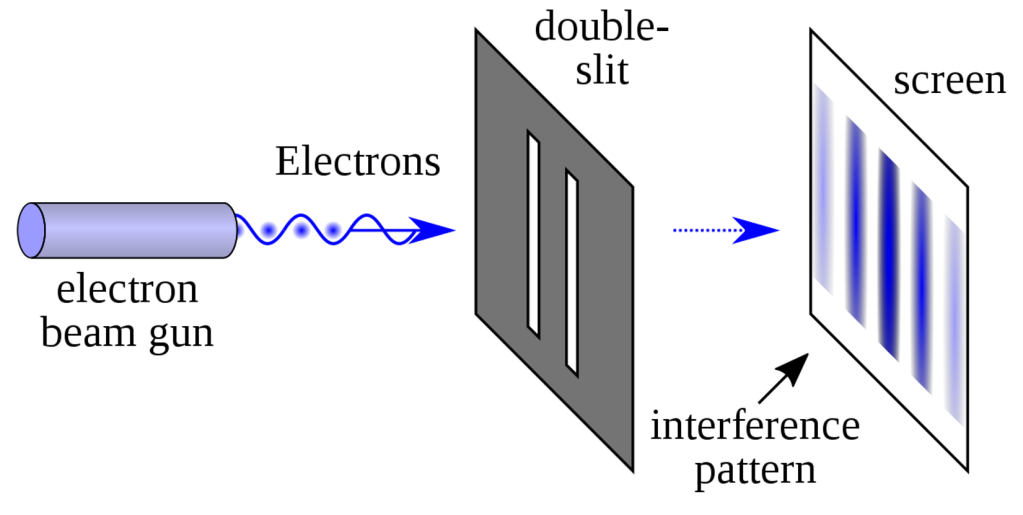
The Double-slit experiment was first done by Thomas Young back in 1801, and was an attempt to determine if light was composed of particles or waves. A beam of light was projected at a screen with two vertical slits. If light was composed of particles, only two bands of light should be on the phosphorescent screen behind the one with the slits. If wave-based, an interference pattern should result. The wave theory was initially confirmed experimentally, but that was later called into question by Einstein and others.
The experiment was later done with particles, like electrons, and it was clearly assumed that these would be shown to be hard fixed particles, generating the expected pattern shown on the right.
However, what resulted was an interference pattern, implying that the electrons were actually waves. Thinking that perhaps electrons were interfering with each other, the experiment was modified to shoot one electron at a time. And still the interference pattern slowly build up on the back screen.
To make sense of the interference pattern, experimenters wondered if they could determine which slit each electron went through, so they put a detector before the double list. Et voila, the interference pattern disappeared! It was as if the actual conscious act of observation converted the electrons from waves to particles. The common interpretation was that the electrons actual exist only a probability function and the observation actually snaps them into existence.
It is very much like the old adage that a tree falling in the woods makes no sound unless someone is there to see it. Of course, this idea of putting consciousness as a parameter in the equations of physics generated no end of consternation for the deterministic materialists. They have spent the last twenty years designing experiments to disprove this “Observer Effect” to no avail. Even when the “which way” detector is place after the double slit, the interference pattern disappears. The only tenable conclusion is that reality does not exist in an objective manner and its instantiation depends on something. But what?
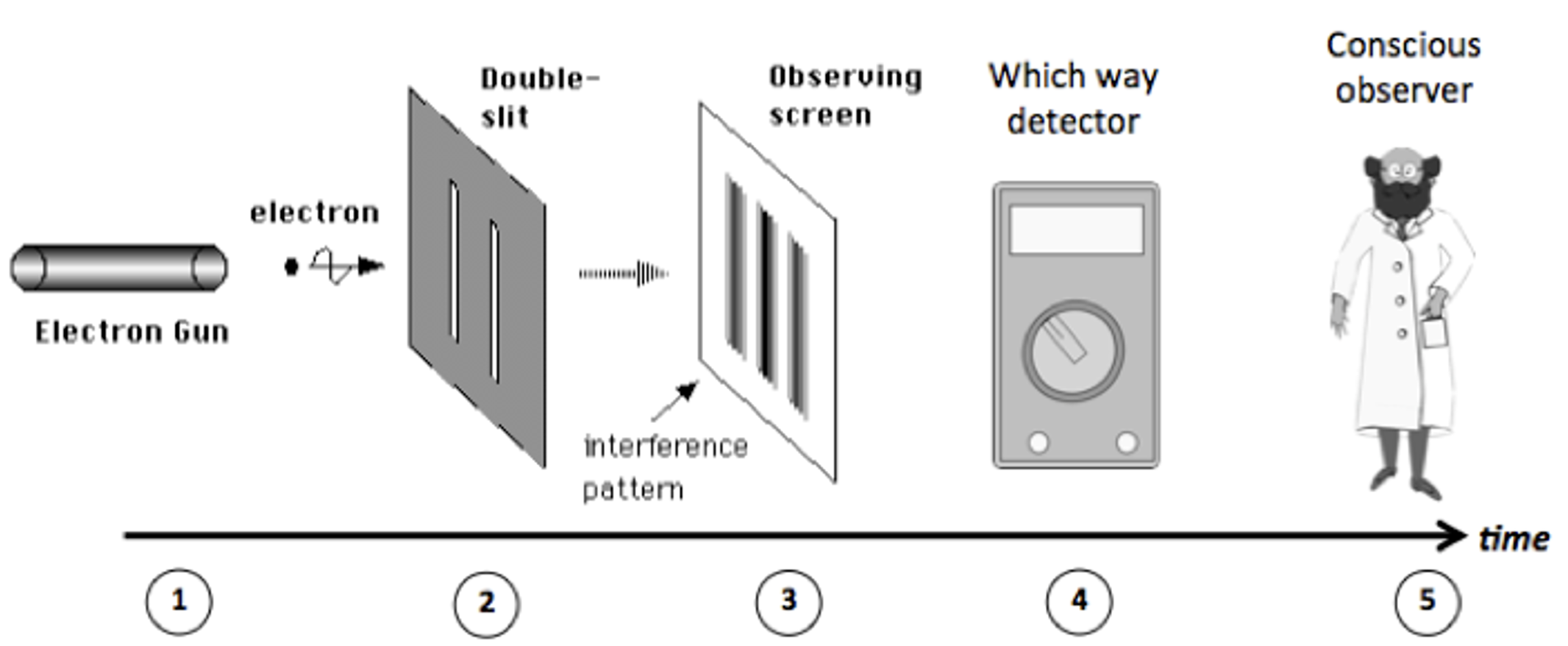
The diagram below helps us visualize the possibilities. When does reality come into existence?
Clearly it is not at points 1, 2 or 3, because it isn’t until the “which way” detector is installed that we see the shift in reality. So is it due to the detector itself or the conscious observer reading the results of the detector. One could image experiments where the results of the “which way” detector are hidden from the conscious observer for an arbitrary period of time; maybe printed out and put in an envelope without looking, where it sits on the shelf for a day while the interference pattern exists. And someone opens the envelope and suddenly the interference pattern disappears. I have always suspected that the answer will be that reality comes into existence at point 4. I believe that it is just logical that a reality generating universe be efficient. Recent experiments bear this out.
I believe this says something incredibly fundamental about the nature of our reality. But what would efficiency have to do with the nature of reality? Let’s explore a little further – what kinds of efficiencies would this lead to?
POP QUIZ! – is reality analog or digital? There is actually no conclusion to this question and many papers have been written in support of either point of view. But if our reality is created on some sort of underlying construct, there is only one answer – it has to be digital. Here’s why…
How much information would it take to fully describe the cup of coffee on the right?
In an analog reality, it would take an infinite amount of information.
In a digital reality, fully modeled at the Planck resolution (what some people think is the deepest possible digital resolution), it would require 4*1071 bits/second give or take. It’s a huge number for sure, but infinitely less than the analog case.
But wait a minute. Why would we need that level of information to describe a simple cup of coffee? So let’s ask a different question… How much information is needed for a subjective human experience of that cup of coffee – the smell, the taste, the visual experience. You don’t really need to know the position and momentum vector of each subatomic particle in each molecule of coffee in that cup. All you need to know is what it takes to experience it. The answer is roughly 1*109 bits/second. In other words, there could be as much as a 4*1062 factor of compression involved in generating a subjective experience. In other words, we don’t really need to know where each electron is in the coffee, just as you don’t need to know which slit each electron goes through in the double slit experiment. That is, UNTIL YOU MEASURE IT!
So, the baffling results of the double slit experiments actually make complete sense if reality is:
Digital
Compressed
Dynamically generated to meet the needs of the inhabitants of that reality
Sounds computational doesn’t it? In fact, if reality were a computational system, it would make sense for it to need to have efficiencies at this level.
There are such systems – one well known example is a video game called No Man’s Sky that dynamically generates its universe as the user plays the game. Art inadvertently imitating life?
Earlier in this article I suggested that the concept of God could explain the stabilization effect of our reality. If we redefine “God” to mean “All That There Is” (of which, our apparent physical reality is only a part), reality becomes a “learning lab” that needs to be stable for our consciousnesses to interact virtually.
I wrote about this and proposed this model back in 2007 in my first book “The Universe-Solved!.” In 2021, an impressive set of physicists and technologists came up with the same theory, which they called “The Autodidactic Universe.” They collaborated to explore methods, structures, and topologies in which the universe might be learning and modifying its laws according to what is needed. Such ideas included neural nets and Restricted Boltzman Machines. This provides an entirely different way of looking at any potential apocalypse. And it make you wonder…
UFO INTERVENTION
In 2021, over one hundred military personnel, including Retired Air Force Captain Robert Salas, Retired First Lieutenant Robert Jacobs, and Retired Captain David Schindele met at the National Press Club in Washington, DC to present historical case evidence that UFOs have been involved with disarming nuclear missiles. A few examples…
Malmstrom Air Force Base, Montana, 1967 – “a large glowing, pulsating red oval-shaped object hovering over the front gate,” as alarms went off showing nearly all 10 missiles shown in the control room had been disabled.
Minot Air Force Base, North Dakota, 1966 – Eight airmen said that 10 missiles at silos in the vicinity all went down with guidance and control malfunctions when an 80- to 100-foot wide flying object with bright flashing lights had hovered over the site.
Vandenberg Air Force Base, California, 1964 – “It went around the top of the warhead, fired a beam of light down on the top of the warhead.” After circling, it “then flew out the frame the same way it had come in.”
Ukraine, 1982 – launch countdowns were activated for 15 seconds while a disc-shaped UFO hovered above the base, according to declassified KGB documents
As the History Channel reported, areas of high UFO activity are correlated with nuclear and military facilities worldwide.
Perhaps UFOs are an artifact of our physical reality learning lab, under the control of some conscious entity or possibly even an autonomous (AI) bot in the system. As part of the “autodidactic” programming mechanisms that maintain stability in our programmed reality. Other mechanisms could involve things like adjusting the availability of certain resources or even nudging consciousnesses toward solutions to problems. If this model of reality is accurate, we may find that we have little to worry about regarding an AI apocalypse. Instead it will just be another force that contributes toward our evolution.
To that end, there is also a sector of thinkers who recommend a different approach. Rather than fight the AI progression, or simply let the chips fall, we should welcome our AI overlords and merge with them. That scenario will be explored in Part 10 of this series.
Apparently your reality may be different than mine. Wait, what???
Several recent studies have demonstrated to an extremely high degree of certainty that objective reality does not exist. This year, adding to the mounting pile of evidence for a consciousness-centric reality, came the results of an experiment that for the first time, tested the highly paradoxical Wigner’s Friend thought experiment. The conclusion was that your reality and my reality can actually be different. I don’t mean different in the sense that your rods and cones have a different sensitivity, or that your brain interprets things differently, but fundamentally intrinsically different. Ultimately, things may happen in your reality that might not happen in my reality and vice versa.
Almost sounds like a dream, doesn’t it? Or like you and I are playing some kind of virtual reality game and the information stream that is coming into your senses via your headset or whatever is different that the information stream coming into mine.
Eugene Paul Wigner received the Nobel Prize for physics in 1963 for his work on quantum mechanics and the structure of the atom. More importantly perhaps, he, along with Max Planck, Neils Bohr, John Wheeler, Kurt Godel, Erwin Schrodinger, and many other forward thinking scientists and mathematicians, opposed the common materialistic worldview shared by most scientists of his day (not to mention, most scientists of today). As such, he was an inspiration for, and a forerunner of consciousness-centric philosophies, such as my Digital Consciousness, Donald Hoffman’s MUI theory, and Tom Campbell’s My Big TOE.
As if Schrodinger’s Cat wasn’t enough to bend people’s minds, Wigner raised the stakes of quantum weirdness in 1961 when he proposed a thought experiment, referred to as “Wigner’s Friend.” In the scenario are two people, let’s say Wigner and his friend. One of them is in an enclosed space, hidden to the other and observes something like Schrodinger’s cat, further hidden in a box. At the time Wigner opens the box the wave function collapses, establishing whether or not the cat is dead. But the cat is still in superposition to Wigner’s friend, outside of the entire subsystem. Only when he opens the door to see Wigner and the result of the cat experiment, does his wave function collapse. Therefore, Wigner and his friend have differing interpretations of when reality become realized; hence different realities.
Fast forward to 2019, and scientists (Massimiliano Proietti, Alexander Pickston, Francesco Graffitti, Peter Barrow, Dmytro Kundys, Cyril Branciard, Martin Ringbauer, and Alessandro Fedrizzi) at Heriot-Watt University in Edinburgh, were finally able to test the paradox using double slits, lasers, and polarizers. The results confirmed Wigner’s hypothesis to a certainty of 5 standard deviations, which essentially means that objective reality doesn’t exist, and your and my realities can differ- to a certainty of 1 in 3.5 million!
Of course, I live for this stuff, because it simply adds one more piece of supporting evidence to my theory, Digital Consciousness. And it adds yet another nail in the coffin of that ancient scientific religion, materialism.
How does it work?
Digital Consciousness asserts that consciousness is primary; hence, all that we can truly know is what we each experience subjectively. This experiment doesn’t necessarily prove that the fundamental construct of reality is information, but it is a lot more plausible that individual experiences based on virtual simulations are at the root of this paradox rather than, say, a complex violation of Hilbert space, allowing parallel realities based on traditional physical fields to intermingle. As an analogy, imagine that you are playing an MMORPG (video game with many other simultaneous players) – it isn’t difficult to see how each individual could be having a slightly different experience, based perhaps on their skill level or something. As information is the carrier of the experience, the information entering the consciousness of one player could easily be slightly different than the information entering the consciousness of another player. This is by far the simplest explanation, and by Occam’s Razor, supports my theory.
Too bad Wigner isn’t alive to see this experiment, or to ponder Digital Consciousness theory. But I’m sure his consciousness is having a good laugh.
The idea of an AI-driven Apocalypse is based on AI outpacing humanity in intelligence. The point at which that might happen depends on how fast AI evolves and how fast (or slow) humanity evolves.
In Part I of this article, I demonstrated how, given current trends in the advancement of Artificial Intelligence, any AI Apocalypse, Singularity, or what have you, is probably much further out that the transhumanists would have you believe.
In this part, we will examine the other half of the argument by considering the nature of the human mind and how it evolves. To do so, it is very instructive to consider the nature of the mind as a complex system and also the systemic nature of the environments that minds and AIs engage with, and are therefore measured by in terms of general intelligence or AGI.
David Snowden has developed a framework of categorizing systems called Cynefin. The four types of systems are:
Simple – e.g. a bicycle. A Simple system is a simple deterministic system characterized by the fact that most anyone can make decisions and solve problems regarding such systems – it takes something called inferential intuition, which we all have. If the bicycle seat is loose, everyone knows that to fix it, you must look under the seat and find the hardware that needs tightening.
Complicated – e.g. a car. Complicated systems are also deterministic systems, but unlike Simple systems, solutions to problems in this domain are not obvious and typically require analysis and/or experts to figure out what is wrong. That’s why you take your car to the mechanic and why we need software engineers to fix defects.
Complex – Complex systems, while perhaps deterministic from a philosophical point of view, are not deterministic in any practical sense. No matter how much analysis you apply and no matter how experienced the expert is, they will not be able to completely analyze and solve a problem in a complex system. That is because such systems are subject to an incredibly complex set of interactions, inputs, dependencies, and feedback paths that all change continuously. So even if you could apply sufficient resources toward analyzing the entire system, by the time you got your result, your problem state would be obsolete. Examples of complex systems include ecosystems, traffic patterns, the stock market, and basically every single human interaction. Complex systems are best addressed through holistic intuition, which is something that humans possess when they are very experienced in the applicable domain. Problems in complex systems are best addressed by a method called Probe-Sense-Respond, which consists of probing (doing an experiment designed intuitively), sensing (observing the results of that experiment), and responding (acting on those results by moving the system in a positive direction).
Chaotic – Chaotic systems are rarely occurring situations that are unpredictable because they are novel and therefore don’t follow any known patterns. An example would be the situation in New York City after 9/11. Responding to chaotic systems requires an even different method than with other types of systems. Typically, just taking some definitive form of action may be enough to move the system from Chaotic to Complex. The choice of action is a deeply intuitive decision that may be based on an incredibly deep, rich, and nuanced set of knowledge and experiences.
Complicated systems are ideal for early AI. Problems like the ones analyzed in Stanford’s AI Index, such as object detection, natural language parsing, language translation, speech recognition, theorem proving, and SAT solving are all Complicated systems. AI technology at the moment is focused mostly on such problems, not things in the Complex domain, which are instead best addressed by the human brain. However, as processing speed evolves, and learning algorithms evolve, AI will start addressing issues in the Complex domain. Initially, to program or guide the AI systems toward a good sense-and-respond model a human mind will be needed. Eventually perhaps, armed with vague instructions like “try intuitive experiments from a large set of creative ideas that may address the issue,” “figure out how to identify the metrics that indicate a positive result from the experiment,” “measure those metrics,” and “choose a course of action that furthers the positive direction of the quality of the system,” an AI may succeed at addressing problems in the Complex domain.
The human mind of course already has a huge head start. We are incredibly adept at seeing vague patterns, sensing the non-obvious, seeing the big picture, and drawing from collective experiences to select experiments to address complex problems.
Back to our original question, as we lead AI toward developing the skills and intuition to replicate such capabilities, will we be unable to evolve our thinking as well?
In the materialist paradigm, the brain is the limit for an evolving mind. This is why we think the AI can out evolve us, because the brain capacity is fixed. However, in “Digital Consciousness” I have presented a tremendous set of evidence that this is incorrect. In actuality, consciousness, and therefore the mind, is not emergent from the brain. Instead it exists in a deeper level of reality as shown in the Figure below.
It interacts with a separate piece of ATTI that I call the Reality Learning Lab (RLL), commonly known as “the reality we live in,” but more accurately described as our “apparent physical reality” – “apparent” because it is actually Virtual.
As discussed in my blog on creating souls, All That There Is (ATTI) has subdivided itself into components of individuated consciousness, each of which has a purpose to evolve. How it is constructed, and how the boundaries are formed that make it individuated is beyond our knowledge (at the moment).
So what then is our mind?
Simply put, it is organized information. As Tom Campbell eloquently expressed it, “The digital world, which subsumes the virtual physical world, consists only of organization – nothing else. Reality is organized bits.”
As such, what prevents it from evolving in the deeper reality of ATTI just as fast as we can evolve an AI here in the virtual reality of RLL?
Answer – NOTHING!
Don’t get hung up on the fixed complexity of the brain. All our brain is needed for is to emulate the processing mechanism that appears to handle sensory input and mental activity. By analogy, we might consider playing a virtual reality game. In this game we have an avatar and we need to interact with other players. Imagine that a key aspect of the game is the ability to throw a spear at a monster or to shoot an enemy. In our (apparent) physical reality, we would need an arm and a hand to be able to carry out that activity. But in the game, it is technically not required. Our avatar could be arm-less and when we have the need to throw something, we simply press a key sequence on the keyboard. A spear magically appears and gets hurled in the direction of the monster. Just as we don’t need a brain to be aware in our waking reality (because our consciousness is separate from RLL), we don’t need an arm to project a spear toward an enemy in the VR game.
On the other hand, having the arm on the avatar adds a great deal to the experience. For one thing, it adds complexity and meaning to the game. Pressing a key sequence does not have a lot of variability and it certainly doesn’t provide the player with much control. The ability to hit the target could be very precise, such as in the case where you simply point at the target and hit the key sequence. This is boring, requires little skill and ultimately provides no opportunity to develop a skill. On the other hand, the precision of your attack could be dependent on a random number generator, which adds complexity and variability to the game, but still doesn’t provide any opportunity to improve. Or, the precision of the attack could depend on some other nuance of the game, like secondary key sequences, or timing of key sequences, which, although providing the opportunity to develop a skill, have nothing to do with a consistent approach to throwing something. So, it is much better to have your avatar have an arm. In addition, this simply models the reality that you know, and people are comfortable with things that are familiar.
So it is with our brains. In our virtual world, the digital template that is our brain is incapable of doing anything in the “simulation” that it isn’t designed to do. The digital simulation that is the RLL must follow the rules of RLL physics much the way a “physics engine” provides the rules of RLL physics for a computer game. And these rules extend to brain function. Imagine if, in the 21st century, we had no scientific explanation for how we process sensory input or make mental decisions because there was no brain in our bodies. Would that be a “reality” that we could believe in? So, in our level of reality that we call waking reality, we need a brain.
But that brain “template” doesn’t limit the ability for our mind to evolve any more than the lack of brain or central nervous system prevents a collection of single celled organisms called a slime mold from actually learning.
In fact, there is some good evidence for the idea that our minds are evolving as rapidly as technology. Spiral Dynamics is a model of the evolution of values and culture that can be applied to individuals, institutions, and all of humanity. The figure below depicts a very high level overview of the stages, or memes, depicted by the model.
Each of these stages represents a shift in values, culture, and thinking, as compared to the previous. Given that it is the human mind that drives these changes, it is fair to say that the progression models the evolution of the human mind. As can be seen by the timeframes associated with the first appearance of each stage of humanity, this is an exponential progression. In fact, this is the same kind of progression that Transhumanists used to prove exponential progression of technology and AI. This exponential progression of mind would seem to defy the logic that our minds, if based on fixed neurological wiring, are incapable of exponential development.
And so, higher level conscious thought and logic can easily evolve in the human mind in the truer reality, which may very well keep us ahead of the AI that we are creating in our little virtual reality. The trick is in letting go of our limiting assumptions that it cannot be done, and developing protocols for mental evolution.
So, maybe hold off on buying those front row tickets to the Singularity.
Stephen Hawking once warned that “the development of full artificial intelligence could spell the end of the human race.” He went on to explain that AI will “take off on its own and redesign itself at an ever-increasing rate,” while “humans, who are limited by slow biological evolution, couldn’t compete and would be superseded.” He is certainly not alone in his thinking, as Elon Musk, for example, cautions that “With artificial intelligence we are summoning the demon.”
In fact, this is a common theme not only in Hollywood, but also between two prominent groups of philosophers and futurists. One point of view is that Artificial General Intelligence (AGI) will become superintelligent and beyond the control of humans, resulting in all sorts of extinction scenarios (think SkyNet or Grey Goo). The (slightly) more optimistic point of view, held by the transhumanists, is that humanity will merge with advanced AI and form superhumans. So, while biological dumb humanity may go the way of the dodo bird, the new form of human-machine hybrid will continue to advance and rule the universe. By the way, this is supposed to happen around 2045, according to Ray Kurzweil in his 2005 book “The Singularity is Near.”
There are actually plenty of logical and philosophical arguments against these ideas, but this blog is going to focus on something different – the nature of the human mind.
The standard theory is that humans cannot evolve their minds particularly quickly due to the assumption that we are limited by the wiring in our brains. AI, on the other hand, has no such limitations and, via recursive self-improvement, will evolve at a runaway exponential rate, making it inevitable to take over humans at some point in terms of intelligence.
But does this even make sense? Let’s examine both assumptions.
The first assumption is that AI advancements will continue at an exponential pace. This is short-sighted IMHO. Most exponential processes run into negative feedback effects that eventually dampen the acceleration. For example, exponential population growth occurs in bacterial colonies until the environment reaches its carrying capacity and then it levels off. We simply don’t know what the “carrying capacity” is of an AI. In an analogous manner, it has to run in some environment, which may run out of memory, power, or other resources at some point. Moore’s Law, the idea that transistor density doubles every two years, has been applied to many other technology advances, such as CPU speed and networking bit rates, and is the cornerstone of the logic behind the Singularity. However, difficulties in heat dissipation have now slowed down the rate of advances in CPU speed, and Moore’s Law no longer applies. Transistor density is also hitting its limit as transistor junctions are now only a few atoms thick. Paul Allen argues, in his article “The Singularity Isn’t Near,” that the kinds of learning required to move AI ahead do not occur at exponential rates, but rather in an irregular and unpredictable manner. As things get more complex, progress tends to slow, an effect he calls the Complexity Brake.
Let’s look at one example. Deep Blue beat Garry Kasparov in a game in 1996, the first time a machine beat a world Chess champion. Google’s AlphaGo beat a grandmaster at Go for the first time in 2016. In those 20 years, there are 10 2-year doubling cycles in Moore’s Law, which would imply that, if AI were advancing exponentially, the “intelligence” needed to beat a Go master is 1000 times more than the intelligence needed to beat a Chess master. Obviously this is ridiculous. While Go is theoretically a more complex game than Chess because it has many more possible moves, an argument could be made that the intellect and mastery required to become the world champion at each game is roughly the same. So, while the advances in processing speed and algorithmic development (Deep Blue used a brute force algorithm, while AlphaGo did more pattern recognition) were substantial between 1996 and 2016, they don’t really show much advance in “intelligence.”
It would also be insightful to examine some real estimates of AI trends. For some well-researched data, consider Stanford University’s AI Index. Created and launched as a project at Stanford University, the AI Index is an “open, not-for-profit project to track activity and progress in AI.” In their 2017 report, they identify metrics for the progress made in several areas of Artificial Intelligence, such as object detection, natural language parsing, language translation, speech recognition, theorem proving, and SAT solving. For each of the categories for which there is at least 8 years of data, I normalized the AI performance and calculated the improvements over time and averaged the results (note: I was even careful to invert the data – for example, for a pattern recognition algorithm to improve from 90% accuracy to 95%, this is not a 5% improvement; it is actually a 100% improvement in the ability to reject false positives). The chart below shows that AI is not advancing nearly as quickly as Moore’s Law.
Figure 1 – Advancing Artificial Intelligence
In fact, the doubling period is about 6 years instead of 2, which would suggest that we need 3 times as long before hitting the Singularity as compared to Kurzweil’s prediction. Since the 2045 projection for the Singularity occurred in 2005, this would say that we wouldn’t really see it until 2125. That’s assuming that we keep pace with the current rate of growth of AI, and don’t even hit Paul Allen’s Complexity Brake. So, chances are it is much further off than that. (As an aside, according to some futurists, Ray does not have a particularly great success rate for his predictions, even ones that are only 10 years out.
But a lot can happen in 120 years. Unexpected, discontinuous jumps in technology can accelerate the process. Social, economic, and political factors can severely slow it down. Recall how in just 10 years in the 1960s, we figured out how to land a man on the moon. Given the rate at which we were advancing our space technology and applying Moore’s Law (which was in effect at that time), it would not have been unreasonable to expect a manned mission to Mars by 1980. In fact Werner von Braun, the leader of the American rocket team, predicted after the moon landing that we would be on Mars in the early 1980s. But in the wake of the Vietnam debacle, public support for additional investment in NASA waned and the entire space program took a drastic turn. Such factors are probably even more impactful to the future of AI than the limitations of Moore’s Law.
The second assumption we need to examine is that the capacity of the human mind is limited by the complexity of the human brain, and is therefore relatively fixed. We will do that in Part II of this article.
A recent quantum mechanics experiment, conducted at the University of Queensland in Australia, seems to defy causal order, baffling scientists. In this post however, I’ll explain why this isn’t anomalous at all; at least, if you come to accept the Digital Consciousness Theory (DCT) of reality. It boils down to a virtually identical explanation that I gave seven years ago to Daryl Bem’s seemingly anomalous precognition studies.
DCT says that subatomic particles are controlled by finite state machines (FSMs), which are tiny components of our Reality Learning Lab (RLL, aka “reality”). These finite state machines that control the behavior of the atoms or photons in the experiment don’t really come into existence until the measurement is made, which effectively means that the atom or photon doesn’t really exist until it needs to. In RLL, the portion of the system that needs to describe the operation of the laser, the prisms, and the mirrors, at least from the perspective of the observer, is defined and running, but only at a macroscopic level. It only needs to show the observer the things that are consistent with the expected performance of those components and the RLL laws of physics. So, for example, we can see the laser beam. But only when we need to determine something at a deeper level, like the path of a particular photon, is a finite state machine for that proton instantiated. And in these retrocausality experiments, like the delayed choice quantum eraser experiments, and this one done in Queensland, the FSMs only start when the observation is made, which is after the photon has gone through the apparatus; hence, it never really had a path. It didn’t need to. The path can be inferred later by measurement, but it is incorrect to think that that inference was objective reality. There was no path, and so there was no real deterministic order of operation.
There are only the attributes of the photon determined at measurement time, when its finite state machine comes into existence. Again, the photon is just data, described by the attributes of the finite state machine, so this makes complete sense. Programmatically, the FSM did not exist before the individuated consciousness required a measurement because it didn’t need to. Therefore, the inference of “which operation came first” is only that – an inference, not a true history.
So what is really going on? There are at least three options:
1. Evidence is rewritten after the fact. In other words, after the photons pass through the experimental apparatus, the System goes back and rewrites all records of the results, so as to create the non-causal anomaly. Those records consist of the experimenters memories, as well as any written or recorded artifacts. Since the System is in control of all of these items, the complete record of the past can be changed, and no one would ever know.
2. The System selects the operations to match the results, so as to generate the non-causal anomaly.
3. We live in an Observer-created reality and the entire sequence of events is either planned out or influenced by intent, and then just played out by the experimenter and students.
The point is that it requires a computational system to generate such anomalies; not the deterministic materialistic continuous system that mainstream science has taught us that we live in.
OMG can anyone write an article on the simulation hypothesis without focusing on Nick Bostrom and Elon Musk? It’s like writing an article about climate change and only mentioning Al Gore.
Dear journalists who are trying to be edgy and write about cool fringe theories, please pay attention. The idea that we might be living in an illusory world is not novel. Chinese philosopher Zhuangzi wrote about it with his butterfly dream in 369 BC. Plato discussed his cave allegory in 380 BC. The other aspect of simulation theory, the idea that the world is discrete or digital, is equally ancient. Plato and Democritous considered atoms, and therefore the fundamental constructs of reality, to be discrete.
I’m not taking anything away from Nick Bostrom, who is a very intelligent modern philosopher. His 2001 Simulation Argument is certainly thought provoking and deserves its place in the annals of digital philosophy. But it was predated by “The Matrix”. Which was predated by Philip K. Dick’s pronouncement in 1977 that we might be living in a computer-programmed reality. Which was predated by Konrad Zuse’s 1969 work on discrete reality, “Calculating Space.”
And as interesting as Bostrom’s Simulation Argument is, it was a 12-page paper on a single idea. Since then, he has not really evolved his thinking on digital philosophy, preferring instead to concentrate on existential risk and the future of humanity.
Nor am I taking anything away from Elon Musk, a brilliant entrepreneur who latched onto Bostrom’s idea for a few minutes, generated a couple sound bites, and then it was back to solar panels and hyperloops.
But Bostrom, Musk, and the tired old posthuman-generated simulation hypothesis is all that the rank and file of journalists seem to know to write about. It is really sad, considering that Tom Campbell wrote an 800-page treatise on the computational nature of reality. I have written two books on the subject. Both of our material is largely consistent and has evolved the thinking far beyond the idea that we live in a posthuman-generated simulation. In fact, I provide a great deal of evidence that the Bostrom-esque possibility is actually not very likely. And Brian Whitworth has a 10-year legacy of provocative scientific papers on evidence for a programmed reality that are far beyond the speculations of Musk and Bostrom.
The world need to know about these things and Campbell, Whitworth, and I can’t force people to read our books, blogs, and papers. So journalists, with all due respect, please up your simulation game.
There is something fascinating going on in the world, hidden deep beneath the noise of Trump, soccer matches, and Game of Thrones. It is an exploration into the nature of reality – what is making the world tick?
To cut to the chase, it appears that our reality is being dynamically generated based on an ultra-sophisticated algorithm that takes into account not just the usual cause/effect context (as materialists believe), and conscious observation and intent (as idealists believe), but also a complex array of reality configuration probabilities so as to be optimally efficient.
Wait, what?
This philosophical journey has its origins in the well-known double slit experiment, originally done by Thomas Young in 1801 to determine that light had wavelike properties. In 1961, the experiment was performed with electrons, which also showed wavelike properties. The experimental setup involved shooting electrons through a screen containing two thin vertical slits. The wave nature of the particles was manifested in the form of an interference pattern on a screen that was placed on the other side of the double slit screen. It was a curious result but confirmed quantum theory. In 1974, the experiment was performed one electron at a time, with the same resulting interference pattern, which showed that it was not the electrons that interfered with each other, but rather a probabilistic spatial distribution function that was followed by the pattern on the screen. Quantum theory predicted that if a detector was placed at each of the slits so as to determine which slit each electron would go through, the interference pattern would disappear and just leave two vertical lines, due to the quantum complementarity principle. This was difficult to create in the lab, but experiments in the 1980s confirmed expectations – that the “which way did the particle go” measurement killed the interference pattern. The mystery was that the mere act of observation seemed to change the results of the experiment.
So, at this point, people who were interested in how the universe works effectively split into two camps, representing two fundamental philosophies that set the foundation for thinking, analysis, hypothesis, and theorizing:
A zillion web pages can be found for each category.
The problem is that most scientists, and probably at least 99% of all outspoken science trolls believe in Materialism. And “believe” is the operative word. Because there is ZERO proof that Materialism is correct. Nor is there proof that Idealism is correct. So, “believe” is all that can be done. Although, as the massive amount of evidence leans in favor of Idealism, it is fair to say that those believers at least have the scientific method behind them, whereas materialists just have “well gosh, it sure seems like we live in a deterministic world.” What is interesting is that Materialism can be falsified, but I’m not sure that Idealism can be. The Materialist camp had plenty of theories to explain the paradox of the double slit experiments – alternative interpretations of quantum mechanics, local hidden variables, non-local hidden variables, a variety of loopholes, or simply the notion that the detector took energy from the particles and impacted the results of the experiment (as has been said, when you put a thermometer in a glass of water, you aren’t measuring the temperature of the water, you are measuring the temperature of the water with a thermometer in it.)
Over the years, the double-slit experiment has been progressively refined to the point where most of the materialistic arguments have been eliminated. For example, there is now the delayed choice quantum eraser experiment, which puts the “which way” detectors after the interference screen, making it impossible for the detector to physically interfere with the outcome of the experiment. And, one by one, all of the hidden variable possibilities and loopholes have been disproven. In 2015, several experiments were performed independently that closed all loopholes simultaneously with both photons and electrons. Since all of these various experimental tests over the years have shown that objective realism is false and non-local given the experimenters choices, the only other explanation could be what John Bell called Super-determinism, a universe completely devoid of free will, running like clockwork playing out a fully predetermined script of events. If true, this would bring about the extremely odd result that the universe is set up to ensure that the outcomes of these experiments imply the opposite to how the universe really works. But I digress…
The net result is that Materialism-based theories on reality are being chipped away experiment by experiment. Those that believe in Materialist dogma are finding themselves being painted into an ever-shrinking philosophical corner. But Idealism-based theories are huge with possibilities, very few of which have been falsified experimentally.
Physicist and fellow digital philosopher, Tom Campbell, has boldly suggested a number of double slit experiments that can probe the nature of reality a little deeper. Tom, like me, believes that consciousness plays a key role in the nature of and creation of our reality. So much so that he believes that the outcome of the double slit experiments is due strictly to the conscious observation of the which-way detector data. In other words, if no human (or “sufficiently conscious” entity) observes the data, the interference pattern should remain. Theoretically, one could save the data to a file, store the file on a disk, hide the disk in a box and the interference pattern would remain on the screen. Open the box a day later and the interference pattern should automatically disappear, effectively rewriting history with the knowledge of the paths of the particles. His ideas have incurred the wrath of the physics trolls, who are quick to point out that regardless of the fact that humans ever read the data, the interference pattern is gone if the detectors record the data. The data can be destroyed, or not even written to a permanent medium, and the interference pattern would be gone. If these claims are true, it does not prove Materialism at all. But it does infer something very interesting.
From this and many many other categories of evidence it is strongly likely that our reality is dynamically being generated. Quantum entanglement, quantum zeno effect, and the observer effect all look very much like artifacts of an efficient system that dynamically creates reality as needed. It is the “as needed” part of this assertion that is most interesting. I shall refer to that which creates reality as “the system.”
Entanglement happens because when a two-particle-generating event occurs, it is efficient to create two particles using the same instance of a finite state machine and, therefore, when it is needed to determine the properties of one, the properties of the other are automatically known, as detailed in my blog post on entanglement. The quantum zeno effect happens because it is more efficient to reset the probability function each time an observation is made, as detailed in my blog post on quantum zeno. And so what about the double slit mystery? To illuminate, see the diagram below.
If the physicists are right, reality comes into existence at point 4 in the diagram. Why would that be? The paths of the particles are apparently not needed for the experience of the conscious observer, but rather to satisfy the consistency of the experiment. The fact that the detector registers the data is enough to create the reality. Perhaps the system “realizes” that it is less efficient to leave hanging experiments all over the place until a human “opens the envelope” than it is to instantiate real electron paths despite the unlikely possibility of data deletion. Makes logical sense to me. But it also indicates a sophisticated awareness of all of the probabilities of how the reality can play out out vis a vis potential human interactions.
There are so many things wrong with this backwards scientific thinking, I almost don’t know where to start. But here are a few…
1. The word “disproves” doesn’t belong here. It is unscientific at best. Maybe use “evidence against one possible explanation for ghosts” – I can even begin to appreciate that. But if I can demonstrate even one potential mechanism for the paranormal that the LHC couldn’t detect, you cannot use the word “disprove.” And here is one potential mechanism – an unknown force that the LHC can’t explore because its experiments are designed to only measure interactions in the 4 forces physicists are aware of.
The smoking gun is Brian Cox’s statement “If we want some sort of pattern that carries information about our living cells to persist then we must specify precisely what medium carries that pattern and how it interacts with the matter particles out of which our bodies are made. We must, in other words, invent an extension to the Standard Model of Particle Physics that has escaped detection at the Large Hadron Collider. That’s almost inconceivable at the energy scales typical of the particle interactions in our bodies.” So, based on that statement, here are a few more problems…
2. “almost inconceivable” is logically inconsistent with the term “disproves.”
3. “If we want some sort of pattern that carries information about our living cells to persist…” is an invalid assumption. We do not need information about our cells to persist in a traditional physical medium for paranormal effects to have a way to propagate. They can propagate by a non-traditional (unknown) medium, such as an information storage mechanism operating outside of our classically observable means. Imagine telling a couple of scientists just 200 years ago about how people can communicate instantaneously via radio waves. Their response would be “no, that is impossible because our greatest measurement equipment has not revealed any mechanism that allows information to be transmitted in that manner.” Isn’t that the same thing Brian Cox is saying?
4. The underlying assumption is that we live in a materialist reality. Aside from the fact that Quantum Mechanics experiments have disproven this (and yes, I am comfortable using that word), a REAL scientist should allow for the possibility that consciousness is independent of grey matter and create experiments to support or invalidate such hypotheses. One clear possibility is the simulation argument. Out of band signaling is an obvious and easy mechanism for paranormal effects. Unfortunately, the REAL scientists (such as Anton Zeilinger) are not the ones who get most of the press.
5. “That’s almost inconceivable at the energy scales typical of the particle interactions in our bodies” is also bad logic. It assumes that we fully understand the energy scales typical of the particle interactions in our bodies. If scientific history has shown us anything, it is that there is more that we don’t understand than there is that we do.
Well, the universe is at it again, messing with our minds. Last year, I wrote a blog about the Berenstein Bears, which at that time was the most recent example of a Mandela Effect. The Mandela Effect seems to be the de facto name for the idea that something that many people remember from the past is somehow changed, or rewritten. It was named for former president of South Africa, Nelson Mandela, whom many people recall having died in a South African prison, which, history now tells us, is untrue. He died, according to all of the historical artifacts in our reality, of natural causes at the ripe old age of 95. I personally have a vague recollection of hearing some news about his demise in prison, but I can’t really place it.
That’s the thing about memories; they are completely fallible. When one remembers something, according to research, one is not remembering the original event, but rather the last time that you recalled that particular memory. As such, memories are subject to the “whisper down the lane” syndrome of changing slightly with every recollection. So, my vague Mandela recollection could easily have morphed from a confluence of news reports and “Mandela Effect” claims that I have heard over the years.
However, that does not at all explain why large numbers of people would have the same memory of something entirely fallacious. Which brings me back to the latest of this genre of anomalies: Did Dolly Have Braces?
The 1979 James Bond film Moonraker featured a character named Jaws, a huge henchman with metal teeth played by the late Richard Kiel. In one scene, Jaws’ Brazilian cable car crashes and he is helped out of the rubble by Dolly, a bespectacled young blonde woman played by the French actress Blanche Ravalec. There is one of those movie moments that any Bond aficionado will recall, when Jaws first looks at Dolly and grins, bearing his mouthful of metal. She looks at him and grins, showing her mouthful of metal braces, and therefore, as the music swells, they fall instantly in love and walk off hand in hand. At least that’s the way we all remember it, myself included. The only problem is that if you watch the scene today, Dolly has no braces!
Those 70s era Bond movies were full of campy moments like this one. It was done to make the audience chuckle – in this case: “ahhh, despite their drastically different looks, they fall in love with each other, because of the braces connection” – and everyone laughs. That was the entire point. But now, the scene simply doesn’t even make sense any more. This is actually a key difference from the Berenstein Bears (I refuse to spell it any other way) Mandela effect. In that one, there was no real corroborating evidence that it ever was “Berenstein” with the exception of all of our fallible memories. In contrast, the Dolly, Jaws, and Braces scenario does have separate corroborating evidence that it was once as we remember it – the very point of the scene itself. In addition, I dug out a 2014 BBC obituary of Richard Kiel that references the movie describing Dolly as “a small, pig-tailed blonde with braces.” I’m sure the BBC checks their facts fairly carefully and wouldn’t typically be subject to mass delusion. Also, someone on Reddit managed to find an image somewhere where Dolly still appears to have braces, but you have to look closely:
So, here, it seems, the universe (ATTI, all that there is) is really messing with us, and didn’t even bother to clean up all of the artifacts.
First, a quick comment on the word “universe” – the underlying “real” universe is what i call ATTI (all that there is) to distinguish it from the physical universe that we know and love, but which is actually virtual. This virtual world is all a subjective experience of our true consciousness, which sits somewhere as part of ATTI. Hence ATTI can modify our virtual world, as could another conscious entity within ATTI (who perhaps has an evolved level of access). I’m not sure which of these is messing with the historical artifacts, but either is very possible. It would be analogous to being a programmer of a multi-player virtual reality fantasy game, and deciding to go back into the game and replace all of the pine trees with palm trees. The players would certainly notice, but they would think that there was a patch applied to the game for some reason and wouldn’t really give it a second though because they realize the game is virtual. The only reason the Mandela effect freaks us out when we discover one, like Dolly’s braces, is because we don’t realize our reality is virtual.
As I post this, it feels like I am documenting something significant. However, I realize that tomorrow, this post may be gone. Or perhaps the references that I listed to Dolly with braces will have disappeared, and along with them, the original sources. And closed-minded science snobs like Bill Nye and Neil deGrasse Tyson will say it always was that way.
Note: I sometimes make a few changes to these blog posts when I realize that I can be more clear about something. So if you notice something different the second time you read it, it probably isn’t because of the Mandela effect (but it could be 🙂 ). Also, for those who haven’t read my original blog on this effect, I will repeat the explanation for Dolly, courtesy of digital consciousness theory:
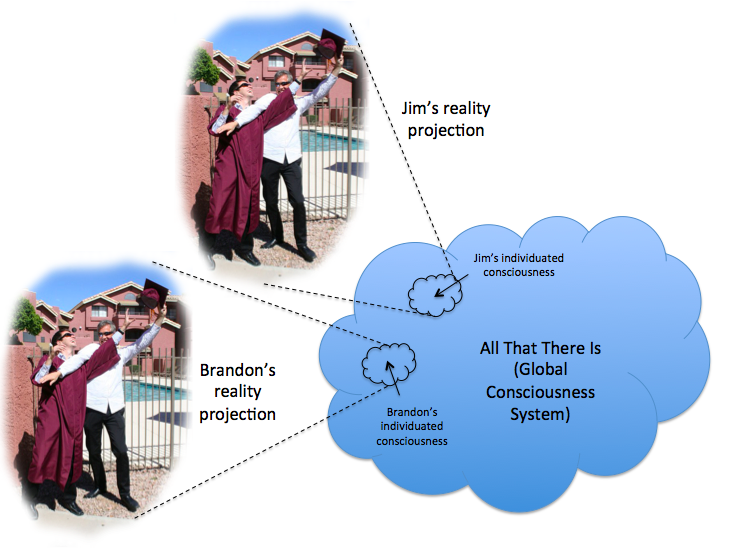
My own theory, Digital Consciousness (fka “Programmed Reality”), has a much better, comprehensive, and perfectly consistent explanation (note: this has the same foundation as Tom Campbell’s theory, “My Big TOE”). See the figure below.
“We” are each a segment of organized information in “all that there is” (ATTI). Hence, we feel individual, but are connected to the whole. (No time to dive into how perfectly this syncs with virtually every spiritual experience throughout history, but you probably get it.) The “Reality Learning Lab” (RLL) (Campbell) is a different set of organized information within ATTI. The RLL is what we experience every day while conscious. (While meditating, or in deep sleep, we are connected elsewhere) It is where all of the artifacts representing Jaws and Dolly exist. It is where various “simulation” timelines run. The information that represents our memories is in three places:
The “brain” part of the simulation. Think of this as our cache.
The temporary part of our soul’s record (or use the term “spirit”, “essence”, “consciousness”, “Being”, or whatever you prefer – words don’t matter), which we lose when we die. This is the stuff our “brain” has full access to, especially when our minds are quiet.
The permanent part of our soul’s record; what we retain from life to life, what we are here to evolve and improve, what in turn contributes to the inexorable evolution of ATTI. Values and morality are here. Irrelevant details like whether or not Dolly had braces don’t belong.
For some reason, ATTI decided that it made sense to remove Dolly’s braces in all of the artifacts of our reality (DVDs, YouTube clips, etc.) But, for some reason, the consciousness data stores did not get rewritten when that happened, and so we still have long-term recollection of Dolly with braces.
Why? ATTI just messing with us? Random experiment? Glitch?
Maybe ATTI is giving us subtle hints that it exists, that “we” are permanent, so that we use the information to correct our path?
We can’t know. ATTI is way beyond our comprehension.










 OMG can anyone write an article on the simulation hypothesis without focusing on




 Musings on the Nature of Reality