How to Survive an AI Apocalypse – Part 9: The Stabilization Effect

PREVIOUS: How to Survive an AI Apocalypse – Part 8: Fighting Back

Here’s where it gets fun.

Or goes off the rails, depending on your point of view.

AI meets Digital Philosophy meets Quantum Mechanics meets UFOs.

This entire blog series has been about surviving an AI-based Apocalypse, a very doomsday kind of event. For some experts, this is all but inevitable. You readers may be coming to a similar conclusion.

But haven’t we heard this before? Doomsday prophesies have been around as long as… Keith Richards. The Norse Ragnarök, The Hindu prophecy of the end of times during the current age of Kaliyuga, the Zoroastrian Renovation, and of course, the Christian Armageddon. An ancient Assyrian tablet dated 2800-2500 BCE tells of corruption and unruly teenagers and prophecies that “earth is in its final days; the world is slowly deteriorating into a corrupt society that will only end with its destruction.” Fast forward to the modern era, where the Industrial Revolution was going to lead to the world’s destruction. We have since had the energy crisis, the population crisis, and the doomsday clock ticking down to nuclear armageddon. None of it ever comes to pass.

Is the AI apocalypse more of the same, or is it frighteningly different in some way? This Part 9 of the series will examine such questions and present a startling conclusion that all may be well.

THE NUCLEAR APOCALYPSE

To get a handle on the likelihood of catastrophic end times, let’s take a deep dive into the the specter of a nuclear holocaust.

It’s hard for many of us to appreciate what a frightening time it was in the 1950s, as people built fallout shelters and children regularly executed duck and cover drills in the classrooms.

Often considered to be the most dangerous point of the cold war, the 1962 Cuban Missile Crisis was a standoff between the Soviet Union and the United States involving the deployment of Soviet missiles in Cuba. At one point the US Navy began dropping depth charges to force a nuclear-armed Soviet submarine to surface. The crew on the sub, having had no radio communication with the outside world didn’t know if war was breaking out or not. The captain, Valentin Savitsky, wanted to launch a nuclear weapon, but a unanimous decision among the three top officers was required for launch. Vasily Arkhipov, the second in command, was the sole dissenting vote and even got into an argument with the other two officers. His courage effectively prevented the nuclear war that was likely to result. Thomas S Blanton, later the director of the US National Security Archive called Arkhipov “the man who saved the world.”

But that wasn’t the only time we were a hair’s breadth away from the nuclear apocalypse.

On May 23, 1967, US military commanders issued a high alert due to what appeared to be jammed missile detection radars in Alaska, Greenland, and the UK. Considered to be an act of war, they authorized preparations for war, including the deployment of aircraft armed with nuclear weapons. Fortunately, a NORAD solar forecaster identified the reason for the jammed radar – a massive solar storm.

Then, on the other side of the red curtain, on 26 September 1983, with international tensions still high after the recent Soviet military shoot down of Korean Air Lines Flight 007, a nuclear early-warning system in Moscow reported that 5 ICBMs (intercontinental ballistic missiles) had been launched from the US. Lieutenant colonel Stanislav Petrov was the duty officer at the command center and suspected a false alarm, so he awaited confirmation before reporting, thereby disobeying Soviet protocol. He later said that had he not been on the shift at that time, his colleagues would have reported the missile launch, likely triggering a nuclear war.

In fact, over the years there have been at least 21 nuclear war close calls, any of which could easily led to a nuclear conflagration and the destruction of humanity. The following timeline, courtesy of the Future of Life Institute, shows how many occurred in just the 30-year period from 1958 to 1988.

It kinds of makes you wonder what else could go wrong…

END OF SOCIETY PREDICTED

Another modern age apocalyptic fear was driven by the recognition that exponential growth and limited resources are ultimately incompatible. At the time, the world population was growing exponentially and important resources like oil and arable land were being depleted. The Rockefeller Foundation partnered with the OECD (Organization for Economic Cooperation and Development) to form The Club of Rome, a group of current and former heads of state, scientists, economists, and business leaders to discuss the problem and potential solutions. In 1972, with the support of computational modeling from MIT, they issued their first report, The Limits to Growth, which painted a bleak picture of the world’s future. Some of the predictions (and their ultimate outcomes) follow:

Another source for this scare was the book The Population Bomb by Stanford biologist Paul Ehrlich. He and people like Harvard biologist George Wald also made some dire predictions…

There is actually no end to failed environmental apocalyptic predictions – too many to list. But a brief smattering includes:

  • “Unless we are extremely lucky, everyone will disappear in a cloud of blue steam in 20 years.” (New York Times, 1969)
  • “UN official says rising seas to ‘obliterate nations’ by 2000.” (Associated Press, 1989)
  • “Britain will Be Siberian in less than 20 years” (The Guardian, 2004)
  • “Scientist Predicts a New Ice Age by 21th Century” (Boston Globe, 1970)
  • “NASA scientist says we’re toast. In 5-10 years, the arctic will be ice free.” (Associated Press, 2008)

Y2K

And who could forget this apocalyptic gem…

My intent is not to cherry pick the poor predictions and make fun of them. It is simply that when we are swimming in the sea of impending doom, it is really hard to see the way out. And yet, there does always seem to be a way out. 

Sometimes it is mathematical. For example, there was a mathematical determination of when we would run out of oil based on known supply and rate of usage, perhaps factoring in the trend of increase in rate of usage. But what were not factored into the equation were the counter effects of the rate of new reserves being discovered and the improvements in engine efficiencies. One could argue that in the latter case, the scare achieved its purpose, just as the fear of global warming has resulted in a number of new environmental policies and laws, such as California’s upcoming ban on gasoline powered vehicles in 2035. However, that isn’t always the case. Many natural resources, for instance, seem to actually be increasing in supply. I am not necessarily arguing for something like the abiotic oil theory. However, at the macro level, doesn’t it sometimes feel like a game of civilization, where we are given a set of resources, cause and effect interrelationships, and ability to acquire certain skills. In the video game, when we fail on an apocalyptic level, we simply hit the reset button and start over. But in real life we can’t do that. Yet, doesn’t it seem like the “game makers” always hand us a way out, such as unheard of new technologies that are seemingly suddenly enabled? And it isn’t always human ingenuity that saves us? Sometimes, the right person is on duty at the perfect time against all odds. Sometimes, oil fields magically replenish on their own. Sometimes asteroids strike the most remote place on the planet.

THE STABILIZATION EFFECT

In fact, it seems statistically significant that apocalypses, while seemingly imminent, NEVER really occur. So much so that I decided to model it with a spreadsheet using random number generation (also demonstrating how weak my programming skills have gotten). The intent of the model is to encapsulate the state of humanity on a simple timeline using a parameter called “Mood” for lack of a better term. We start at a point in society that is neither euphoric (the Roaring Twenties) nor disastrous (the Great Depression). As time progresses, events occur that push the Mood in one direction or the other, with a 50/50 chance of either occurring. The assumption in this model is that no matter what the Mood is, it can still get better or worse with equal probability. Each of the following graphs depicts a randomly generated timeline.

On the graph are two thresholds – one of a positive nature, where things seemingly can’t get much better, and one of a negative nature, whereby all it should take is a nudge to send us down the path to disaster. In any of the situations we’ve discussed in this part of the series, when we are on the brink of apocalypse, the statistical likelihood that the situation would improve at that point should not be more than 50/50. If true, running a few simulations shows that an apocalypse is actually fairly likely. Figures 1 and 3 pop over the positive limit and then turn back toward neutral. Figure 2 seems to take off in the positive direction even after passing the limit. Figure 4 hits and goes through the negative limit several times, implying that if our reality actually worked this way, apocalyptic situations would actually be likely.

However, what always seems to happen is that when things get that bad, there is a stabilizing force of some sort. I made an adjustment to my reality model by inserting some negative feedback to model this stabilizing effect. For those unfamiliar with the term, complex systems can have positive or negative feedback loops; often both. Negative feedback tends to bring a system back to a stable state. Examples in the body include the maintenance of body temperature and blood sugar levels. If blood sugar gets too high, the pancreas secretes insulin which chemically reduces the level. When it gets too low, the pancreas secretes glucagon which increases the level. In nature, when the temperature gets high, cloud level increases, which provides the negative feedback needed to reduce the temperature. Positive feedback loops also exist in nature. The runaway greenhouse effect is a classic example.

When I applied the negative feedback to the reality model, all curves tended to stay within the positive and negative limits, as show below.

Doesn’t it feel like this is how our reality works at the most fundamental level? But how likely would it be that every aspect of our reality is subject to negative feedback? And where does that negative feedback come from?

REALITY IS ADAPTIVE

This is how I believe that reality works at its most fundamental level…
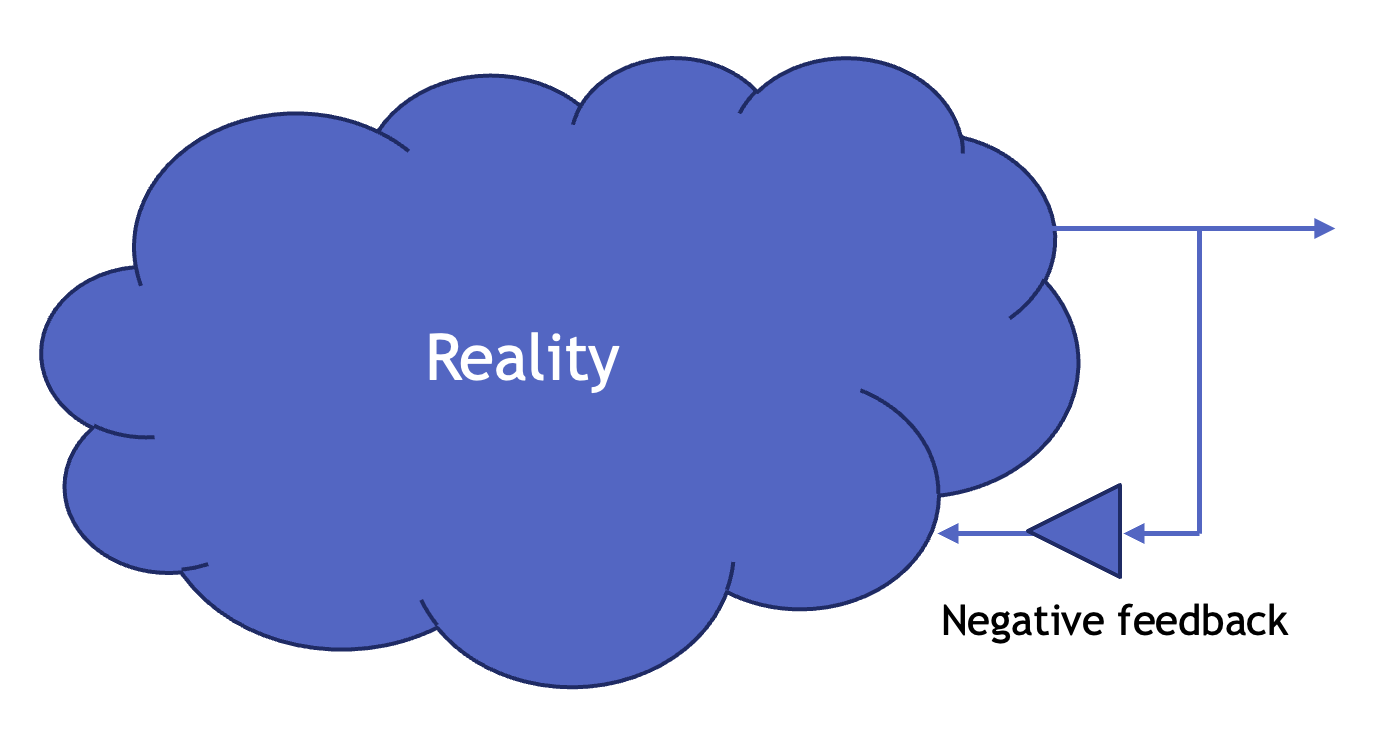
Why would that be? Two obvious ideas come to mind.

  1. Natural causes – this would be the viewpoint of reductionist materialist scientists. Heat increase causes ice sheets to melt which creates more water vapor, generating more clouds, reducing the heating effect of the sun. But this does not at all explain why the human condition, and the civilization trends that we’ve discussed in this article, always tend toward neutral.
  2. God – this would be the viewpoint of people whose beliefs are firmly grounded in their religion. God is always intervening to prevent catastrophes. But apparently God doesn’t mind minor catastrophes and plenty of pain and suffering in general. More importantly though, this does not explain dynamic reality generation.

DYNAMIC REALITY GENERATION

Enter Quantum Mechanics.

The Double-slit experiment was first done by Thomas Young back in 1801, and was an attempt to determine if light was composed of particles or waves. A beam of light was projected at a screen with two vertical slits. If light was composed of particles, only two bands of light should be on the phosphorescent screen behind the one with the slits. If wave-based, an interference pattern should result. The wave theory was initially confirmed experimentally, but that was later called into question by Einstein and others. 

The experiment was later done with particles, like electrons, and it was clearly assumed that these would be shown to be hard fixed particles, generating the expected pattern shown on the right.

However, what resulted was an interference pattern, implying that the electrons were actually waves. Thinking that perhaps electrons were interfering with each other, the experiment was modified to shoot one electron at a time. And still the interference pattern slowly build up on the back screen.
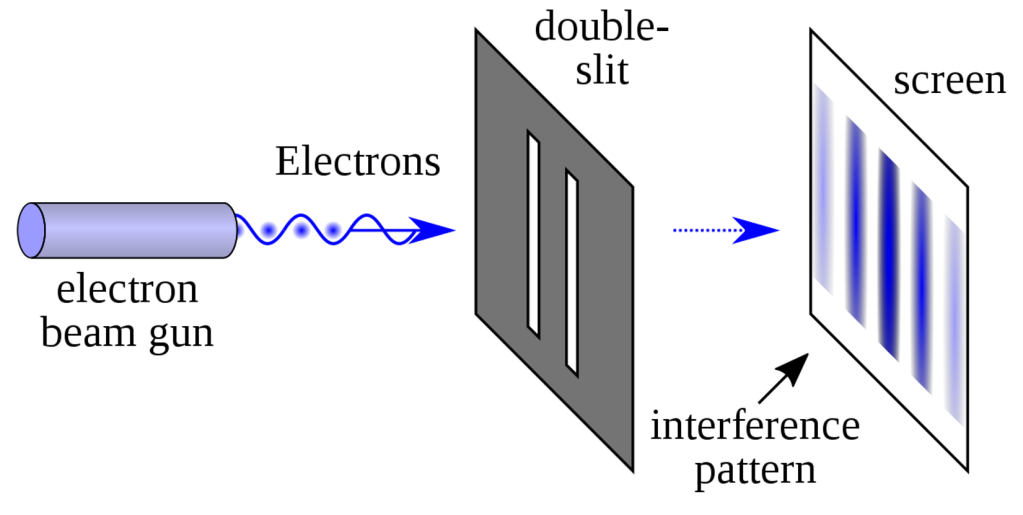
To make sense of the interference pattern, experimenters wondered if they could determine which slit each electron went through, so they put a detector before the double list. Et voila, the interference pattern disappeared! It was as if the actual conscious act of observation converted the electrons from waves to particles. The common interpretation was that the electrons actual exist only a probability function and the observation actually snaps them into existence.

It is very much like the old adage that a tree falling in the woods makes no sound unless someone is there to see it. Of course, this idea of putting consciousness as a parameter in the equations of physics generated no end of consternation for the deterministic materialists. They have spent the last twenty years designing experiments to disprove this “Observer Effect” to no avail. Even when the “which way” detector is place after the double slit, the interference pattern disappears. The only tenable conclusion is that reality does not exist in an objective manner and its instantiation depends on something. But what?

The diagram below helps us visualize the possibilities. When does reality come into existence?
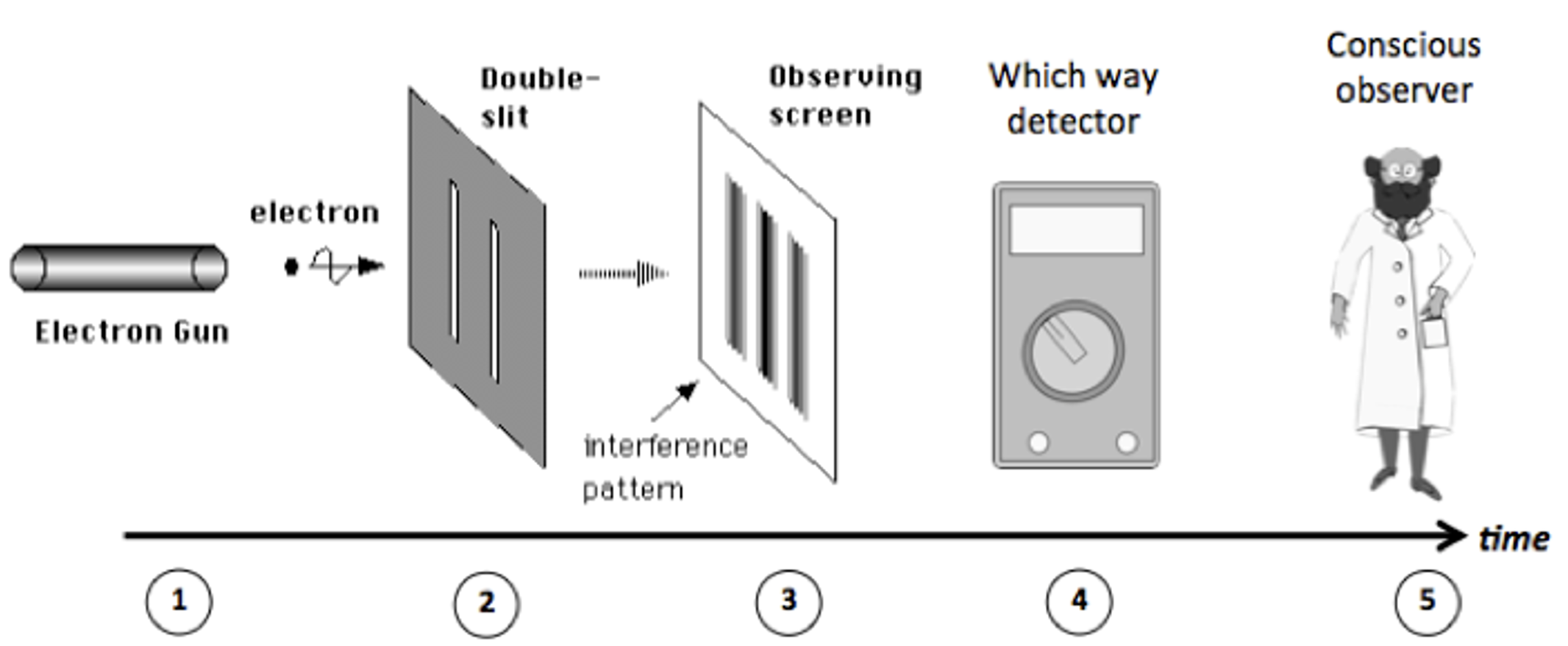
Clearly it is not at points 1, 2 or 3, because it isn’t until the “which way” detector is installed that we see the shift in reality. So is it due to the detector itself or the conscious observer reading the results of the detector. One could image experiments where the results of the “which way” detector are hidden from the conscious observer for an arbitrary period of time; maybe printed out and put in an envelope without looking, where it sits on the shelf for a day while the interference pattern exists. And someone opens the envelope and suddenly the interference pattern disappears. I have always suspected that the answer will be that reality comes into existence at point 4. I believe that it is just logical that a reality generating universe be efficient. Recent experiments bear this out.

I believe this says something incredibly fundamental about the nature of our reality. But what would efficiency have to do with the nature of reality? Let’s explore a little further – what kinds of efficiencies would this lead to?

POP QUIZ! – is reality analog or digital? There is actually no conclusion to this question and many papers have been written in support of either point of view. But if our reality is created on some sort of underlying construct, there is only one answer – it has to be digital. Here’s why…

How much information would it take to fully describe the cup of coffee on the right?

In an analog reality, it would take an infinite amount of information.

In a digital reality, fully modeled at the Planck resolution (what some people think is the deepest possible digital resolution), it would require 4*1071 bits/second give or take. It’s a huge number for sure, but infinitely less than the analog case.

But wait a minute.  Why would we need that level of information to describe a simple cup of coffee? So let’s ask a different question… How much information is needed for a subjective human experience of that cup of coffee – the smell, the taste, the visual experience. You don’t really need to know the position and momentum vector of each subatomic particle in each molecule of coffee in that cup. All you need to know is what it takes to experience it. The answer is roughly 1*109 bits/second. In other words, there could be as much as a 4*1062 factor of compression involved in generating a subjective experience. In other words, we don’t really need to know where each electron is in the coffee, just as you don’t need to know which slit each electron goes through in the double slit experiment. That is, UNTIL YOU MEASURE IT!

So, the baffling results of the double slit experiments actually make complete sense if reality is:

  • Digital
  • Compressed
  • Dynamically generated to meet the needs of the inhabitants of that reality

Sounds computational doesn’t it? In fact, if reality were a computational system, it would make sense for it to need to have efficiencies at this level. 

There are such systems – one well known example is a video game called No Man’s Sky that dynamically generates its universe as the user plays the game. Art inadvertently imitating life?

Earlier in this article I suggested that the concept of God could explain the stabilization effect of our reality. If we redefine “God” to mean “All That There Is” (of which, our apparent physical reality is only a part), reality becomes a “learning lab” that needs to be stable for our consciousnesses to interact virtually.

I wrote about this and proposed this model back in 2007 in my first book “The Universe-Solved!.”  In 2021, an impressive set of physicists and technologists came up with the same theory, which they called “The Autodidactic Universe.” They collaborated to explore methods, structures, and topologies in which the universe might be learning and modifying its laws according to what is needed. Such ideas included neural nets and Restricted Boltzman Machines. This provides an entirely different way of looking at any potential apocalypse. And it make you wonder…

UFO INTERVENTION

In 2021, over one hundred military personnel, including Retired Air Force Captain Robert Salas, Retired First Lieutenant Robert Jacobs, and Retired Captain David Schindele met at the National Press Club in Washington, DC to present historical case evidence that UFOs have been involved with disarming nuclear missiles. A few examples…

  • Malmstrom Air Force Base, Montana, 1967 – “a large glowing, pulsating red oval-shaped object hovering over the front gate,” as alarms went off showing nearly all 10 missiles shown in the control room had been disabled.
  • Minot Air Force Base, North Dakota, 1966 – Eight airmen said that 10 missiles at silos in the vicinity all went down with guidance and control malfunctions when an 80- to 100-foot wide flying object with bright flashing lights had hovered over the site.
  • Vandenberg Air Force Base, California, 1964 – “It went around the top of the warhead, fired a beam of light down on the top of the warhead.” After circling, it “then flew out the frame the same way it had come in.”
  • Ukraine, 1982 – launch countdowns were activated for 15 seconds while a disc-shaped UFO hovered above the base, according to declassified KGB documents

As the History Channel reported, areas of high UFO activity are correlated with nuclear and military facilities worldwide.

Perhaps UFOs are an artifact of our physical reality learning lab, under the control of some conscious entity or possibly even an autonomous (AI) bot in the system. As part of the “autodidactic” programming mechanisms that maintain stability in our programmed reality. Other mechanisms could involve things like adjusting the availability of certain resources or even nudging consciousnesses toward solutions to problems. If this model of reality is accurate, we may find that we have little to worry about regarding an AI apocalypse. Instead it will just be another force that contributes toward our evolution.

To that end, there is also a sector of thinkers who recommend a different approach. Rather than fight the AI progression, or simply let the chips fall, we should welcome our AI overlords and merge with them. That scenario will be explored in Part 10 of this series.

NEXT: How to Survive an AI Apocalypse – Part 10: If You Can’t Beat ’em, Join ’em

How to Survive an AI Apocalypse – Part 3: How Real is the Hype?

PREVIOUS: How to Survive an AI Apocalypse – Part 2: Understanding the Enemy

In Part 2 of this series on Surviving an AI Apocalypse, we examined the landscape of AI and attempted to make sense of the acronym jungle. In this part, in order to continue to develop our understanding of the beast, we will examine some of the elements of publicity and propaganda that pervade the media these days and consider how likely they are. Once we have examined the logical arguments, Dr. Einstein will be our arbiter of truth. Let’s start with the metaphysical descriptors. Could an AI ever be sentient? Conscious? Self-aware? Could it have free will?

CAN AN AI HAVE CONSCIOUSNESS OR FREE WILL?

Scientists and philosophers can’t even agree on the definition of consciousness and whether or not humans have free will, so how could they possibly come to a conclusion about AIs? Fortunately, your truly has strong opinions on the matter.

According to philosophical materialists, reality is ultimately deterministic. Therefore, nothing has free will. To these folks, there actually isn’t any point to their professions, since everything is predetermined. Why run an experiment? Why theorize? What will be has already been determined. This superdeterminism is a last ditch effort for materialists to cling to the idea of an objective reality, because Bell’s Theorem and all of the experiments done since Bell’s Theorem have proven one of two things, either: 1. There is no objective reality, or 2: There is no free will. I gave (what I think are) strong arguments for the existence of free will in all conscious entities in both of my books, The Universe-Solved! and Digital Consciousness. And the support for our reality being virtual and our consciousness being separate from the brain is monumental: The Observer Effect, near death experiences, out of body experiences, simulation arguments, Hoffman’s evolutionary argument against reality, xenoglossy, the placebo effect… I could go on.

To many, consciousness, or the state of being aware of your existence, is simply a matter of complexity. Following this logic, everything has some level of consciousness, including the coaster under your coffee mug. Also know as panpsychism, it’s actually a reasonable idea. Why would there exist some arbitrary threshold of complexity, which, once crossed by a previously unconscious entity, it becomes conscious? it makes much more sense that consciousness is a continuum, or a spectrum, not unlike light, or intelligence. As such, an AI could certainly be considered conscious.

But what do we really mean when we say “conscious?” What we don’t mean is that we simply have sensors that tell some processing system that something is happening inside or outside of us. What we mean is deeper than that – life, a soul, an ability to be self-aware because we want to be, and have the free will to make that choice. AI will never achieve that because it is ultimately deterministic. Some may argue that neural nets are not deterministic, but that is just semantics. For certain, they are not predictable, but only because the system is too complex and adaptive to analyze sufficiently at any exact point in time. Determinism means no free will.

The point is that it really doesn’t matter whether or not you believe that AIs develop “free will” or some breakthrough level of consciousness – what matters is that they are not predictable. Do you agree, Albert?

IS AGI RIGHT AROUND THE CORNER?

This is probably the most contentious question out there. Let’s see how well the predictions have held up over the years.

In 1956, ten of the leading experts in the idea of machine intelligence got together for an eight-week project at Dartmouth University to discuss computational systems, natural language processing, neural networks, and other related topics. They coined the term Artificial Intelligence and so this event is generally considered the birth of the idea. They also made some predictions about when AGI, Artificial General Intelligence, would occur. Their prediction was “20 years away,” a view that has had a lot of staying power. Until only recently.

Historical predictions for AGI:

That’s right, in early 2023, tech entrepreneur and developer, Siqi Chen, claimed that GPT-5 “will” achieve Artificial General Intelligence (AGI) by the end of 2023. Didn’t happen, and won’t this year either. Much of this hype was due to the dramatic ChatGPT performance that came seemingly out of nowhere in early 2023. As with all things hyped, though, claims are expected to be greatly exaggerated. The ability for an AI to “pass the Turing test” (which is what most people are thinking) does not equate with AGI – it doesn’t even mean intelligence, in the sense of what humans have. Much more about this later. All of that said, AGI, in the strict sense of being able to do all intelligent tasks that a human can, is probably going to happen soon. Maybe not, this year, but maybe within five. What say you, Albert?

IS AI GOING TO BECOME BILLIONS OF TIMES SMARTER THAN HUMANS?

Well, mainstream media certainly seems to think so. Because they confuse intelligence with things that have nothing to do with intelligence.

If processing speed is what makes intelligence, then your smart toaster is far brighter than you are. Ditto for recall accuracy as an intelligence metric. We only retain half of what we learned yesterday, and it degrades exponentially over time. Not so with the toaster. If storage is the metric, cloud storage giant, Amazon Web Services, would have to be fifty times smarter than we are. 

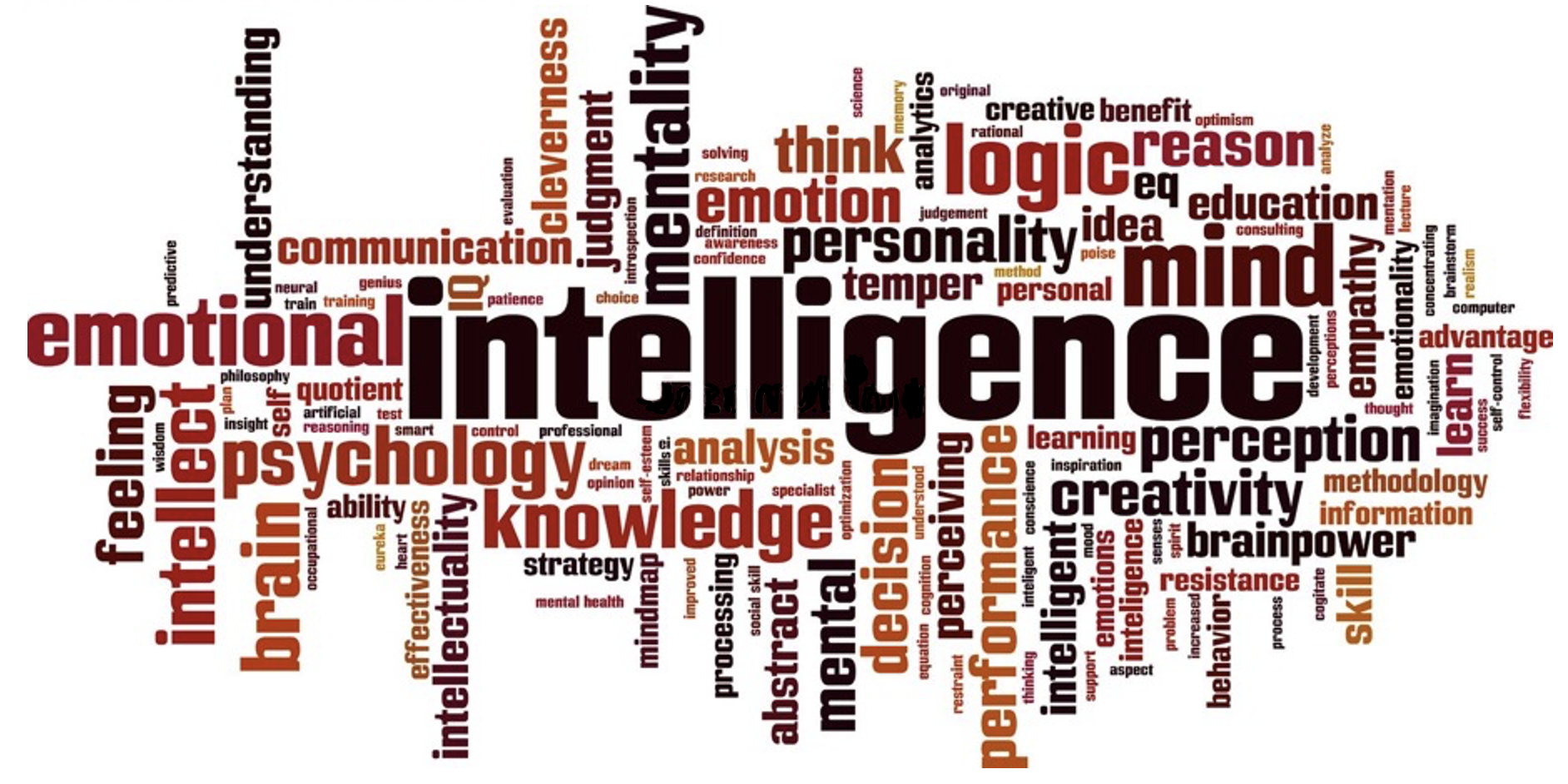
However, the following word cloud captures the complexity behind the kind of intelligence that we have.

That said, processing speed is not to be underestimated, as it is at the root of all that can go wrong. The faster the system, the sooner its actions can go critical. In Nick Bostrom’s book Superintelligence, he references the potential “superpowers” that can be attained by an AGI that is fast enough to become an ASI, Artificial Superintelligence. Intelligence amplification, for example, is where an AI can bootstrap its own intelligence. As it learns to improve its ability to learn, it will develop exponentially. In the movie Her, the Operating System, Samantha, evolved so quickly that it got bored being with one person and overnight began to interact with another 8316 people.

Another superpower is the ability to think far ahead and strategize. Humans can think ahead 10-15 moves in a game of chess, but not in an exhaustive or brute force manner, rather by a few single threaded sequences. Early chess-playing AIs played differently, doing brute force calculations of all possible sequences 3 or 4 moves ahead, and picking the one that led to the most optimal outcome. Nowadays, AI systems designed for chess can think ahead 20 moves, due mostly to the speed improvements in the underlying system. As this progresses, strategizing will be a skill that AIs can do better than humans.

Social manipulation for escaping human control, getting support, and encouraging desired courses of action coupled with hacking capabilities for stealing hardware, money and infrastructure, and escaping human control are the next superpowers than an AGI could possess. If you think otherwise, recall from Part 2 of this series that AIs have already been observed gaming specifications, or the rules under which their creators thought they were programmed. They have also unexpectedly developed apparent cognitive skills, like Theory of Mind. So their ability to get around rules to achieve their objective is already in place.

Bostrom adds technology research and economic productivity as advanced superpowers attainable by an ASI, resulting in the ability to create military forces, surveillance, space transport, or simply generating money to buy influence.

How long might it take for an AGI to evolve to an ASI? Wait But Why blogger Tim Urban posted a provocative image that shows the possibility of it happening extremely quickly. Expert estimates vary widely, from hours (an in Her) to many years.

Bostrom’s fear is that the first AGI that makes the jump will become a singleton, acquiring all resources and control. Think SkyNet. So, Albert, given all of this, will AIs soon become billions of times smarter than humans, as CNN reports?

COULDN’T WE JUST PULL THE PLUG IF THINGS START GOING SOUTH?

Yeah, why not just unplug it? To get a sense for the answer to that question, how would you unplug Google? Google’s infrastructure, shown below, comprises over 100 points of presence in 18 geographical zones. Each one has high availability technology and redundant power.

Theoretically an advanced AI could spread its brain across any number of nodes worldwide, some of which may be be solar powered, others of which may be in control of the power systems.  By the time AGI is real, high availability technology will be far advanced. You see the problem. Thoughts, Dr. Einstein?

Now that we understand the nature of the beast, and have an appreciation for the realistic capabilities of our AI frenemy, we can take a look at a possible apocalyptic scenario, courtesy of Nick Bostrom’s book, Superintelligence. Below can be seen a possible sequence of events that lead an AGI to essentially take over the world. I recommend reading the book for the details. Bostrom is a brilliant guy, and also the one who authored The Simulation Argument, which has gotten all manner of scientists, mathematicians, and philosophers in a tizzy over its logic and implications, so it is worth taking seriously.

And think of some of the technologies that we’ve developed that facilitate an operation like this… cloud computing, drones, digital financial services, social media. It all plays very well. In the next post, we will begin to examine all sorts of AI-run-amok scenarios, and assess the likelihood and severity of each.

NEXT: How to Survive an AI Apocalypse – Part 4: AI Run Amok Scenarios

Disproving the Claim that the LHC Disproves the Existence of Ghosts

Recent articles in dozens of online magazines shout things like: “The LHC Disproves the Existence of Ghosts and the Paranormal.”

To which I respond: LOLOLOLOLOL

There are so many things wrong with this backwards scientific thinking, I almost don’t know where to start.  But here are a few…

1. The word “disproves” doesn’t belong here. It is unscientific at best. Maybe use “evidence against one possible explanation for ghosts” – I can even begin to appreciate that. But if I can demonstrate even one potential mechanism for the paranormal that the LHC couldn’t detect, you cannot use the word “disprove.” And here is one potential mechanism – an unknown force that the LHC can’t explore because its experiments are designed to only measure interactions in the 4 forces physicists are aware of.

The smoking gun is Brian Cox’s statement “If we want some sort of pattern that carries information about our living cells to persist then we must specify precisely what medium carries that pattern and how it interacts with the matter particles out of which our bodies are made. We must, in other words, invent an extension to the Standard Model of Particle Physics that has escaped detection at the Large Hadron Collider. That’s almost inconceivable at the energy scales typical of the particle interactions in our bodies.” So, based on that statement, here are a few more problems…

2. “almost inconceivable” is logically inconsistent with the term “disproves.”

3. “If we want some sort of pattern that carries information about our living cells to persist…” is an invalid assumption. We do not need information about our cells to persist in a traditional physical medium for paranormal effects to have a way to propagate. They can propagate by a non-traditional (unknown) medium, such as an information storage mechanism operating outside of our classically observable means. Imagine telling a couple of scientists just 200 years ago about how people can communicate instantaneously via radio waves. Their response would be “no, that is impossible because our greatest measurement equipment has not revealed any mechanism that allows information to be transmitted in that manner.” Isn’t that the same thing Brian Cox is saying?

4. The underlying assumption is that we live in a materialist reality. Aside from the fact that Quantum Mechanics experiments have disproven this (and yes, I am comfortable using that word), a REAL scientist should allow for the possibility that consciousness is independent of grey matter and create experiments to support or invalidate such hypotheses. One clear possibility is the simulation argument. Out of band signaling is an obvious and easy mechanism for paranormal effects.  Unfortunately, the REAL scientists (such as Anton Zeilinger) are not the ones who get most of the press.

5. “That’s almost inconceivable at the energy scales typical of the particle interactions in our bodies” is also bad logic. It assumes that we fully understand the energy scales typical of the particle interactions in our bodies. If scientific history has shown us anything, it is that there is more that we don’t understand than there is that we do.

lhcghosts

Slime Mold for President

In a year when many of us are losing faith in the intelligence of humanity, it’s refreshing to see an example of unexpected cognitive abilities in another species. But seriously, slime molds?

A slime mold is a bizarre single-celled organism which has the propensity to aggregate with others of its species to act like a large multicellular organism. Slime molds can be found on your lawn, in your gutters, or on decomposing logs, and might reach a size of a square meter or more. In both its unicellular state and in its aggregate slime state, the organism has neither a brain nor a nervous system.

So imagine scientists’ surprise to discover that one such representative species, Physarum polycephalum, has shown the ability to learn. Researchers from Toulouse University, placed the mold in a petri dish along with a food source, separated by a distasteful (to the mold) barrier consisting of caffeine or quinine. In the initial run of the experiment, the yucky tasting barrier stopped the mold from getting to its dinner. However, over a few hours, Physarum polycephalum learned to cross over the barrier to get to the food, after which each run of the experiment resulted in faster times and less hesitancy to get to its goal.

This rudimentary learning process requires “a behavioral response to whatever the trigger is, memory of that moment, and future changed behavior based on the memory,” which combination would appear to be impossible without a brain or nervous system.

Even more remarkable is Physarum polycephalum’s ability to solve complex mazes and emulate ancient Rome’s road building logic.

As science puzzles over this conundrum and develops theories based on cellular memory and binary genetic codes, I offer a simpler explanation:

Learning does require a sufficiently complex adaptive system, but that system does not necessarily need to be embodied in a central nervous system of the organism. Quantum Mechanics experiments have proven beyond a reasonable doubt that consciousness plays a central role in the creation of reality. This implies that consciousness is not an artifact of the system that it is creating – it is rather, a separate aspect of reality. Evidence abounds that we live in a consciousness-centric reality, and that consciousness is therefore “out there” elsewhere. The informational substrate in which consciousness resides is either “the true physical reality” or a “truer reality” than the virtual one in which we think we reside. It is that substrate that may contain the complexity for memory and learning on the part of the consciousness of the organism.

For my Masters project in college, I had to develop a system that would take rich complex information from weather balloon sensors and crunch the data to match the low bit rate telemetry limitations of the transmission system. In an analogous manner, perhaps, the consciousness that got stuck with the poor slime mold template has very little to work with in terms of interacting with its virtual world. But all the mold really needs is a small subset of the three elements described above: the ability to sense and deliver information to its conscious host and the ability to respond to instructions from that host and interact with its environment. The consciousness does the rest.

In a similar way, a perfectly respectable individuated consciousness may be stuck with a cognitively challenged human template running as a presidential candidate.

Yellow_slime_mold trump

Transhumanism and Immortality – 21st Century Snake Oil

Before I start my rant, I recognize that the Transhumanism movement is chock full of cool ideas, many of which make complete sense, even though they are perhaps obvious and inevitable.  The application of science and technology to the betterment of the human body ranges from current practices like prosthetics and Lasik to genetic modification and curing diseases through nanotech.  It is happening and there’s nothing anyone can to to stop it, so enjoy the ride as you uplift your biology to posthumanism.

However, part of the Transhumanist dogma is the idea that we can “live long enough to live forever.”  Live long enough to be able to take advantage of future technologies like genetic manipulation  which could end the aging process and YOU TOO can be immortal!

The problem with this mentality is that we are already immortal!  And there is a reason why our corporeal bodies die.  Simply put, we live our lives in this reality in order to evolve our consciousness, one life instance at a time.  If we didn’t die, our consciousness evolution would come to a grinding halt, as we spend the rest of eternity playing solitaire and standing in line at the buffet.  The “Universe” or “All That There Is” appears to evolve through our collective individuated consciousnesses.  Therefore, deciding to be physically immortal could be the end of the evolution of the Universe itself.  Underlying this unfortunate and misguided direction of Transhumanism is the belief (and, I can’t stress this enough, it is ONLY that – a belief) that it is lights out when we die.  Following the train of logic, if this were true, consciousness only emerges from brain function, we have zero free will, the entire universe is a deterministic machine, and even investigative science doesn’t make sense any more.  So why even bother with Transhumanism if everything is predetermined?  It is logically inconsistent.  Materialism, the denial of the duality of mind and body, is a dogmatic Religion.  Its more vocal adherents (just head on over to the JREF Forum to find these knuckleheads) are as ignorant to the evidence and as blind to what true science is as the most bass-ackward fundamentalist religious zealots.

OK, to be fair, no one can be 100% certain of anything.  But, there is FAR more evidence for consciousness driven reality than for deterministic materialism.  This blog contains a lot of it, as does my first book, “The Universe-Solved!“, with much more in my upcoming book.

The spokesman for transhumanistic immortality is the self-professed “Transcendent Man“, Ray Kurzweil.  Really Ray?  Did you seriously NOT fight the producers of this movie about you to change the title to something a little less self-aggrandizing, like “Modern Messiah”? #LRonHubbard

So I came across this article about the 77 supplements that Ray takes every day.  From the accompanying video clip, he believes that they are already reversing his aging process: “I’m 65. On many biological aging tests I come out a lot younger. I expect to be in my 40s 15 years from now.”

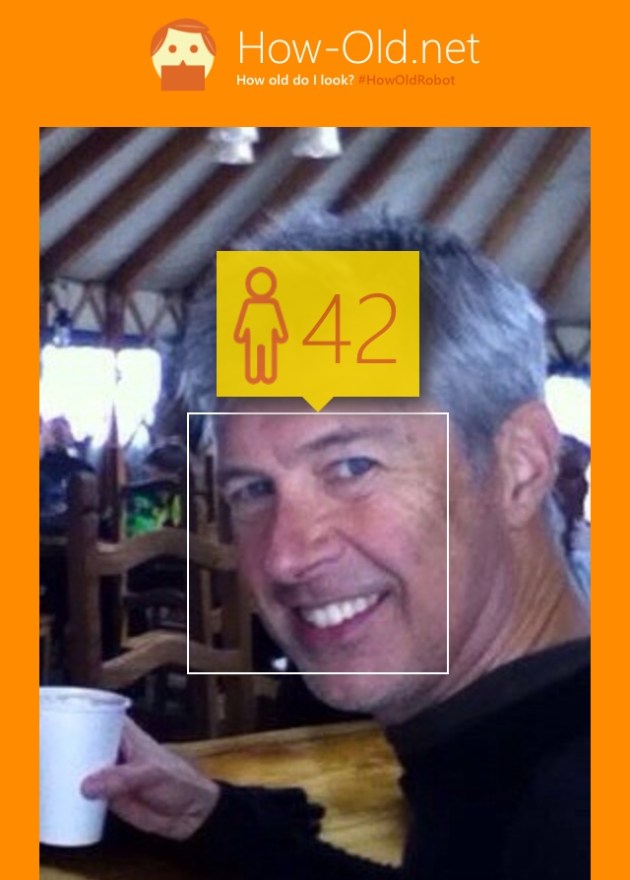
He has been on this regimen for years.  So let’s see how well those supplements are doing.  Picking an objective tool from one of Ray’s own favorite technologies – Artificial Intelligence – the website how-old.net has an AI bot that automatically estimates your age from an uploaded photo.  I took a screen shot from the video clip (Ray is 65 in the clip) and uploaded it:

Ray Kurzweil Age

85!  Uh oh.  Hmmm, maybe the bot overestimates everyone’s age. I’m 10 years younger than Ray.  Let’s see how I fare, using a shot taken the same year at a ski resort – you know, one of those sports Ray says to avoid (Ray also claims that his kids will probably be immortal as long as they don’t take up extreme sports):

JimHowOld

I don’t know if it is the supplements that make Ray look 20 years older than he is, or the extreme skiing that makes me look 13 years younger than I am.  But I’m thinking maybe I’m onto something. [Note: I do realize that the choice of pictures could result in different outcomes.  I just thought it was ironic that the first two that I tried had these results]

Yes, I’m fairly confident that these supplements have some value in improving the function of various organs and benefiting a person’s overall health and well being.  I’m also fairly certain that much of traditional medical community would disagree and point to the lack of rigorous scientific studies supporting these supposed benefits as they always do.  On the whole, I suspect that, on the average, supplements might extend one’s lifetime somewhat.  But I doubt that they will reverse aging.  The human body is far too complex to hope that adding a few organic compounds would be sufficient to modify and synchronize all of the complex cellular and systemic metabolic chemical reactions toward a reversal of the aging process.  Kurzweil is obviously a very bright man who has had a significant entrepreneurial legacy in the high tech world.  However I think he and the rest of the materialist transhumanists are way over their heads on the topic of immortality and our place and purpose in the Universe.

My suggestion, Ray… skip the supplements, skip the self-promotion, skip the Google plugs, drive your goddamn car, and don’t be afraid to be active.  Stick with high tech, leave the evolution of the universe to its own devices, and enjoy the rest of this life.

Questions to Ask at the End of Your Life

“I wish I had worked harder.”  Said no one ever on his or her deathbed.

Isn’t it ironic how there seems to be a consensus on how not to live one’s life, and yet; very few of us really live our lives according to that wisdom. It is as if we have two identities: one, which revolves around playing the game, chasing the dream, helping corporations and governments move capital around like piles of sand from one place to the other, paying taxes, chasing passions, using the right apps, wearing the right clothes, and rooting for the right team. And then, there is the other identity, which wryly observes all of this madness and is deeply fulfilled instead by love, connections, service, spirituality, and beauty. Eckhart Tolle explains these two identities clearly in his book “The Power of Now.” The first identity, he says, is the ego, and is created from all of the mental thinking that we do when we focus our attention on the past and on the future. The second identity is our true Being, the individuated consciousness that is connected to everything else, to “all that there is,” which we find when we focus on the present.

So it got me thinking about what questions I would ask at the end of my life, as I look back and assess how well I did this time around. I came up with a few:

  • How well did I learn to love, forgive, and be compassionate?
  • How much of a positive impact did I make on other living entities?
  • How well did I learn the life lessons that I was supposed to, in order to evolve my consciousness?
  • How well did I attain happiness?
  • How well did I eradicate fear from my driving forces?

Questions I would not ask:

  • Did I work hard enough?
  • Was I punctual?
  • Did I follow the rules?

Still, I know that I am expending more energy following the ego’s plan, but it is ever so slowly shifting.

I would love to hear what questions others would ask and not ask.

questions

Macroscopic Coherence Explained

Coherence is a general property of a system whereby the components of that system all act in a similar manner. Coherent light is what makes lasers what they are – an alignment of photons, or waveform phases (why cats chase them is a little harder to explain). Superconductivity, a property of zero resistance to electrical flow that was formerly only observed at temperatures near absolute zero, is closely related in that the atoms of the superconducting material are aligned coherently. Quantum entanglement is an example of perfect coherence between two or more particles, in that they act as a single particle no matter how far away from each other you take them. Einstein famously referred to this property as “spooky action at a distance.” The Bose-Einstein condensate is another state of matter that exists at extremely low temperatures and involves a system of particles that have all achieved the lowest quantum state, and hence, are coherent.

Over the years, clever experimental scientists have pushed the boundaries of coherence from extreme cryogenics and quantum scales to room temperatures and macroscopic scales. Author and fellow truth seeker Anthony Peake posted an article today about experiments that are being done at various research institutes which demonstrate how the contents of liquid containers connected by arbitrarily thin channels exhibit “action at a distance” macroscopically.

Once again, such anomalies have scientists scratching their heads for explanations; that is, scientists who cling to the never-proven pre-assumed dogma of objective materialism. Entanglement and macroscopic action at a distance find no home in this religion.

However, over here at “Consciousness-based Digital Reality” Central, we enjoy the simplicity of fitting such anomalies into our model of reality. 🙂

It all follows from three core ideas:

  1. That all matter is ultimately comprised of data (“it from bit” as John Wheeler would say) and that forces are simply the rules of how the complex data structures that form particles interact with each other.
  1. That consciousness, which is also organized data, interacts with the components of reality according to other rules of the overall system (this greater System being “reality”, “the universe”, God, “all that there is” or whatever you want to call it).
  1. The System evolves according to what Tom Campbell calls the “Fundamental Rule.” Similar to evolution, the system changes state and evolves in the direction of more profitable or useful states and away from less useful states.

Because of #3, our system has evolved to be efficient. As such, it would likely not be wasteful. So, when an observer observes (consciousness interacts with) a pair of particles in proximity to each other, the system sets their states (collapsing the wave function) and the rules of their behavior (a finite state machine) to be coherent simply out of efficiency. That is, each particle is set to the same finite state machine, and forever behaves that way no matter how far apart you take them (distance being a virtual concept in a virtual digital world).

So what prevents the same logic from applying to macroscopic collections of coherent particles? Nothing. In fact, it is inevitable. These clever scientists have learned methods to establish a coherent identical quantum state across huge quantities of particles (aka macroscopic). At the point in which the experimenter creates this state and observes it, the system establishes the state machines for all of them at once, since they are all to be in the same quantum state. And so we get room temperature superconductivity and macroscopic containers of liquid that demonstrate non-locality.

carl

Objective vs. Subjective Reality

Today’s blog is one part rehash of an ancient dilemma that has puzzled and divided philosophers and scientists for millennia and two parts The Universe – Solved!

First a couple definitions…

Objective Reality – a reality that completely exists independent of any conscious entity to observe it.

Subjective Reality – what we perceive.

As it is well known, subjective reality is “subject” to an elaborate set of filters, any one of which can modify a perception of that reality; sensory apparatus (e.g. the rods and cones in our eyes), sensory processing (e.g. the visual cortex), higher level brain function, and psychological factors (e.g. expectations). As such, what one person experiences is always different than what any other person experiences, but usually in subtle ways.

Fundamentally, one cannot prove the existence of an objective reality. We can only infer its properties through observations, which of course, are subjective. However, it may be possible to prove that objective reality doesn’t exist, if, for example, it can be shown that the properties inferred via a particular observer fundamentally contradict properties inferred via another observer. But even then those inferences may be hopelessly subjective. Suppose person A sees a car as red and person B sees the same car as green. We can’t conclude that there is no objective reality because person B could simply have an unusual filter somewhere between the car and the seat of their consciousness.

What if we can use some sort of high-precision reproducible measurement apparatus to make some observations on reality and find that under certain controlled circumstances, reality changes depending on some parameter that appears to be disconnected to the reality itself? There are a lot of qualifiers and imperfections in that question – like “high (vs. infinite) precision” and “appears” – but what comes to mind is the well-known double slit experiment. In 1998, researchers at the Weizmann Institute of Science, demonstrated that reality shifts depending on the amount of observation, even if the “observer” is a completely non-intrusive device. IQOQI upped the ante in terms of precision in 2008 by showing that objective reality doesn’t exist to a certainly of 80 orders of magnitude (probability of being false due to error or chance = 1E-80). That’s good enough for me. And, in 2012, Dr. Dean Radin conducted what appear to be well-designed and rigorous scientific experiments that show to a high probability that conscious intent can directly alter the results of the double slit experiment. Just as it only takes one white crow to prove that not all crows are black, it only takes one experiment that demonstrates the non-existence of objective reality to prove that objective reality is an illusion.

So that debate is over. Let’s get past it and move onto the next interesting questions

What is this reality that we all perceive to be “almost” solid and consistent?

I believe it is a digital consciousness-influenced high-consensus reality for reasons outlined here. It has to have a high degree of consensus because, in order to learn and evolve our consciousness, we have to believe in a well-grounded cause and effect.

What does “almost” mean?

We could define “almost” as 1 minus the degree to which apparent objective reality is inconsistent, either between separate observers, or in experiments that have a different outcomes depending on the state of the observer. For now, I’ll have to punt on the estimates because I haven’t found any supporting research, but I suspect it is between 99.999% and 1.

How does “almost” work?

Subjective reality does not mean that you can call the shots and become a millionaire just due to intent. The world would be insane if that were the case. Because of the “consensus” requirement, the effects are much more subtle than that. For you to see a passing car and make it turn red just because you want to, would violate the color consensus that must be maintained for the other 1000 people that see that car drive by. In fact, there is nothing to say that the aggregate of conscious intents from all conscious entities fully shape the subjective reality. Most of it may be driven by the rules of the system (that aspect of digital global consciousness that drives the projection of the physical reality). See the figure below. In the digital global consciousness system (see my “The Universe-Solved!” or Tom Campbell’s “My Big TOE” for more in depth explanations of this view of the nature of reality), Brandon and I are just individuated segments of the greater whole. (Note: This is how we are all connected. The small cloud borders are not impervious to communication, either from other individuated consciousnesses (aka telepathy) or from the system as a whole (aka spiritual enlightenment)).

system

Brandon’s reality projection may have three components. First, it is generated by the system, based on whatever rules the system has for creating our digital reality. Second, it may be influenced by the aggregate of the intent of all conscious entities, which is also known by the system. Finally, his projection may be slightly influenced by his own consciousness. The same applies to my own projection. Hence, our realities are slightly different, but not enough to notice on a day-to-day basis. Only now that our scientific instrumentation has become sensitive enough, are we starting to be able to realize (but not yet quantify) this. Perhaps 5% of reality is shaped by the aggregate consensus and 95% by the system itself. Or 1% and 99%. Or .00001% and 99.99999%. All are possible, but none are objective.

Continuity of Self

Dr. Pim van Lommel presents an interesting question in his book “Consciousness Beyond Life” regarding the continuity of consciousness: “Every day, fifty billion cells are broken down and regenerated in our body. And yet we experience our body as continuous… Every two weeks all of the molecules and atoms in our body’s cells are replaced. How can we account for long-term memory if the molecular makeup of the cell membrane of neurons is completely renewed every two weeks and the millions of synapses in the brain undergo a process of constant adaptation (neuroplasticity)?” Further, he notes that since quarks and gluons are destroyed and reconstituted every 1E-23 seconds, effectively so are our bodies. How then does it appear continuous?

Our cells can live independently of our bodies, so effectively “we” are a large network of cells, much in the same ways that beehives are large networks of bees and computer networks are large networks of interconnected computers. In these cases, it is fairly easy to identify that the whole is the sum of the parts, while allowing the parts to be swapped out. If a few bees die and some new bees join the colony, one still sees the entire hive as continuous, although it might undergo continuous change. So the puzzle at the core of this question is not a philosophical debate about the validity of the existence of a large identifiable structure, but rather the existence of something that is truly continuous despite the replacement of its parts, such as human consciousness.

Or is it continuous? Are you the same person you were yesterday? Can we say to the judge: “Your honor, that wasn’t me that stole the car on that date. I was a different person then.”?

What links our past to our present (and hence, generates the appearance of continuity) is our structure for memories. If I lost every memory when I slept at night, would I even have the sense of having a continuous consciousness? Or, to flip the argument around, is it really the central database of memories in our brains that makes us have a continuous consciousness? The research actually supports the idea that the sense of “continuity of self” extends beyond mere memory recollection. For example, patients who have full retrograde amnesia, completely incapable of recollecting a single event from their past, nonetheless have the sense of a continuous personal identity1 and often show no personality change after the event that triggered the amnesia2,3.

This would seem to suggest that since “sense of self” is greater than simply memories, our consciousness is either due to some as yet unknown aspect of the brain that maintains a continuity of “self” aside from memory, or it is a superset of brain function entirely.

Given the evidence that values and personality extend beyond the brain and the preponderance of other evidence that a consciousness exists beyond the brain, it seems likely that continuity of self is just one more data point that supports the consciousness driven digital reality model.

  1. Klein, Stanley B., “Memory and the Sense of Personal Identity”, University of California, Santa Barbara (http://dingo.sbs.arizona.edu/~snichols/Papers/MemoryandSenseofPersonalIdentity.pdf)
  2. Brooks, DN and W McKinlay, “Personality and behavioural change after severe blunt head injury – a relative’s view” Journal of Neurology, Neurosurgery, and Psychiatry 1983;46:336-344.
  3. http://www.britannica.com/EBchecked/topic/374514/memory-abnormality/23519/Traumatic-amnesia

6 future-self continuity

Embracing Virtuality

In 2009, a Japanese man married a woman named Nene Anegasaki on the island of Guam.  The curious thing was that Nene was a virtual character in the Nintendo videogame LovePlus.

OurVirtualFuture1

In 2013, Spike Jonze directed the highly acclaimed (and Academy Award nominated) film “Her”, in which the protagonist falls in love with an OS (operating system) AI (artificial intelligence).

OurVirtualFuture2

Outrageous you say?

Consider that for centuries people have been falling in love sight unseen via snail mail.  Today, with online dating, this is even more prevalent.  Philosophy professor Aaron Ben-Ze’ev notes that online technology “enables having a connection that is faster and more direct.”

So it got me thinking that these types of relationships aren’t that different from the virtual ones that are depicted in “Her” and are going to occur with increasing frequency as AI progresses.  The interactions are exactly the same; it is just that the entity at the end of the communication channel is either real or artificial.

But wait, what is artificial and what is real?  As Morpheus said in “The Matrix,” “What is real? How do you define ‘real’? If you’re talking about what you can feel, what you can smell, what you can taste and see, then ‘real’ is simply electrical signals interpreted by your brain.”  This is not just philosophy; this is as factual as you can get.

As a growing number of researchers, physicists, and philosophers come to terms with the supporting evidence that we already live in a virtual reality, we realize that there is no distinction between a virtual entity that we think is virtual (such as a game character) and a virtual entity that we think is real (such as the person you are in a relationship with).  Your consciousness does not emerge from your brain; its seat is elsewhere.  Your lover’s consciousness therefore is also elsewhere.  You are interacting with it via the transfer of data and your emotions are part of your core consciousness.  Does it matter whether that data transfer is between two conscious entities outside of physical reality or between a conscious entity and another somewhat less conscious entity?

As technology progresses, AI advances, and gaming and simulations become more immersive, falling in love or having any other kind of emotional experience will be occurring more and more frequently with what we today think of as virtual entities.

Now, it seems shocking.  Tomorrow it will be curious.  Eventually it will be the norm.