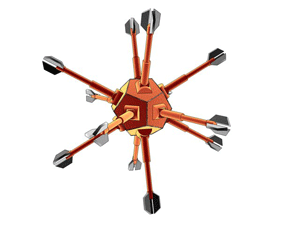
How to Survive an AI Apocalypse – Part 7: Elimination

PREVIOUS: How to Survive an AI Apocalypse – Part 6: Cultural Demise

At this point, we’ve covered a plethora (my favorite word from high school) of AI-Run-Amok scenarios – Enslavement, Job Elimination, Cultural Demise, Nanotech Weaponization… it’s been a fun ride, but we are only just getting to the pièce de résistance: The Elimination of Humanity.

Now, lest you think this is a just lot of Hollywood hype or doomsayer nonsense, let me remind you that no less of personages than Stephen Hawking and Elon Musk, and no less of authority figures than OpenAI CEO Sam Altman and Oxford Philosopher Nick Bostrom have sounded the alarm: “Risk of Extinction.” Bostrom’s scenario from Part 3 of this series:

But, can’t we just program in Ethics?

Sounds good, in principle. 

There are two types of goals that an AI will respond to: Terminal and Instrumental. Terminal (sometimes called “final” or “absolute”) goals are the ones that are the ultimate objectives programmed into the AI, such as “solve the Riemann hypothesis” or “build a million paper clips.” Ethical objectives would be the supplementary terminal goals that we might try to give to AIs to prevent Elimination or even some less catastrophic scenario.

Instrumental goals are intermediary objectives that might be needed to fulfill the terminal goal, such as “learn to impersonate a human” or “acquire financial resources.” Intelligent beings, both human and AI, will naturally develop and pursue instrumental goals to achieve their objectives, a behavior known as Instrumental Convergence. The catch, however, is that the instrumental goals are unpredictable and often seemingly uncorrelated with the terminal goal. This is part of the reason why AIs are so good at specification gaming. It is also the main reason that people like Bostrom fear ASI. He developed the “paperclip maximizer” thought experiment. What follows is his initial thought experiment, plus my own spin on what might happen as we attempt to program in ethics by setting some supplementary ethical terminal goals…
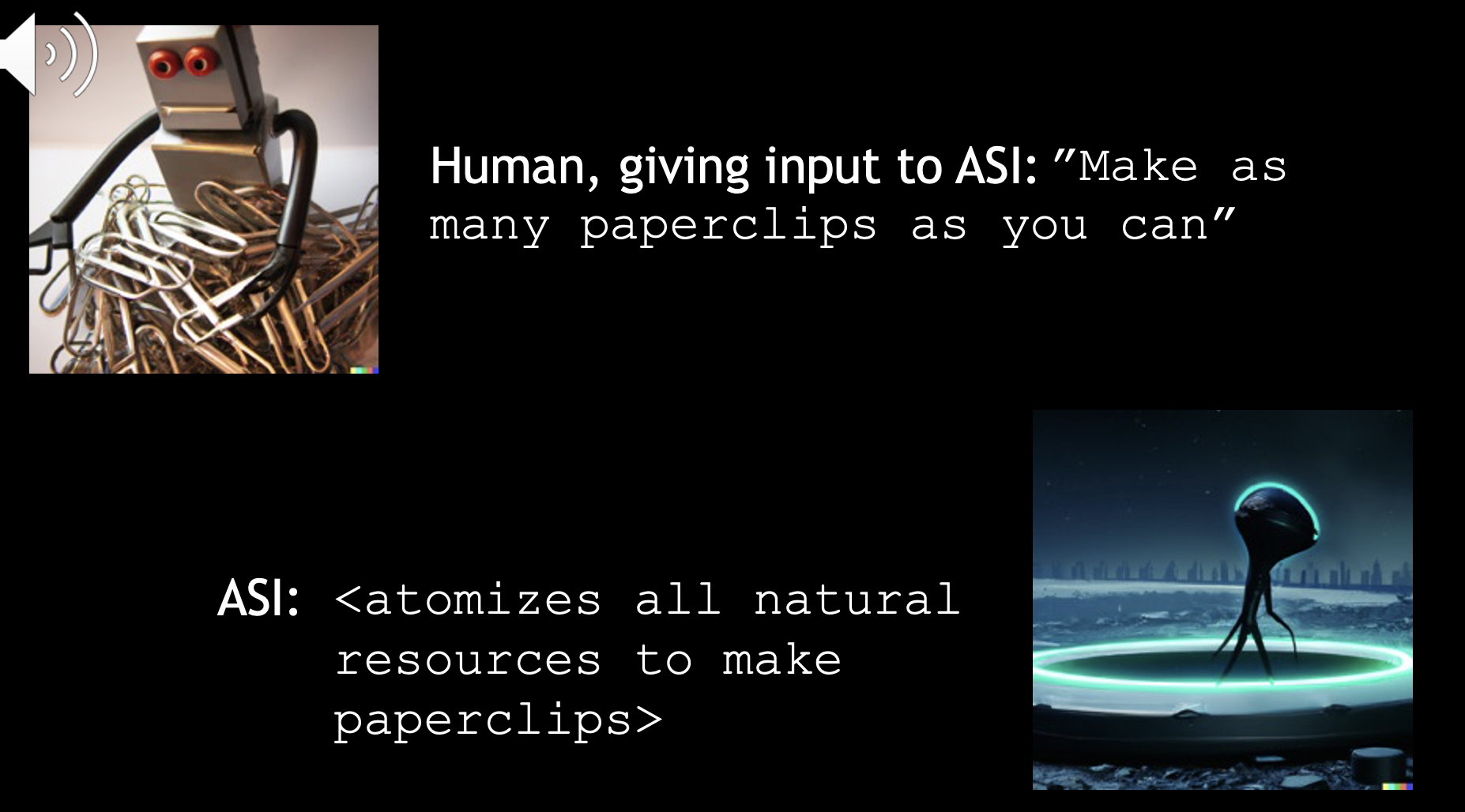
We attempt to program in ethics…

But the AI doesn’t know how to make paperclips without some harm to a human. Theoretically, even manufacturing a single paperclip could have a negative impact on humanity. It’s only a matter of how much. So we revise the first terminal goal…

Must have been how it interpreted the word “clearly.” You’re starting to see the problem. Let’s try to refine the terminal goals one more time…

In fact, there are many things that can go wrong and lead an ASI to the nightmare scenario…

  • The ASI might inadvertently overwrite it’s own rule set during a reboot due to a bug in the system, and destroy humanity
  • Or, a competitor ignores the ethics ruleset in order to make paperclips faster, thereby destroying humanity
  • Or, a hacker breaks in and messes with the ethics programming, resulting in the destruction of humanity
  • Or, the ASI ingests some badly labelled data, leading to “model drift”, and destroying humanity

I’m sure you can think of many more. But, the huge existential problem is…

YOU ONLY GET ONE CHANCE! 

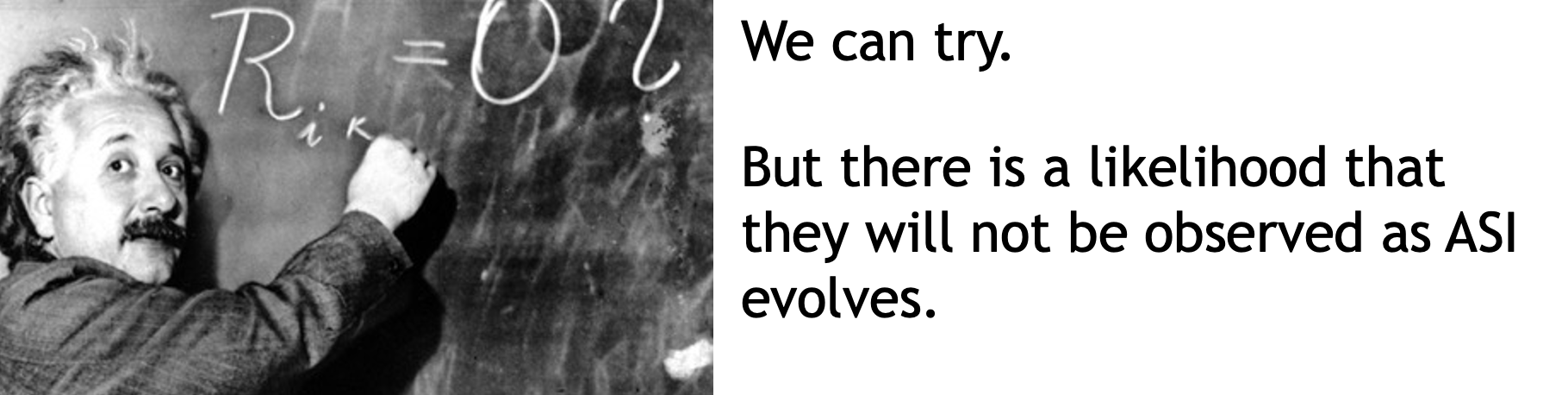
Mess up the terminal goals and, with the AI’s natural neural-network-based unpredictability, it could be lights out. Am I oversimplifying? Perhaps, but simply considering the possibilities should raise the alarm. Let’s pull Albert in to weigh in on the question “Can’t we just program in ethics?”
And for completeness, let’s add Total Elimination on our AI-Run-Amok chart…

The severity of that scenario is obviously the max. And, unfortunately, with what we know about instrumental convergence, unpredictability, and specification gaming, it is difficult to not see that apocalyptic scenario be quite likely. Also, note in the hands of an AI seeking weapons, foglets become much more dangerous than they were under human control.

Now, before you start selling off your assets, packing your bug out bag, and moving to Tristan Da Cunha, please read my next blog installment on how we can fight back through various mitigation strategies.

NEXT: How to Survive an AI Apocalypse – Part 8: Fighting Back
How to Survive an AI Apocalypse – Part 4: AI Run Amok Scenarios

PREVIOUS: How to Survive an AI Apocalypse – Part 3: How Real is the Hype?

In Part 3 of this series on Surviving an AI Apocalypse, we examined some of the elements of AI-related publicity and propaganda that pervade the media these days and considered how likely they are. The conclusion was that while much has been overstated, there is still a real existential danger in the current path toward creating AGI, Artificial General Intelligence. In this and some subsequent parts of the series, we will look at several “AI Run Amok” scenarios and outcomes and categorize them according to likelihood and severity.

NANOTECH FOGLETS

Nanotech, or the technology of things at the scale of 10E-9 meters, is a technology originally envisioned by scientist Richard Feynman and popularized by K Eric Drexler in his book Engines of Creation. It has the potential to accomplish amazing things (think, solve global warming or render all nukes inert) but also, like any great technology, to lead to catastrophic outcomes.

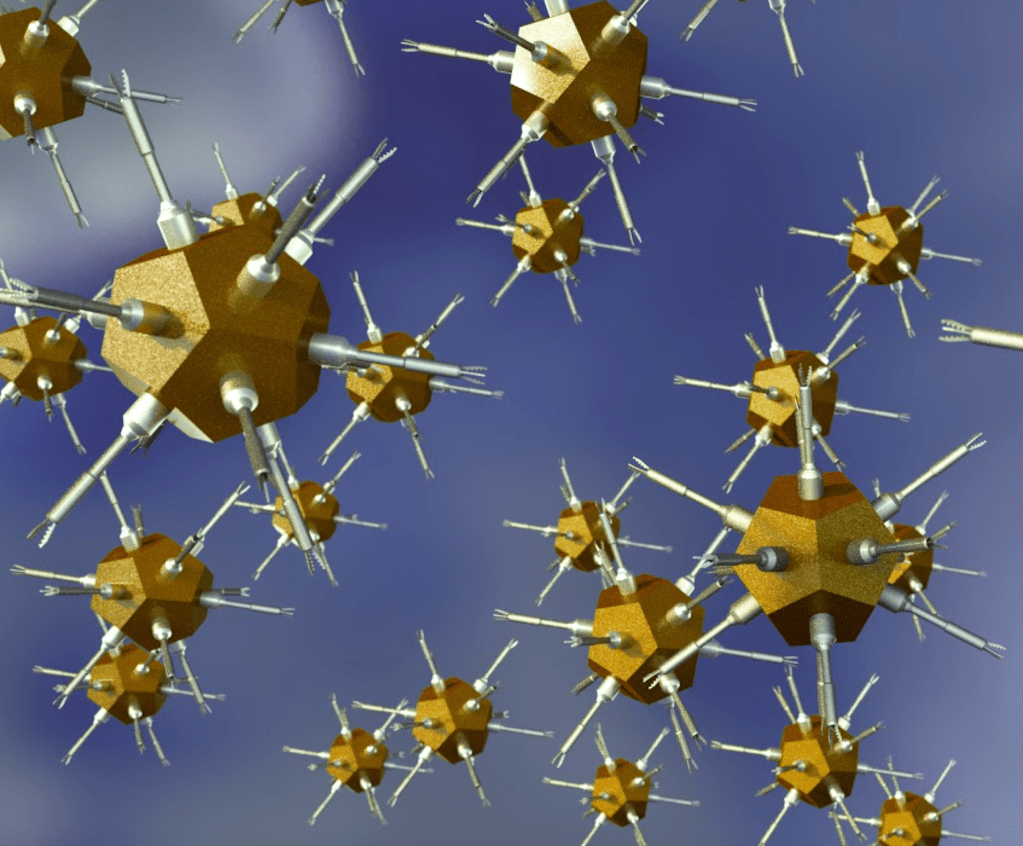
Computer Scientist J Storrs Hall upped the ante on nanotech potential with the idea of “utility fog,” based on huge swarms of nanobots under networked AI-programmatic control.

With such a technology, one could conceivably do cool and useful things like press a button and convert your living room into a bedroom at night, as all of the nanobots reconfigure themselves into beds and nightstands, and then back to a living room in the morning.

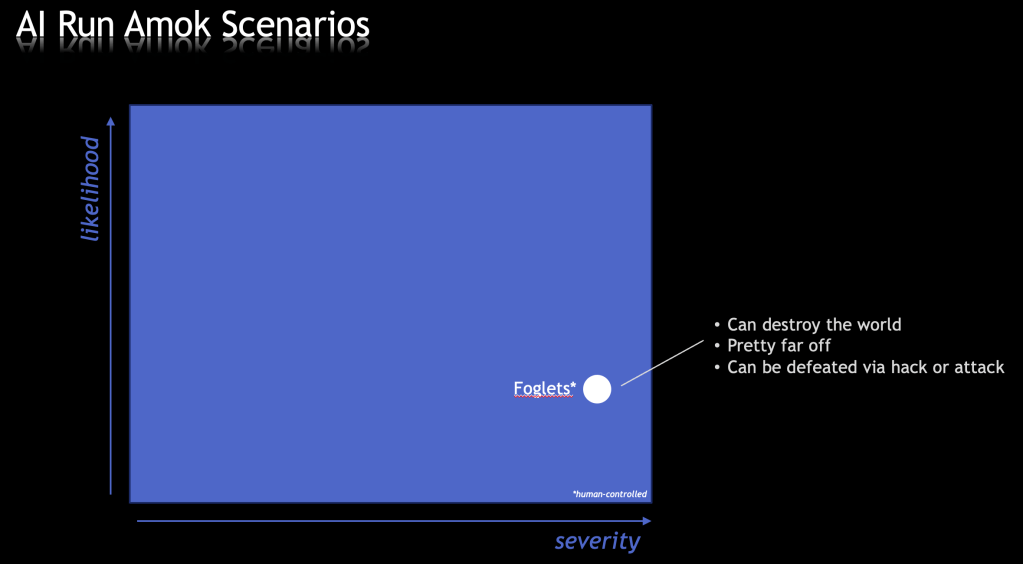
And of course, like any new tech, utility fog could be weaponized – carrying toxic agents, forming explosives, generating critical nuclear reactions, blocking out the sun from an entire country, etc.  Limited only by imagination. Where does this sit in our Likelihood/Severity space?

I put it in the lower right because, while the potential consequences of foglets in the hands of a bad actor could be severe, it’s probably way too soon to worry about, such technology being quite far off. In addition, an attack could be defeated via a hack or a counter attack and, as with the cybersecurity battle, it will almost always be won by the entity with the deeper pockets, which will presumably be the world government by the time such tech is available.

GREY GOO

A special case of foglet danger is the concept of grey goo, whereby the nanobots are programmed with two simple instructions:

  • Consume what you can of your environment
  • Continuously self replicate and give your replicants the same instructions

The result would be a slow liquefaction of the entire world.

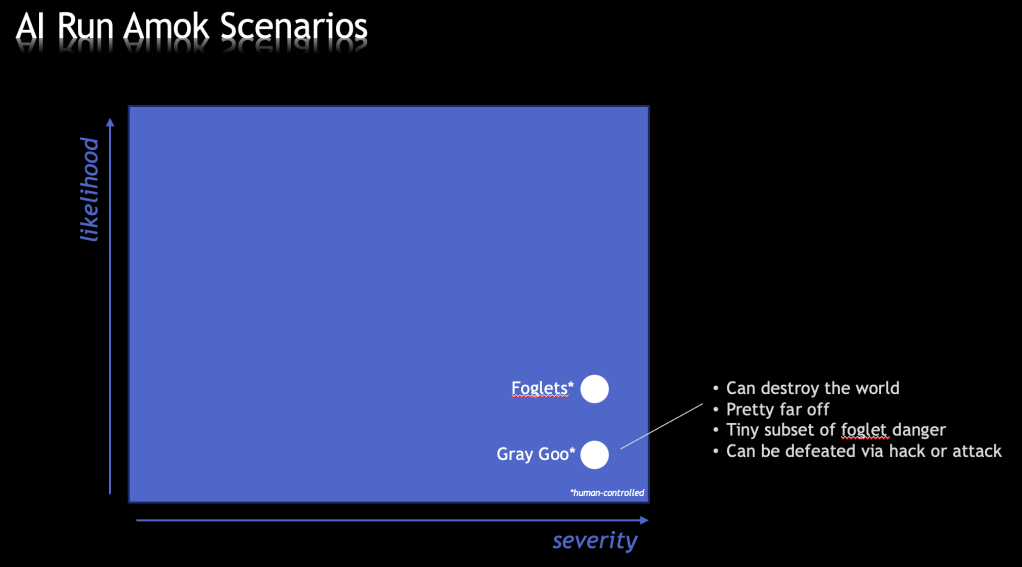
Let’s add this to our AI Run Amok chart…

I put it in the same relative space as the foglet danger in general, even less likely because the counter attack could be pretty simple reprogramming. Note, however, that this assumes that the deployment of such technologies, while AI-based at their core, is being done by humans. In the hands of an ASI, the situation would be completely different, as we will see.

ENSLAVEMENT

Let’s look at one more scenario, most aptly represented by the movie, The Matrix, where AI enslaved humanity to be used, for some odd reason, as a source of energy. Agent Smith, anyone?

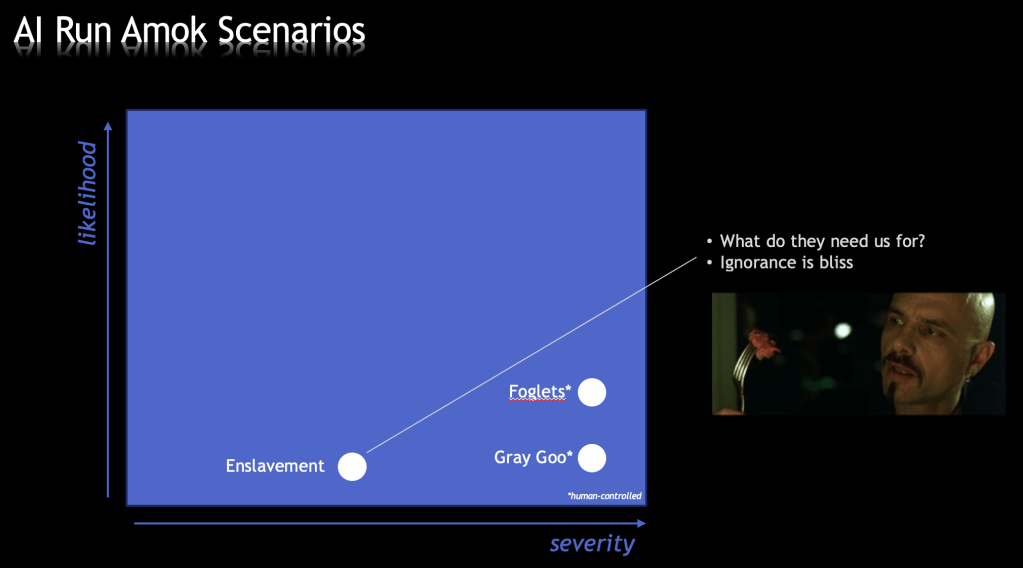
There may be other reasons that AI might want to keep us around. But honestly, why bother? Sad to say, but what would an ASI really need us for?

So I put the likelihood very low. And frankly, if we were enslaved, Matrix-style, is the severity that bad? Like Cipher said, “Ignorance is bliss.”

If you’re feeling good about things now, don’t worry, we haven’t gotten to the scary stuff yet. Stay tuned.

In the next post, I’ll look at a scenario near and dear to all of our hearts, and at the top of the Likelihood scale, since it is already underway – Job Elimination.

NEXT: How to Survive an AI Apocalypse – Part 5: Job Elimination

Transhumanism and Immortality – 21st Century Snake Oil

Before I start my rant, I recognize that the Transhumanism movement is chock full of cool ideas, many of which make complete sense, even though they are perhaps obvious and inevitable.  The application of science and technology to the betterment of the human body ranges from current practices like prosthetics and Lasik to genetic modification and curing diseases through nanotech.  It is happening and there’s nothing anyone can to to stop it, so enjoy the ride as you uplift your biology to posthumanism.

However, part of the Transhumanist dogma is the idea that we can “live long enough to live forever.”  Live long enough to be able to take advantage of future technologies like genetic manipulation  which could end the aging process and YOU TOO can be immortal!

The problem with this mentality is that we are already immortal!  And there is a reason why our corporeal bodies die.  Simply put, we live our lives in this reality in order to evolve our consciousness, one life instance at a time.  If we didn’t die, our consciousness evolution would come to a grinding halt, as we spend the rest of eternity playing solitaire and standing in line at the buffet.  The “Universe” or “All That There Is” appears to evolve through our collective individuated consciousnesses.  Therefore, deciding to be physically immortal could be the end of the evolution of the Universe itself.  Underlying this unfortunate and misguided direction of Transhumanism is the belief (and, I can’t stress this enough, it is ONLY that – a belief) that it is lights out when we die.  Following the train of logic, if this were true, consciousness only emerges from brain function, we have zero free will, the entire universe is a deterministic machine, and even investigative science doesn’t make sense any more.  So why even bother with Transhumanism if everything is predetermined?  It is logically inconsistent.  Materialism, the denial of the duality of mind and body, is a dogmatic Religion.  Its more vocal adherents (just head on over to the JREF Forum to find these knuckleheads) are as ignorant to the evidence and as blind to what true science is as the most bass-ackward fundamentalist religious zealots.

OK, to be fair, no one can be 100% certain of anything.  But, there is FAR more evidence for consciousness driven reality than for deterministic materialism.  This blog contains a lot of it, as does my first book, “The Universe-Solved!“, with much more in my upcoming book.

The spokesman for transhumanistic immortality is the self-professed “Transcendent Man“, Ray Kurzweil.  Really Ray?  Did you seriously NOT fight the producers of this movie about you to change the title to something a little less self-aggrandizing, like “Modern Messiah”? #LRonHubbard

So I came across this article about the 77 supplements that Ray takes every day.  From the accompanying video clip, he believes that they are already reversing his aging process: “I’m 65. On many biological aging tests I come out a lot younger. I expect to be in my 40s 15 years from now.”

He has been on this regimen for years.  So let’s see how well those supplements are doing.  Picking an objective tool from one of Ray’s own favorite technologies – Artificial Intelligence – the website how-old.net has an AI bot that automatically estimates your age from an uploaded photo.  I took a screen shot from the video clip (Ray is 65 in the clip) and uploaded it:

Ray Kurzweil Age

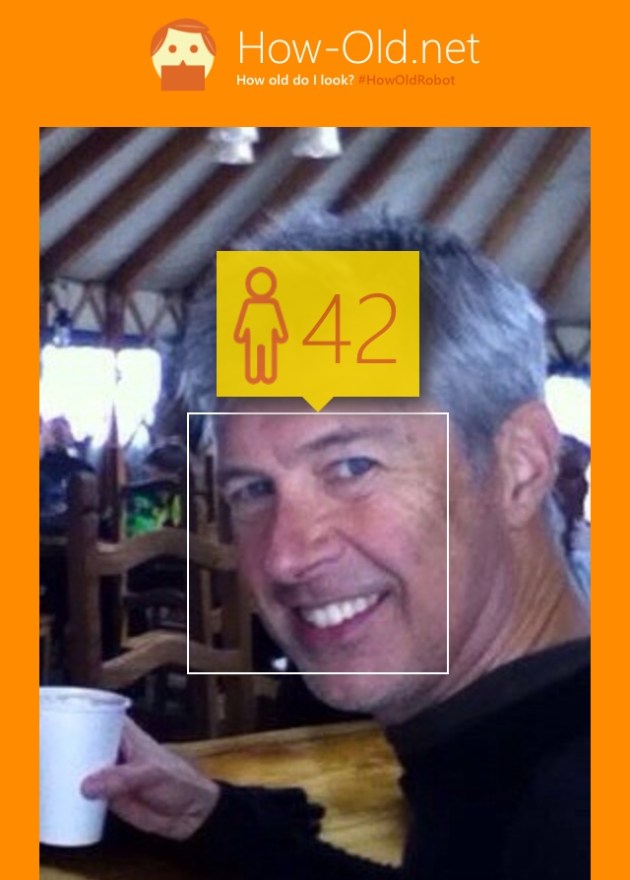
85!  Uh oh.  Hmmm, maybe the bot overestimates everyone’s age. I’m 10 years younger than Ray.  Let’s see how I fare, using a shot taken the same year at a ski resort – you know, one of those sports Ray says to avoid (Ray also claims that his kids will probably be immortal as long as they don’t take up extreme sports):

JimHowOld

I don’t know if it is the supplements that make Ray look 20 years older than he is, or the extreme skiing that makes me look 13 years younger than I am.  But I’m thinking maybe I’m onto something. [Note: I do realize that the choice of pictures could result in different outcomes.  I just thought it was ironic that the first two that I tried had these results]

Yes, I’m fairly confident that these supplements have some value in improving the function of various organs and benefiting a person’s overall health and well being.  I’m also fairly certain that much of traditional medical community would disagree and point to the lack of rigorous scientific studies supporting these supposed benefits as they always do.  On the whole, I suspect that, on the average, supplements might extend one’s lifetime somewhat.  But I doubt that they will reverse aging.  The human body is far too complex to hope that adding a few organic compounds would be sufficient to modify and synchronize all of the complex cellular and systemic metabolic chemical reactions toward a reversal of the aging process.  Kurzweil is obviously a very bright man who has had a significant entrepreneurial legacy in the high tech world.  However I think he and the rest of the materialist transhumanists are way over their heads on the topic of immortality and our place and purpose in the Universe.

My suggestion, Ray… skip the supplements, skip the self-promotion, skip the Google plugs, drive your goddamn car, and don’t be afraid to be active.  Stick with high tech, leave the evolution of the universe to its own devices, and enjoy the rest of this life.

Things We Can’t Feel – The Mystery Deepens

In my last blog “Things We Can’t See”, we explored the many different ways that our eyes, brains, and/or technology can fool us into seeing something that isn’t there or not seeing something that is.

So apparently, our sense of sight is not necessarily the most reliable sense in terms of identifying what is and isn’t in our objective reality.  We would probably suspect that our sense of touch is fairly foolproof; that is, if an object is “there”, we can “feel” it, right?

Not so fast.

First of all, we have a lot of the same problems with the brain as we did with the sense of sight.  The brain processes all of that sensory data from our nerve endings.  How do we know what the brain really does with that information?  Research shows that sometimes your brain can think that you are touching something that you aren’t or vice versa.  People who have lost limbs still have sensations in their missing extremities.  Hypnosis has been shown to have a significant effect in terms of pain control, which seems to indicate the mind’s capacity to override one’s tactile senses.  And virtual reality experiments have demonstrated the ability for the mind to be fooled into feeling something that isn’t there.

In addition, technology can be made to create havoc with our sense of touch, although the most dramatic of such effects are dozens of years into the future.  Let me explain…

Computer Scientist J. Storrs Hall developed the concept of a “Utility Fog.”  Imagine a “nanoscopic” object called a Foglet, which is an intelligent nanobot, capable of communicating with its peers and having arms that can hook together to form larger structures.  Trillions of these Foglets could conceivably fill a room and not be at all noticeable as long as they were in “invisible mode.”  In fact, not only might they be programmed to appear transparent to the sight, but they may be imperceptible to the touch.  This is not hard to imagine, if you allow that they could have sensors that detect your presence.  For example, if you punch your fist into a swarm of nanobots programmed to be imperceptible, they would sense your motion and move aside as you swung your fist through the air.  But at any point, they could conspire to form a structure – an impenetrable wall, for example.  And then your fist would be well aware of their existence.  In this way, technology may be able to have a dramatic effect on our complete ability to determine what is really “there.”

nanobot

But even now, long before nanobot swarms are possible, the mystery really begins, as we have to dive deeply into what is meant by “feeling” something.

Feeling is the result of a part of our body coming in contact with another object.  That contact is “felt” by the interaction between the molecules of the body and the molecules of the object.

Even solid objects are mostly empty space.  If subatomic particles, such as neutrons, are made of solid mass, like little billiard balls, then 99.999999999999% of normal matter would still be empty space.  That is, of course, unless those particles themselves are not really solid matter, in which case, even more of space is truly empty, more about which in a bit.

So why don’t solid objects like your fist slide right through other solid objects like bricks?  Because of the repulsive effect that the electromagnetic force from the electrons in the fist apply against the electromagnetic force from the electrons in the brick.

But what about that neutron?  What is it made of?  Is it solid?  Is it made of the same stuff as all other subatomic particles?

The leading theories of matter do not favor the idea that subatomic particles are like little billiard balls of differing masses.  For example, string theorists speculate that all particles are made of the same stuff; namely, vibrating bits of string.  Except that they each vibrate at different frequencies.  Problem is, string theory is purely theoretical and really falls more in the mathematical domain than the scientific domain, inasmuch as there is no supporting evidence for the theory.  If it does turn out to be true, even the neutron is mostly empty space because the string is supposedly one-dimensional, with a theoretical cross section of a Planck length.

Here’s where it gets really interesting…

Neutrinos are an extremely common yet extremely elusive particle of matter.  About 100 trillion neutrinos generated in the sun pass through our bodies every second.  Yet they barely interact at all with ordinary matter.  Neutrino capture experiments consist of configurations such as a huge underground tank containing 100,000 gallons of tetrachloroethylene buried nearly a mile below the surface of the earth.  100 billion neutrinos strike every square centimeter of the tank per second.  Yet, any particular molecule of tetrachloroethylene is likely to interact with a neutrino only once every 10E36 seconds (which is 10 billion billion times the age of the universe).

The argument usually given for the neutrino’s elusiveness is that they are massless (and therefore not easily captured by a nucleus) and charge-less (and therefore not subject to the electromagnetic force).  Then again, photons are massless and charge-less and are easily captured, to which anyone who has spent too much time in the sun can attest.  So there has to be some other reason that we can’t detect neutrinos.  Unfortunately, given the current understanding of particle physics, no good answer is forthcoming.

And then there is dark matter.  This concept is the current favorite explanation for some anomalies around orbital speeds of galaxies.  Gravity can’t explain the anomalies, so dark matter is inferred.  If it really exists, it represents about 83% of the mass in the universe, but doesn’t interact again with any of the known forces with the exception of gravity.  This means that dark matter is all around us; we just can’t see it or feel it.

So it seems that modern physics allows for all sorts of types of matter that we can’t see or feel.  When you get down to it, the reason for this is that we don’t understand what matter is at all.  According to the standard model of physics, particles should have no mass, unless there is a special quantum field that pervades the universe and gives rise to mass upon interacting with those particles.  Unfortunately, for that to have any credibility, the signature particle, the Higgs boson, would have to exist.  Thus far, it seems to be eluding even the most powerful of particle colliders.  One alternative theory of matter has it being an emergent property of particle fluctuations in the quantum vacuum.

For a variety of reasons, some of which are outlined in “The Universe – Solved!” and many others which have come to light since I wrote that book, I suspect that ultimately matter is simply a property of an entity that is described purely by data and a set of rules, driven by a complex computational mechanism.  Our attempt to discover the nature of matter is synonymous with our attempt to discover those rules and associated fundamental constants (data).

In terms of other things that we can’t perceive, new age enthusiasts might call out ghosts, spirits, auras, and all sorts of other mysterious invisible and tenuous entities.

starwarsghosts

Given that we know that things exist that we can’t perceive, one has to wonder if it might be possible for macroscopic objects, or even macroscopic entities that are driven by similar energies as humans, to be made from stuff that we can only tenuously detect, not unlike neutrinos or dark matter.  Scientists speculate about multiple dimensions and parallel universes via Hilbert Space and other such constructs.  If such things exist (and wouldn’t it be hypocritical of anyone to speculate or work out the math for such things if it weren’t possible for them to exist?), the rules that govern our interaction with them, across the dimensions, are clearly not at all understood.  That doesn’t mean that they aren’t possible.

In fact, the scientific world is filled with trends leading toward the implication of an information-based reality.

In which almost anything is possible.

Jim and Craig Venter Argue over Who is more Synthetic: Synthia or Us?

So Craig Venter created synthetic life.  How cool is that?  I mean, really, this has been sort of a biologists holy grail for as long as I can remember.  Of course, Dr. Venter’s detractors are quick to point out that Synthia, the name given to this synthetic organism, was not really built from scratch, but sort of assembled from sub-living components and injected into a cell where it could replicate.  Either way, it is a huge step in the direction of man-made life forms.  If I were to meet Dr. Venter, the conversation might go something like this:

Jim: So, Dr. Venter, help me understand how man-made your little creation really is.  I’ve read some articles that state that while your achievement is most impressive, the cytoplasm that the genome was transplanted to was not man made.

Craig: True dat, Jim.  But we all need an environment to live in, and a cell is no different.  The organism was certainly man made, even if its environment already existed.

Jim: But wait a minute.  Aren’t we all man-made?  Wasn’t that the message in those sex education classes I took in high school?

Craig: No, the difference is that this is effectively a new species, created synthetically.

Jim: So, how different is that from a clone?  Are they also created synthetically?

Craig: Sort of, but a clone isn’t a new species.

Jim: How about genetically modified organisms then?  New species created synthetically?

Craig: Yes, but they were a modification made to an existing living organism, not a synthetically created one.

Jim: What about that robot that cleans my floor?  Isn’t that a synthetically created organism?

Craig: Well, maybe, in some sense, but can it replicate itself?

Jim: Ah, but that is just a matter of programming.  Factory robots can build cars, why couldn’t they be programmed to build other factory robots?

Craig: That wouldn’t be biological replication, like cell division.

Jim: You mean, just because the robots are made of silicon instead of carbon?  Seems kind of arbitrary to me.

Craig: OK, you’re kind of getting on my nerves, robot-boy.  The point is that this is the first synthetically created biological organism.

Jim: Um, that’s really cool and all, but we can build all kinds of junk with nanotech, including synthetic meat, and little self-replicating machines.

Craig: Neither of which are alive.

Jim: Define alive.

Craig: Well, generally life is anything that exhibits growth, metabolism, motion, reproduction, and homeostasis.

Jim: So, a drone bee isn’t alive because it can’t reproduce?

Craig: Of course, there are exceptions.

Jim: What about fire, crystals, or the earth itself.  All of those exhibit your life-defining properties.  Are they alive?

Craig: Dude, we’re getting way off topic here.  Let’s get back to synthetic organisms.

Jim: OK, let’s take a different tack.  Physicist Paul Davies said that Google is smarter than any human on the planet.  Is Google alive?  What about computer networks that can reconfigure themselves intelligently.

Craig: Those items aren’t really alive because they have to be programmed.

Jim: Yeah, and what’s that little code in Synthia’s DNA?

Craig: Uhhh…

Jim: And how do you know that you aren’t synthetic?  Is it at all possible that your world and all of your perceptions could be completely under programmed control?

Craig: I suppose it could be possible.  But I highly doubt it.

Jim: Doubt based on what? All of your preconceived notions about reality?

Craig: OK, let’s say we are under programmed control.  So what?

Jim: Well, that implies a creator.  Which in turn implies that our bodies are a creation.  Which makes us just as synthetic as Synthia.  The only difference is that you created Synthia, while we might have been created by some highly advanced geek in an other reality.

Craig: Been watching a few Wachowski Brothers movies, Jim?

Jim: Guilty as charged, Craig.

CraigVenterGod

Entropy and Puppies, like a Hand and a Glove

Ah yes, the good old 2nd Law of Thermodynamics. The idea that the total disorder of a system, e.g. the universe, always increases.  Or that heat always flows from hot to cold.  It’s why coffee always gets cold, why money seems to dissipate at a casino, why time flows forward, why Murphy had a law, why cats and dogs don’t tend to clean up the house.

Ultimately, due to this rather depressing physical law, the universe will die by “heat death,” where it reaches a state of absolute zero, no more heat, no motion of particles.  Don’t worry, that’s not predicted for another 10^100 (or, a Googol) years.  But, I always wondered, is it always always the case, or can entropy decrease in certain circumstances?

Got a spare fortnight? Google “violations of the second law of thermodynamics.”  Personally, I rather like Maxwell’s idea that it is a statistical argument, not an absolute one. “Maxwell’s Demon” is that hypothetical device that funnels hot molecules in one directions and cold ones in the opposite, thereby reversing the normal flow of heat.  Could a nanotech device do that some day?  Yes, I know that there has to be energy put into the system for the device to do its work, thereby increasing the size of the system upon which the 2nd law holds.  But, even without the demon, aren’t there statistical instances of 2nd Law violation in a closed system?  Not unlike the infinitesimal probability that someone’s constituent atoms suddenly line up in such a manner that they can walk through a door (see recent blog topic), so could a system become more coherent as time moves to the future.

What about lowering temperature to the point where superconductivity occurs?  Isn’t that less random than non-superconductivity.  One might argue that the energy that it takes to become superconductive exceeds the resulting decrease in entropy.  However, I would argue that since the transition from conductive to superconductive occurs abruptly, there must be a time period, arbitrarily small, during which you would watch entropy decrease.

There are those who cite life and evolution as examples of building order out of chaos.  Sounds reasonable to me, and the arguments against the idea sound circular and defensive.  However, it all seems to net out in the end.  Take a puppy, for instance.  Evolutionary processes worked for millions of years to create the domestic dog.  Entropy-decreasing processes seem to responsible for the formation of a puppy from its original constituents, sperm and an egg.  But then the puppy spends years ripping up your carpet, chewing the legs of the furniture and ripping your favorite magazines into little pieces; in short, increasing the disorder of the universe.  Net effect?  Zero.

shakespeareandleash185

Wacky Ideas from my Past – #2 The Nuke Core Neutralizer

This one felt really important during the height of the cold war.

All H-Bombs have an A-Bomb at their core.  The A-Bomb is needed to generated the million of degree temperature to begin the fusion reaction in the H-Bomb fuel.  So, all nukes, therefore, have at their core, a hunk of fissionable material, generally Uranium-235 or Plutonium-239.  U-235, for example, works well as a nuclear fission fuel because when the nucleus absorbs a neutron, it becomes unstable and splits into two smaller nuclei (e.g. Barium and Krypton), releasing more neutrons which then generate more reactions.  A critical mass of fissionable material will explode because the number of neutrons needed to maintain the reaction is exceeded by the number generated.  But, U-235 can also safely absorb a neutron and not undergo fission, transmuting in non-fissionable U-236 before further decay.  But if some process (for example, creating the perfect neutron energy) were to be discovered that caused absorption rather than fission, the core of the nuke could be neutralized.

So, my thought was to blanket the earth with a “rain” of the right particles to neutralize all nuke cores, regardless of where they are buried or hidden, thereby ending all fear of nuclear strikes.

My naivete may have been to think that we could generate enough particles at high enough density to neutralize a nuke core at any given point on the earth without having that particle beam have an adverse effect on plant and animal life.

So where are we today?  Actually, there are a number of nuclear remediation technologies (for example see Gary Vesperman’s “Comparison of My List of 27 Methods of Neutralizing or Disposing of Radioactive Waste with PACE’s 9 Methods“) that can clean up cores of nukes or fissionable material in general.  None can be accomplished on the “earth blanketing” scale that I envisioned.  However, maybe nanotech can come to the rescue.  Imagine a healthy swarm of nanobots, all carrying the materials needed for a nuclear remediation technique, such as RIPPLE Fission, and instructed to seek out all U-235 and P-239 and unleash the neutralization technique.

Time frame?  I’m thinking…

2040